The Pesach Story for Kids: Yetzias Mitzrayim, Matzah & the Seder
What the Pesach story is, why matzah and the Korban Pesach matter, and how to tell it to a 3-year-old, a 6-year-old and a 10-year-old, with questions for the Yom Tov table.
Published by Torah Tale.
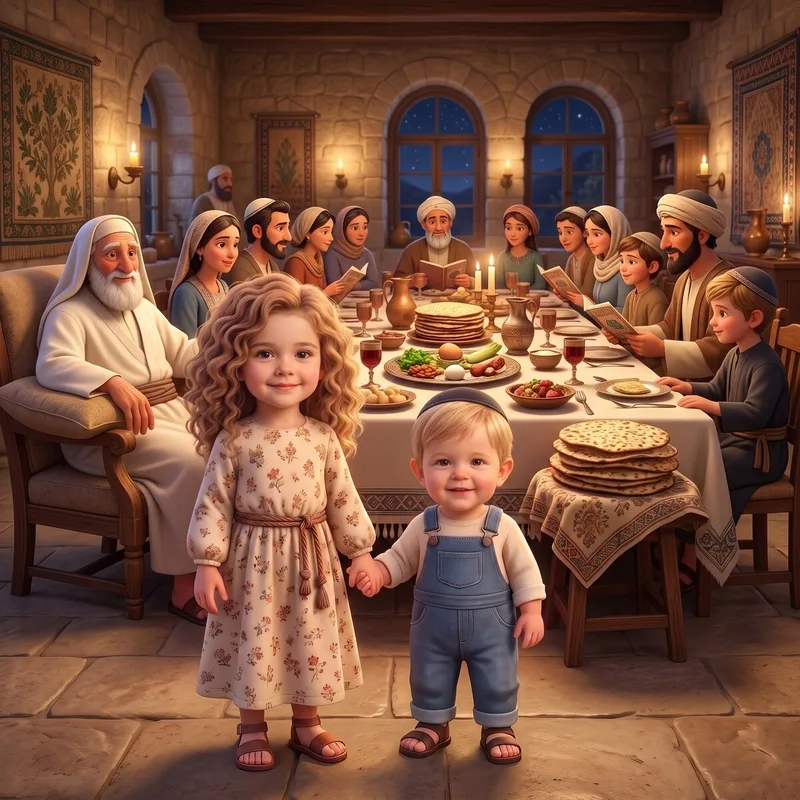
Create this book for your child
The Pesach story is the story of Yetzias Mitzrayim: Bnei Yisrael were slaves in Mitzrayim, Hashem sent the makkos, and then He took them out to become a free people who would receive the Torah. Children connect to it because it is full of things they can see and taste, such as a lamb, a doorpost, a rushed meal and matzah, and because the Torah itself asks the grown-ups to explain it to them.
What is the story of Pesach for kids?
The Torah tells us that Bnei Yisrael worked under harsh labor in Mitzrayim, and the pasuk says the Egyptians made their lives bitter. Hashem sent Moshe and Aharon to Pharaoh, and Pharaoh kept refusing to let them go. You can read that part in Parshas Shemos and Parshas Va'eira.
Before the last makkah, Hashem commanded Bnei Yisrael to take a lamb, keep it from the tenth of the month until the fourteenth, and slaughter it toward evening. They put some of its blood on the two doorposts and the lintel of their homes. They ate the meat roasted, with matzos and maror, ready to leave.
The Torah says that Hashem passed over (pasach) the homes of Bnei Yisrael during makkas bechoros. That is where the name Pesach comes from. Then Pharaoh called for Moshe and Aharon at night and sent Bnei Yisrael out. You can find all of this in Parshas Bo.
Why do we eat matzah on Pesach?
The Torah says it directly: Bnei Yisrael were driven out of Mitzrayim and could not delay, so the dough they had prepared had no time to rise, and they baked it into matzos (Shemos 12:39). Rabban Gamliel in the Mishnah gives the same reason for the matzah we eat at the Seder.
The maror has its own reason. It reminds us of the bitterness of slavery. For a child, that makes a simple pair: the matzah is the taste of leaving in a hurry, and the maror is the taste of how hard it was.
What is the lesson of Pesach for children?
The first lesson is emunah with hakaras hatov. Hashem took us out, so we remember, we thank Him and we keep the mitzvos of the night. A child can feel that without any big words. He or she just says, "Hashem helped us, so we say thank you." If your child likes this theme, our article on teaching hakaras hatov has everyday ways to practice it.
The second lesson is that the child is part of the story. The Mishnah teaches that in every generation a person must see himself as if he himself left Mitzrayim. And the Torah says v'higadta l'vincha, "you shall tell your son." The Seder is built so that a child's question comes first and the answer follows.
How do I explain Pesach to a 3-year-old, a 6-year-old and a 10-year-old?
Age 3. Keep it to what a child can hold and taste. Say, "Yidden were slaves and worked very hard. Hashem took them out. They were in such a hurry that they ate matzah." Let your child touch the matzah, say "Pesach" and sing a song. Three or four sentences is plenty.
Age 6. Now you can add the order of events: the makkos, the lamb, the blood on the doorposts and the night Pharaoh sent them out. Children this age love the questions. Ask, "Why do you think they ate in a hurry?" and "What did they pack?" Teach the Mah Nishtanah as a real set of questions with real answers.
Age 10. Ask for the reasons behind the mitzvos. Why do we eat matzah, maror and the Korban Pesach, and what does each remember? Talk about the Mishnah's line that every person must see himself as if he left Mitzrayim, and ask what that would change about how a person thinks at the Seder. A child this age can also be given a part to lead, such as explaining the matzah to the younger ones.
What questions can we ask at the Yom Tov table?
These are all for talking, so they suit the Seder, a Yom Tov meal or a long Yom Tov afternoon.
- Why did Bnei Yisrael put blood on the doorposts?
- Why was their dough not able to rise?
- What do you think the children of Bnei Yisrael asked their parents that night?
- Which part of the Seder is your favorite, and what does it remember?
- If you were telling the story to a younger cousin, what would you say first?
The Torah mentions children's questions in the context of Pesach itself, and the Haggadah builds the Seder on them. A child who asks has already started the mitzvah of telling the story.
What is a personalized Pesach book like?
A Torah Tale book of Pesach, from our Holidays collection, is a storybook where your child is the hero. Their name appears on the pages, and from one uploaded photo their likeness is illustrated in high-resolution 3D animated-film style. The book is written with careful rabbinical guidance and strict tznius, and our team reviews it before it goes to print.

Softcover 8″×8″

Hardcover 8″×8″

Board book 6″×6″

Coloring book 8.5″×11″
Every book ends with a discussion page of 10 questions about the story, mixing comprehension with middos: what happened, and what it asks of the child. That page helps turn a book that is read to a child into one that is talked about at the table.
If you add parents, grandparents or other relatives with their photos, they appear together with the children on a closing family page, in every format. Reading the storybook is fully appropriate on Shabbos and Yom Tov, so it can be a pleasant companion on a long Yom Tov afternoon. It is not a replacement for the Haggadah.
Which format fits which age?
There are three formats. The board book is 6"x6" with rounded safety corners, for ages 0-4. The softcover photo book is 8"x8", for ages 4-8. The hardcover photo book is 8"x8", for ages 5-18. Softcover and hardcover books open with a dedication page, which a grandparent might use for a Pesach message.
You can include up to eight children in one book, ages 0 to 18, which suits a family where the Seder table has a toddler and a ten-year-old. Creating a book requires a free account and a few short questions: each child's name, boy or girl, age and one photo, any siblings, the story, your community (asked once), the language and the printed format. Languages are English, Hebrew and Yiddish. The whole flow takes about five minutes. With US standard shipping a one-time order arrives in about 12 business days, counted from the order, so order well ahead of Pesach.
What can we do during the weeks before Pesach?
Use the weekdays before Yom Tov to build the excitement. Read the book in the afternoon, talk about one question from the discussion page each day, and let your child tell the story back to a younger sibling.
The optional matching coloring book is 8.5"x11" in black-and-white line art, and it is a weekday activity. It fits the weekdays before Pesach, an ordinary weekday afternoon, erev Shabbos, or Chol HaMoed, when it is permitted. On Shabbos and Yom Tov, keep to the storybook, singing and talking. For another read-aloud on a different theme, see The Shabbos Story for Kids.
When you are ready, create the book and let your child hear the Pesach story with themselves in it.
Frequently asked questions
What is the Pesach story in simple words for kids?
Bnei Yisrael were slaves in Mitzrayim, and Hashem sent Moshe and Aharon to Pharaoh to say, "Let My people go." After the makkos, Pharaoh finally sent them out, and Bnei Yisrael left Mitzrayim and became Hashem's free nation. Every year on Pesach we tell this story, eat matzah and remember that Hashem took us out.
Why do we eat matzah on Pesach?
The Torah tells us that Bnei Yisrael were driven out of Mitzrayim and could not wait, so their dough had no time to rise and they baked it into matzos. Rabban Gamliel in the Mishnah gives this as the reason for the matzah at the Seder. For a young child you can say, "We eat matzah because we left in such a hurry."
How do I explain Pesach to a 3-year-old?
Use a few concrete things: Yidden worked very hard in Mitzrayim, Hashem helped them, and they went out in a hurry with matzah. Let your child hold the matzah, taste it and say the word, and sing a Pesach song together. A short story with the child's own name in it, such as a board book for ages 0-4, makes it easier for a little one to feel part of it.
What is the lesson of Pesach for children?
One lesson is emunah and hakaras hatov: Hashem took us out, and we thank Him and remember. Another is that every child is a link in the chain, because the Mishnah teaches that in every generation a person must see himself as if he himself left Mitzrayim. Parents also live out the lesson by telling the story to their children, which is the mitzvah of v'higadta l'vincha.
Can I read a Pesach storybook at the Seder or on Yom Tov?
Yes, reading a storybook is entirely appropriate on Yom Tov, including a long Yom Tov afternoon. A storybook does not replace the Haggadah, so ask your rav how to fit it into your Seder. The optional coloring book is a weekday activity, best for the days before Pesach, an ordinary weekday afternoon or Chol HaMoed.