Parshas Shemos for Kids: The Basket, the Burning Bush & Moshe
Parshas Shemos opens Sefer Shemos with a family that became a nation, a baby in a basket, and a bush that burned without burning up. Here is how to tell it to a four-year-old and to an eight-year-old, what middah it teaches, and the questions to ask at the Shabbos table.
Published by Torah Tale.
Create this book for your child
Parshas Shemos is the first parsha of Sefer Shemos, and it is the parsha where a family turns into a nation. It tells how Yaakov's children multiplied in Mitzrayim, how a new Pharaoh enslaved them, how one baby was hidden in a basket among the reeds and drawn out of the water by Bas Pharaoh, and how that baby grew up to hear Hashem calling his name from a bush that burned and was not consumed. Children latch onto it because almost every scene is something they can picture: a basket, a big sister watching from a distance, a stick that turns into a snake, a fire that does not burn anything up.
What happens in Parshas Shemos?
The parsha opens by listing the names of the shevatim who came down to Mitzrayim with Yaakov. That generation passes away, and the Yidden grow into a great nation. Then a new king arises over Mitzrayim who did not know Yosef, and he tells his people that the Yidden are becoming too many.
Pharaoh puts taskmasters over them and makes them build the cities of Pisom and Raamses. The more he presses them, the more they grow. He calls in the midwives, Shifra and Puah, and orders them to kill the baby boys. They fear Hashem and keep the babies alive, and Chazal tell us that Shifra and Puah were Yocheved and Miriam. Pharaoh then decrees that the boys be thrown into the river.
A baby is born to Yocheved and Amram of shevet Levi. She hides him for three months, and then places him in a basket coated with tar and pitch among the reeds at the edge of the Nile. His sister Miriam stands at a distance to see what will happen. Bas Pharaoh comes down to the river, sees the basket, and has compassion on the crying baby. Miriam steps forward and offers to bring a Jewish woman to nurse him, and brings his own mother. When he grows, Bas Pharaoh takes him as a son and calls him Moshe, because she drew him from the water.
Moshe grows up and goes out to his brothers and sees their burdens. He sees a Mitzri striking a Jew and saves him. The next day he sees two Yidden fighting and tries to make peace between them. When the matter becomes known, Moshe flees to Midyan, where he helps the daughters of Yisro at the well and becomes a shepherd for Yisro's flock.
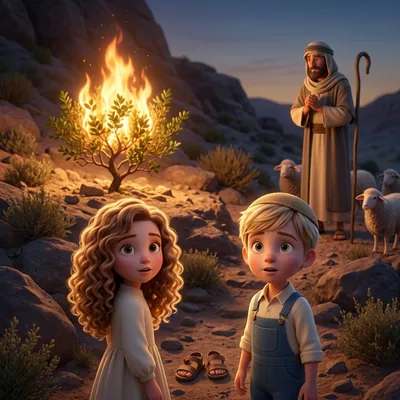
Then comes the sneh. Moshe leads the sheep into the wilderness and sees a bush burning with fire that is not consumed. He turns aside to look, and Hashem calls to him from the bush: Moshe, Moshe. Hashem tells him to remove his shoes, because the ground is holy, and says that He has seen the affliction of His people and heard their cry, and He is sending Moshe to Pharaoh to take them out. Moshe protests again and again that he is not the one, and Hashem gives him signs: a staff that becomes a snake, a hand that becomes covered with tzaraas and is healed, water that turns to blood. Aharon is sent to meet him and to speak for him.
Moshe and Aharon come to Pharaoh with the words Shalach es ami, let My people go. Pharaoh answers that he does not know Hashem, and makes the work harder: the Yidden must now gather their own straw and still make the same number of bricks. The parsha ends with Moshe turning back to Hashem in tefillah, and Hashem promising that now he will see what will be done to Pharaoh.
What is the middah of Parshas Shemos?
The Torah says that Moshe went out to his brothers and saw their burdens. He was a prince in the palace. Nobody was making him look. Chazal explain that he did not merely look at them, he set his eyes and his heart to feel their pain, and put his own shoulder under their load.
That is the middah of the parsha, and it is the reason Moshe was chosen. Hashem takes the man who noticed slaves in a brick pit and the man who chased a runaway young goat in the desert, and gives him a whole nation to lead. Greatness in Torah is not announced. It is what a person does when he sees someone struggling and nobody is watching.
There is a second middah running alongside it: quiet courage. Shifra and Puah defy a king because they feared Hashem. Miriam stands by the river when there is nothing left to do but hope and watch. Yocheved builds a basket instead of giving up. Children understand this instinctively, and it is worth naming out loud for them.
How do I explain Parshas Shemos to a 4-year-old vs an 8-year-old?
The same parsha, told two different ways.
For a 4-year-old, keep it to the basket and the bush. "Pharaoh was a bad king who made the Yidden work very hard. A special baby was born, and his mother made a little basket for him and put it in the river so he would be safe. His big sister Miriam watched him. The princess found him and took care of him, and his name was Moshe. When Moshe grew up, Hashem talked to him from a fire on a bush, and told him: go tell Pharaoh to let My people go." Skip the decree details entirely. A young child needs to know the baby was safe, not to picture the danger.
For an 8-year-old, add the tension and the questions. Why did Pharaoh's plan keep backfiring? Why did Moshe say no so many times, and what does that teach about humility? Why did Hashem show him a bush and not a tall tree, and what might a small thornbush be saying about where Hashem is found when His children are suffering? Older children can also handle the hardest part of the parsha: that after Moshe came, things got worse before they got better, and Moshe himself turned to Hashem with that question.
What is a personalized Torah Tale book of Parshas Shemos like?
A Torah Tale book of Parshas Shemos puts your own child inside the story. Their name is in the text and their face, illustrated in high-resolution 3D animated-film style from one photo you upload, appears on every page: at the edge of the reeds with Miriam, in the palace courtyard, out in the Midyan wilderness when the bush begins to burn. Up to eight siblings can appear in the same book, which is what usually happens in a house where nobody wants to be left out.
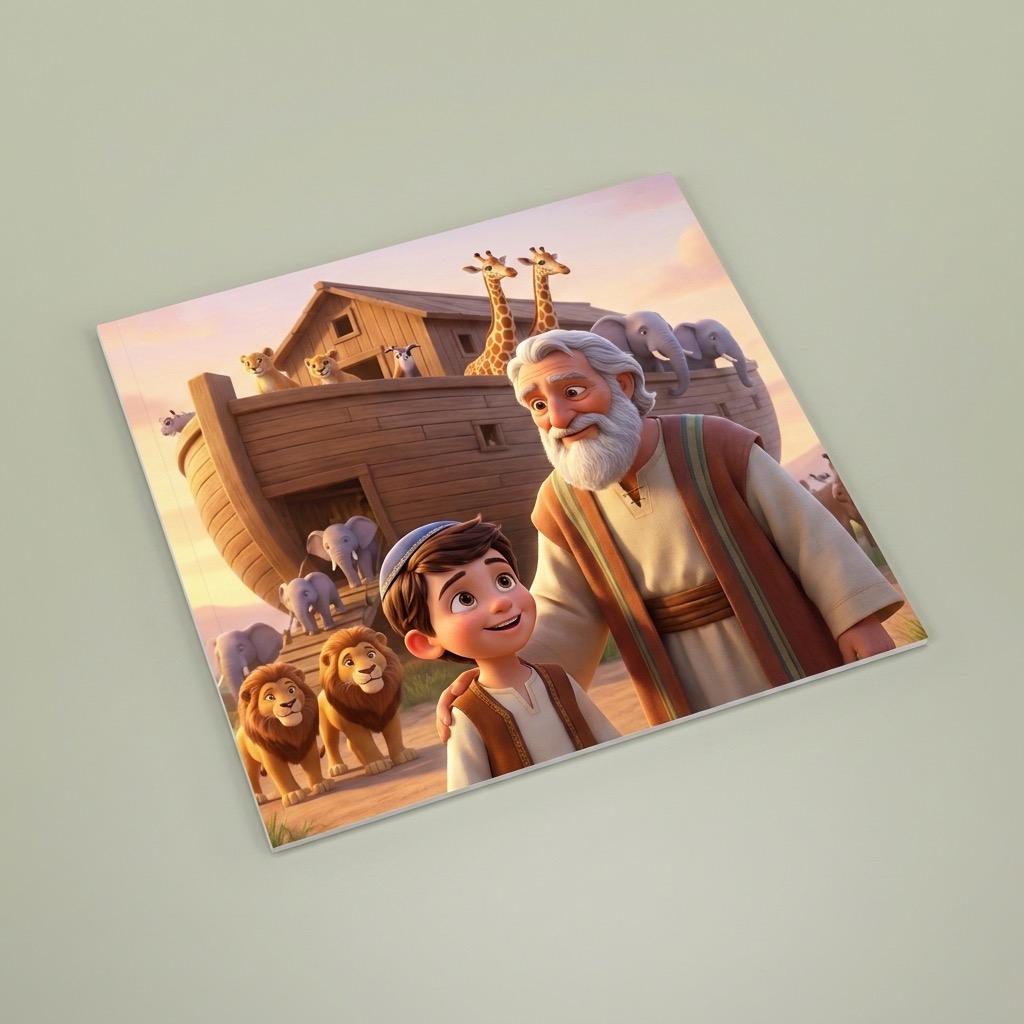
Softcover 8″×8″
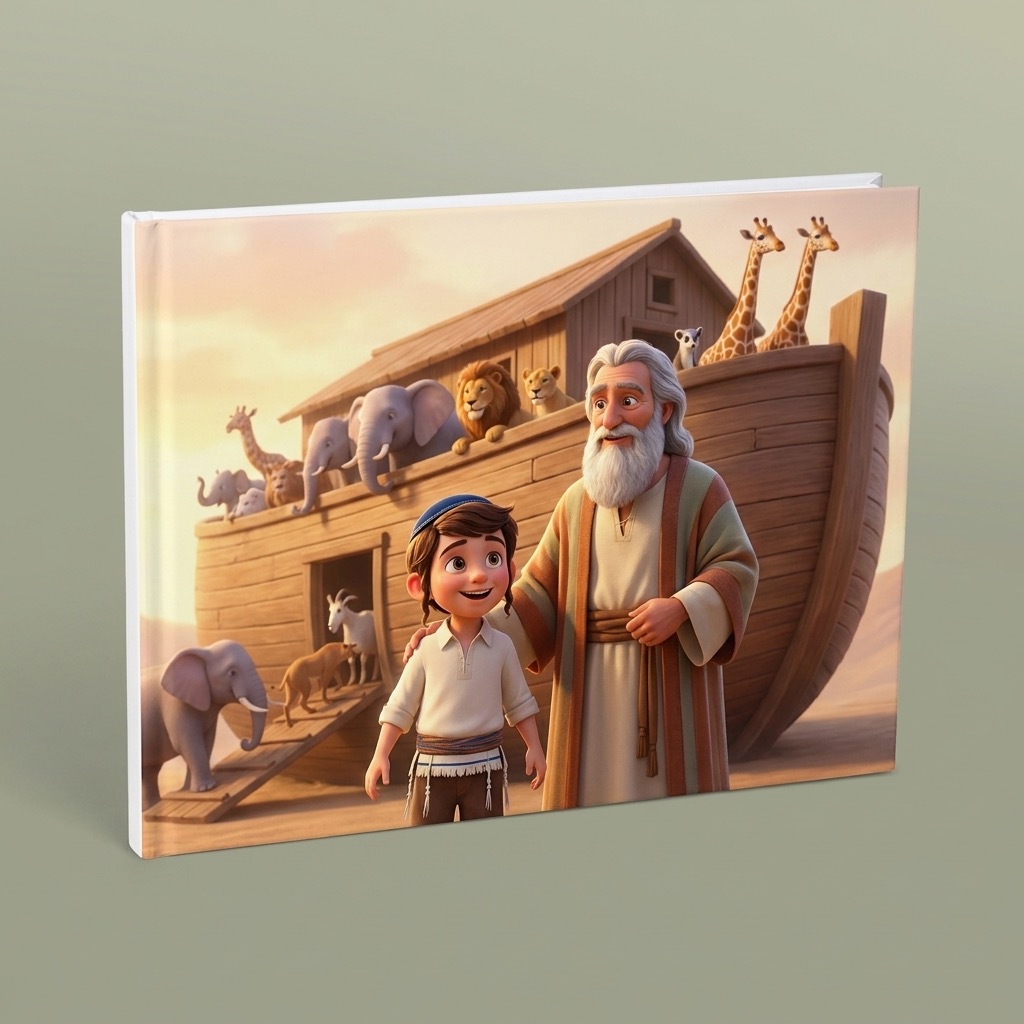
Hardcover 8″×8″
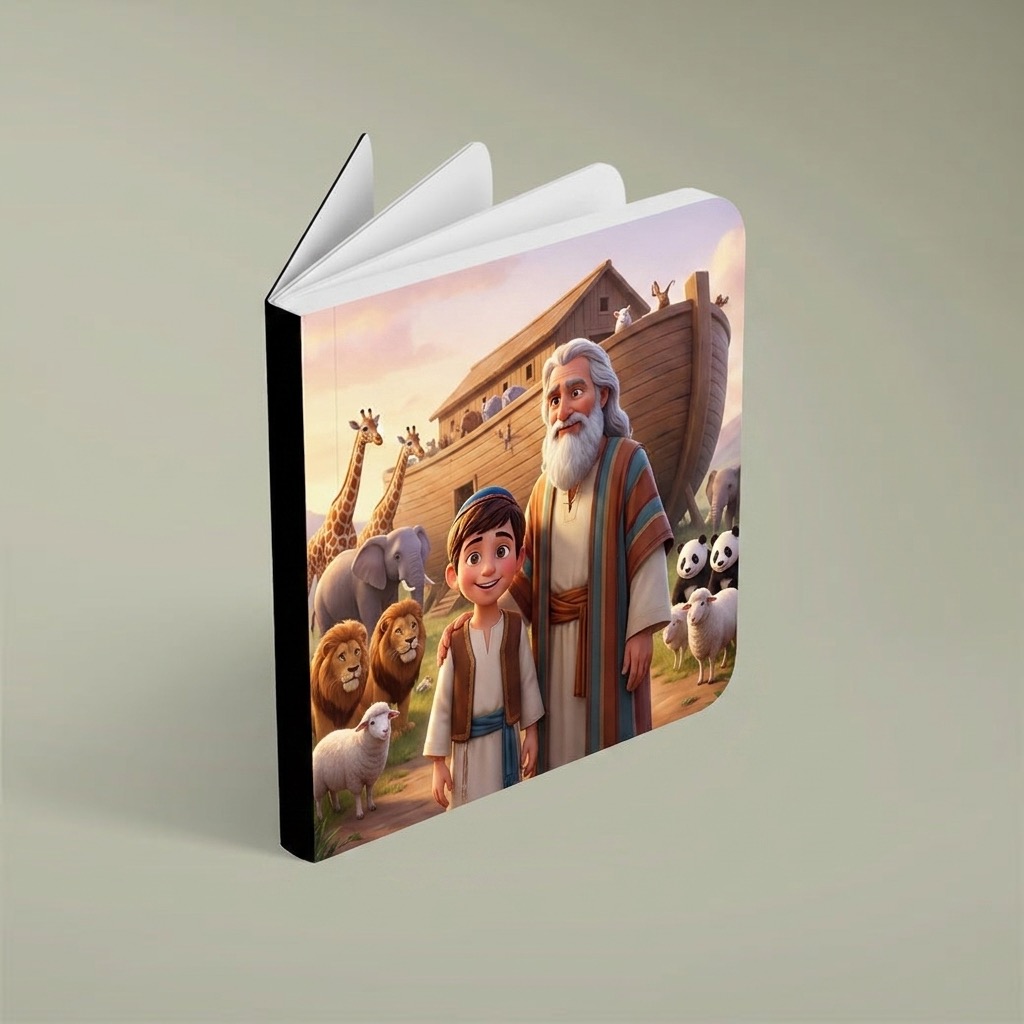
Board book 6″×6″
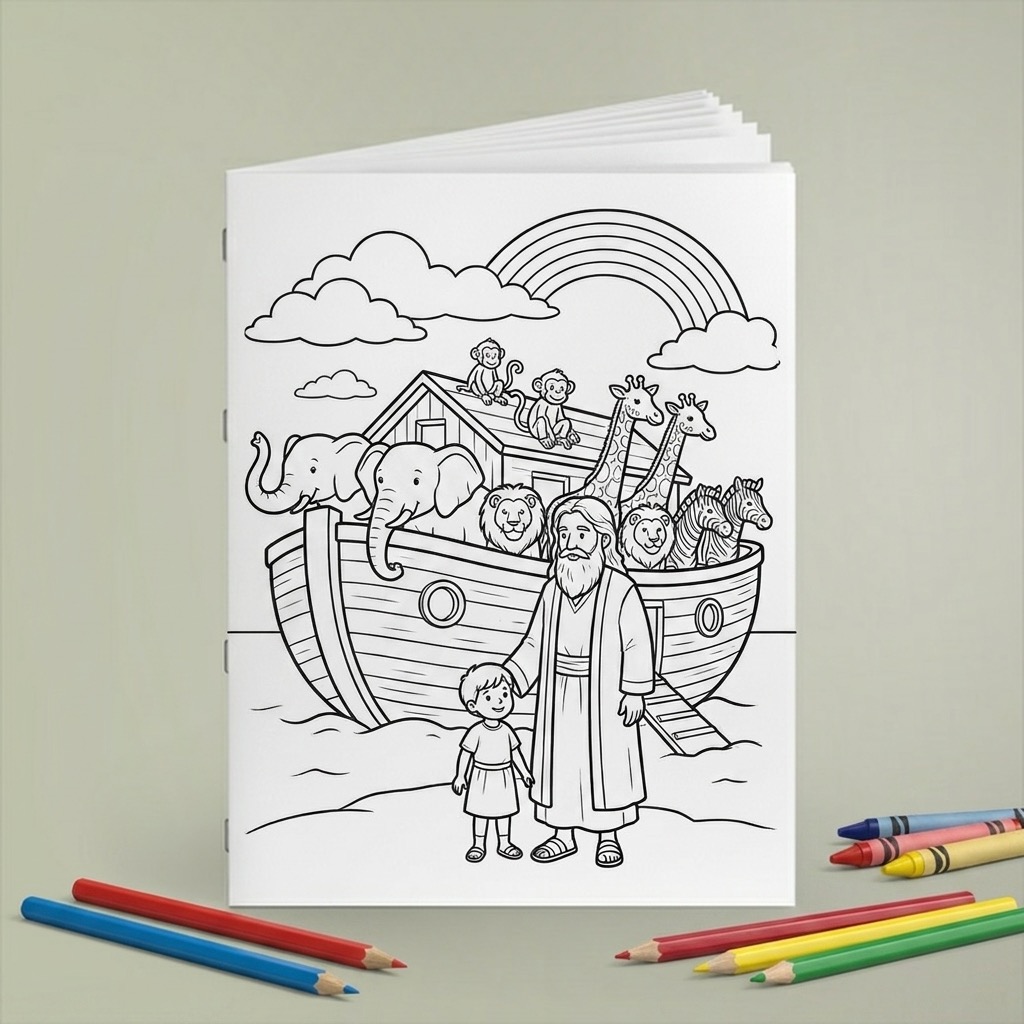
Coloring book 8.5″×11″
Format follows age. The 6x6 board book with rounded safety corners suits ages 0 to 4 and handles the basket-and-bush version well. The 8x8 softcover fits ages 4 to 8. The 8x8 hardcover is built for ages 5 to 18 and is the one that survives being read every Shabbos of the winter. Books come in English, Hebrew or Yiddish, and you can order more than one language. There is also an optional matching coloring book in black-and-white line art, which is a weekday activity: erev Shabbos afternoon or a Sunday, never on Shabbos or Yom Tov, since coloring is melacha.
Every book ends with a discussion page of 10 questions about the story, mixing comprehension with middos. That page is the difference between a book you read to a child and a book your family talks about at the table.
Shabbos table questions for Parshas Shemos
Pick two or three. You are not running a quiz, you are starting a conversation.
- Pharaoh made the Yidden work harder so there would be fewer of them, and instead there were more. What does that teach us about Hashem's plans and people's plans?
- Shifra and Puah were told by a king to do something wrong, and they did not do it. Was that easy? What made them able to refuse?
- Miriam stood far away and watched the basket. What do you think she was thinking? What do we do when we can only wait and daven?
- Moshe lived in a palace. Why did he go out to see the Yidden working?
- Hashem chose Moshe because of the way he took care of sheep. What small thing could someone notice about the way you take care of things?
- The bush burned and did not burn up. What could that be teaching about Klal Yisrael in Mitzrayim?
- Moshe kept saying he was not the right person. Is that a good middah or not? When is it good and when is it not?
A weekday activity that makes the parsha stick
On a weekday afternoon, give each child a small container of water and a few materials, and let them try to build something that floats and keeps a small object dry. Talk while they work about what Yocheved had to think through: it has to float, it has to stay dry inside, it has to be found. Then ask the harder question. She did everything she could, and then she had to let go and rely on Hashem. Where in our lives do we do our part and then hand the rest over?
For a shorter option, have older children write out the words Shalach es ami and what it would have felt like to hear them said to Pharaoh's face.
Where Shemos fits in the year
Shemos is read in the winter, and it follows directly from the end of Bereishis. If you have been building a parsha shelf, the last book of Bereishis is Parshas Vayechi, where Yaakov blesses his sons in Mitzrayim; Shemos opens with those same names and then jumps generations forward into slavery. Reading them close together makes the drop from honored guests to slaves land for a child in a way a summary never does.
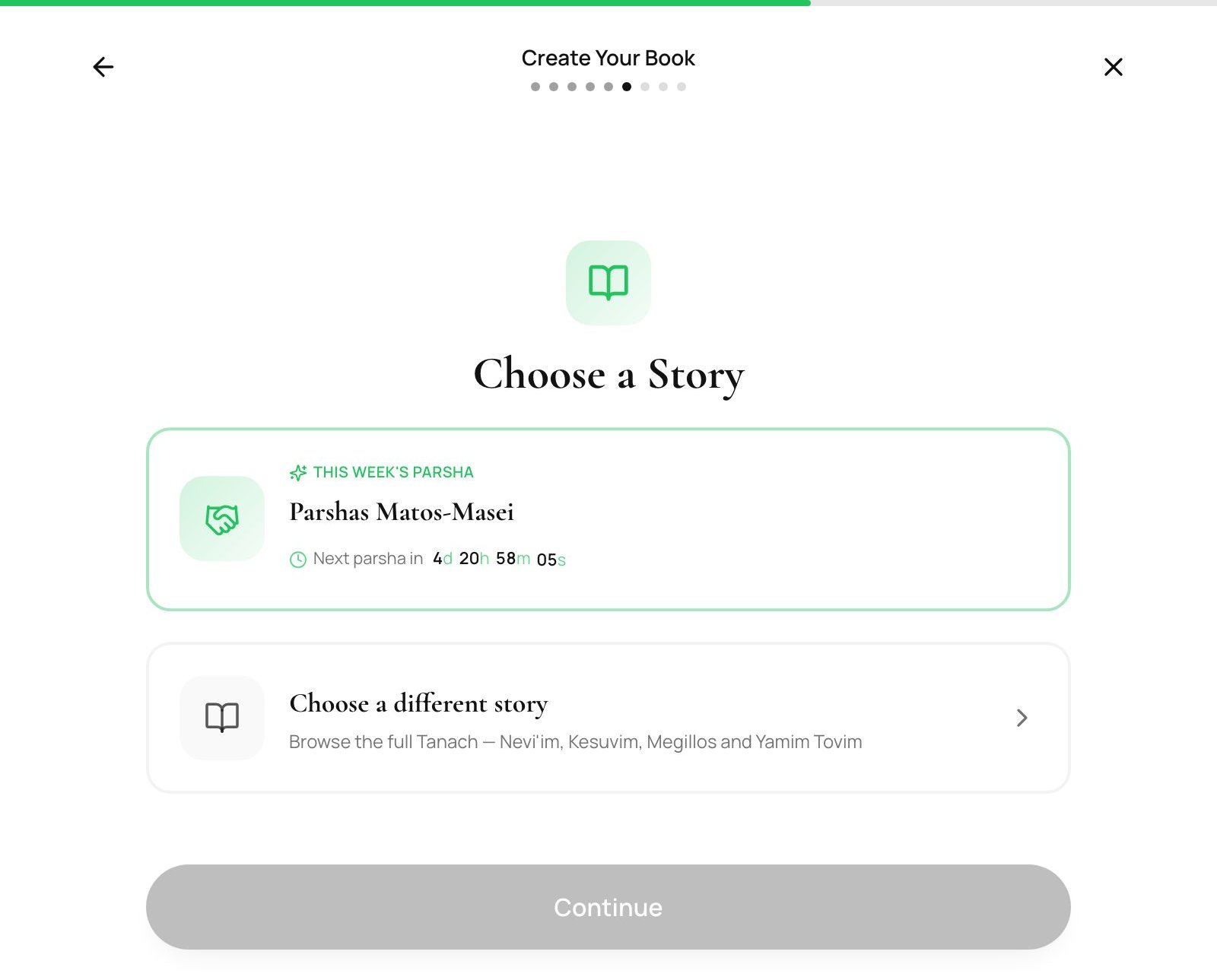
In the Torah Tale book creator, the story picker browses seven collections: Torah, Nevi'im, Kesuvim, Holidays, Jewish Life, Mitzvos and Stories of Tzadikim. The creator suggests next week's parsha by default with a live countdown to the order deadline for delivery before that Shabbos, and a double-parsha week produces one book covering both. You can also pick any story you want from the collections at any time. If you are deciding how to work through the year, this guide to choosing the parsha walks through it, and this step-by-step covers the whole flow.
Making the book
Creating a book takes about five minutes and a few short questions: your child's name, boy or girl, age, one photo, siblings, story, language and printed format. It requires a free account. Every book is written with careful rabbinical guidance and strict tznius and reviewed by our team before it goes to print. You can order a single book or a collection subscription. US standard shipping is $4.99 (free on one-time orders over $60) and arrives in 5 to 8 business days, and we ship worldwide with rates shown at checkout.
If your child has been asking why Moshe Rabbeinu was in a basket, this is the week to hand them a book where they are standing at the riverbank next to Miriam. Create the book and have it on the table before Shabbos.
Frequently asked questions
What is the story of Parshas Shemos in simple words?
Yaakov's family grew into a large nation in Mitzrayim. A new Pharaoh made the Yidden into slaves and decreed against their baby boys, but Yocheved hid her baby and then placed him in a basket among the reeds of the river, where Bas Pharaoh found him and named him Moshe. Moshe grew up in the palace, went out to see his brothers suffering, and later fled to Midyan. There Hashem spoke to him from a bush that burned without burning up and sent him to Pharaoh to take the Yidden out of Mitzrayim.
How do I explain the burning bush to a 5-year-old?
Say it plainly: Moshe was taking care of sheep in the desert when he saw a small bush with fire on it, and the fire was not burning the bush up at all. Moshe turned aside to look, and Hashem called his name from inside the bush and told him He had heard the Yidden crying and was going to save them. For a young child the point is simple: Hashem noticed, Hashem heard, and Hashem chose the shepherd who cared about his sheep to take care of His people.
What is the lesson of Parshas Shemos for children?
The main lesson is noticing other people. The Torah says Moshe went out to his brothers and saw their burdens, and Chazal explain that he did not just glance, he shared their pain and put his shoulder under their load. Children can do the same thing in miniature by noticing the classmate eating alone or the sibling who cannot carry the bag, and then actually getting up.
Who were Shifra and Puah?
Shifra and Puah were the Jewish midwives whom Pharaoh ordered to kill the baby boys. They feared Hashem and refused, and kept the babies alive. Chazal tell us that Shifra and Puah were Yocheved and her daughter Miriam, and that Hashem rewarded them with lasting houses in Klal Yisrael.
Why is Moshe called Moshe?
Bas Pharaoh, the daughter of Pharaoh, drew the baby out of the water and named him Moshe, saying that she had drawn him from the water. The name itself is a permanent reminder of how his life began, and it is the name the Torah uses for him for the rest of Chumash.
What age is a Parshas Shemos book right for?
Torah Tale prints the same story in formats for different ages: a 6x6 board book with rounded safety corners for ages 0 to 4, an 8x8 softcover photo book for ages 4 to 8, and an 8x8 hardcover for ages 5 to 18. For Shemos specifically, younger children hold onto the basket in the river and the bush that would not burn up, while older children can handle the decrees, Moshe's flight to Midyan and the signs he was given.