The Shabbos Story for Kids: The First Shabbos, the Mann & a Day of Rest
The Shabbos story for kids, from the first Shabbos at the end of creation to the mann in the midbar, with ways to explain it to a 3-year-old, a 6-year-old and a 10-year-old, plus questions for the Shabbos table.
Published by Torah Tale.
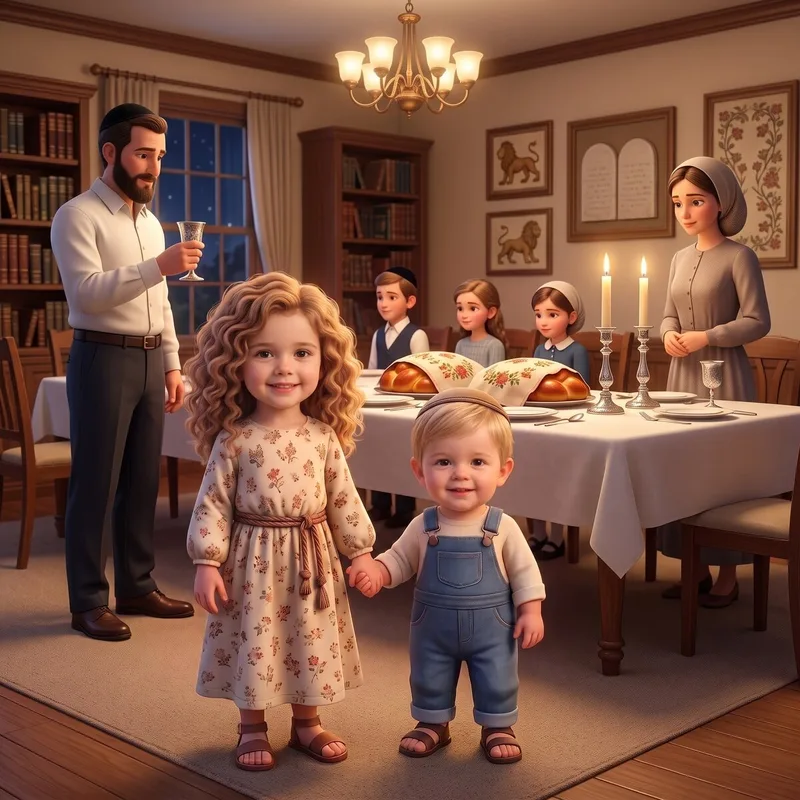
Create this book for your child
The Shabbos story is the Torah's account of how the seventh day came into the world: Hashem finished creation, rested on the seventh day, blessed it and made it holy, and later Bnei Yisrael learned to keep it, beginning with the mann in the midbar. Children connect with it because they already live it every week, with candles, challah, a full table and a house that slows down.
What does the Torah tell us about the first Shabbos?
The story opens in Bereishis 2:1-3. The heavens and the earth were finished, and on the seventh day Hashem finished His work and rested. The Torah then tells us that Hashem blessed the seventh day and made it holy.
That means Shabbos is part of the very first week of the world, before there was a single Yid to keep it. For a child, this is a nice thing to notice: the day we wait for every Friday is as old as creation.
How did Bnei Yisrael learn Shabbos in the midbar?
The Torah teaches Shabbos through the mann in Shemos 16, a story you can read together in Parshas Beshalach for kids. Each morning the mann fell and each person gathered what they needed. On the sixth day, the pasuk says, they gathered a double portion.
Moshe explained that the next day was Shabbos Shabbason, a holy Shabbos to Hashem. The mann kept overnight did not spoil. On Shabbos Moshe told them they would not find it in the field, and when some people went out anyway, they found none.
Chazal tell us that this double portion is why we have two challos at our Shabbos meals. A child can see that connection right on the table.
Why do we keep Shabbos? Two wordings in the Torah
In the Aseres HaDibros in Shemos 20, the Torah says zachor, remember the day of Shabbos to make it holy. It gives the reason: in six days Hashem made heaven and earth, and He rested on the seventh. You can read the setting in Parshas Yisro for kids.
When Moshe repeats the Aseres HaDibros in Devarim 5, the word is shamor, keep it, and the Torah there connects Shabbos with Yetzias Mitzrayim. Later, in Shemos 31, the Torah calls Shabbos a sign between Hashem and Bnei Yisrael.
What is the lesson of Shabbos for a child?
The middah is stopping, trusting and being thankful. We work and prepare during the week, and then we stop because Hashem made the world and gave us this day. The mann gives a child something to picture: Friday was the day of preparing, and Shabbos was the day of rest.
It is also a lesson in being together. Shabbos is the day the family sits at one table without rushing, and children feel that.
How do I explain Shabbos to a 3-year-old, a 6-year-old and a 10-year-old?
Around 3: Say one or two sentences, the same ones every week. Hashem made the whole world, and then He gave us Shabbos. Then point to what they see: the candles, the challah, Kiddush.
Around 6: Tell the mann story with its details: the double portion on Friday and the quiet Shabbos morning with nothing to gather. Ask why they think Hashem arranged it that way. Children this age love the idea that we get ready on Friday so Shabbos can be calm.
Around 10: Notice the two wordings, zachor in Shemos and shamor in Devarim, and ask why the Torah might give two reasons. Talk about Shabbos as a sign between Hashem and Bnei Yisrael. If they ask what exactly we do and do not do on Shabbos, that is a good question to bring to your rav or teacher.
What is a personalized Shabbos book from Torah Tale like?
Torah Tale makes personalized Torah storybooks in which your child is the hero. Their name and, from one uploaded photo, their likeness appear on every page, illustrated in 3D animated-film style. Up to eight siblings, ages 0 to 18, can appear in the same book, and the Shabbos story is one of the stories you can choose in the story picker.

Softcover 8″×8″

Hardcover 8″×8″

Board book 6″×6″

Coloring book 8.5″×11″
There are three formats: a 6x6 board book with rounded safety corners (ages 0-4), an 8x8 softcover photo book (ages 4-8) and an 8x8 hardcover photo book (ages 5-18). The softcover and hardcover open with a dedication page. If you add parents, grandparents and other relatives with their photos, they appear with the children on a closing family page in every format.
Every book ends with a discussion page of 10 questions about the story, mixing comprehension with middos. This is what turns the book from something read to a child into something talked about at the table. Each book is written with careful rabbinical guidance and strict tznius, and reviewed by our team before it goes to print.
What questions can we ask at the Shabbos table?
Reading is entirely appropriate on Shabbos, so a storybook at the table or on a Shabbos afternoon is a good fit. These questions need nothing but talking:
- What did Hashem do on the seventh day?
- What changes in our house when Shabbos comes?
- What did Bnei Yisrael gather on Friday in the midbar, and why?
- Why do we have two challos?
- What is your favorite part of Shabbos, and why?
- What is one thing you could do to make someone else's Shabbos happier?
Is there a weekday activity to go with the Shabbos story?
Yes. The optional matching coloring book (8.5x11, black-and-white line art) is a one-time add-on to a book, and it is a weekday activity. It suits a weekday afternoon or erev Shabbos, well before candle lighting, as a way to get ready for Shabbos during the week.
Ready to make it? Creating the book takes about five minutes: a free account and a few short questions, including your child's name, boy or girl, age and one photo. You can create the book and let your child see themselves in the story of the first Shabbos. For the very beginning of the story, see Parshas Bereishis for kids, and for another parsha about Shabbos, Parshas Vayakhel for kids.
Frequently asked questions
What is the Shabbos story for kids?
It begins in Bereishis, where the Torah tells us that Hashem finished creating the world, rested on the seventh day, blessed it and made it holy. It continues in the midbar, where Bnei Yisrael gathered a double portion of mann on Friday and found none on Shabbos. Children recognize it because it is the same Shabbos they keep every week at home.
How do I explain Shabbos to a 3-year-old?
Keep it short and tie it to what they see: Hashem made the whole world, and then He gave us Shabbos. Point to the candles, the challah and Kiddush as the special things we do because it is Shabbos. A young child learns best from repeating the same few words each week.
Why do we rest on Shabbos?
The Torah gives the reason in the Aseres HaDibros in Shemos: in six days Hashem made heaven and earth and rested on the seventh, which is why He blessed the day and made it holy. In Devarim the Torah connects Shabbos with Yetzias Mitzrayim. A child can hold both ideas: Hashem made the world, and Hashem took us out of Mitzrayim.
What is the lesson of the mann and Shabbos?
On Friday the Yidden gathered a double portion, and the mann kept overnight into Shabbos without spoiling, while none fell on Shabbos itself. A simple way to put it for children is that we prepare during the week, and then we can stop and enjoy the day Hashem gave us. Chazal tell us that the two challos on the Shabbos table recall this double portion.
Can my child read a Shabbos storybook on Shabbos?
Yes, reading is entirely appropriate on Shabbos, and a storybook at the Shabbos table or on a long Shabbos afternoon is a good fit. The matching coloring book is a weekday activity, for a weekday afternoon or for erev Shabbos.
What does a personalized Torah Tale Shabbos book include?
Your child's name and, from one uploaded photo, their likeness appear on every page in 3D animated-film style. The book ends with a discussion page of 10 questions about the story, mixing comprehension with middos. If you add parents, grandparents and other relatives, they appear with the children on a closing family page in every format.