Parshas Vayakhel-Pekudei for Kids: Building the Mishkan & the Cloud
Vayakhel-Pekudei is the parsha where the Mishkan actually gets built and finished. Here is how to tell it to children, what it teaches about Shabbos, honesty and finishing what you start, and how to talk about it at the Shabbos table.
Published by Torah Tale.
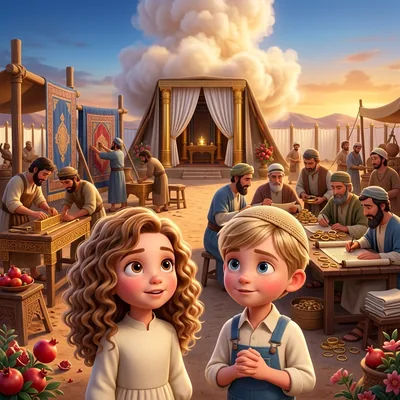
Parshas Vayakhel-Pekudei is the parsha where the Mishkan stops being a plan and becomes a real building. In Vayakhel, Moshe gathers the whole nation, teaches them Shabbos, and collects the donations; in Pekudei, every last piece of gold and silver is counted, the Mishkan is put up on Rosh Chodesh Nissan, and a cloud fills it. For children this is the satisfying end of a long project, and it is full of things they can picture: piles of jewelry, spun goat hair, a boy craftsman, and a building that finally goes up.
What happens in Parshas Vayakhel-Pekudei?
Moshe gathers all of Bnei Yisrael together. Before he says a word about building, he tells them about Shabbos: six days you may do work, and the seventh day is kodesh. Chazal learn from this placement that the thirty-nine melachos we do not do on Shabbos are exactly the kinds of work that were done for the Mishkan. Even building a home for Hashem does not push off Shabbos.
Then Moshe asks for donations, and the people respond. They bring gold, silver and copper, wool dyed techeiles, argaman and tolaas shani, linen, goat hair, oil, spices and precious stones. The Torah describes the women spinning the goat hair with great skill. Chazal relate that the copper washing basin, the kiyor, was made from the polished copper mirrors the women brought, and that Hashem told Moshe these were especially precious to Him because of the Jewish families that had been built in Mitzrayim.
The giving does not slow down. The craftsmen come to Moshe and tell him the people are bringing more than the work needs, and Moshe sends an announcement through the camp: stop, no more donations. It is one of the only times in history a building campaign had to be shut down.
Betzalel ben Uri of shevet Yehuda and Oholiav ben Achisamach of shevet Dan lead the work. Chazal tell us Betzalel was only about thirteen years old, filled by Hashem with wisdom to work in gold, silver, copper, stone and weaving. The Torah then walks through the making of every piece: the curtains, the beams, the Aron, the Shulchan, the Menorah, the Mizbechos.
Pekudei opens with the accounting. Moshe publicly reports exactly how much gold, silver and copper was donated and where each amount went, including the hundred talents of silver from the half-shekalim that became the sockets holding up the walls. The bigdei kehuna are finished, everything is brought to Moshe, and Rashi tells us that when Moshe saw the completed work he blessed the people that Hashem's presence should rest on the work of their hands.
The Mishkan is set up on Rosh Chodesh Nissan of the second year. Rashi brings that Moshe himself erected it, because the heavy beams were beyond any person to lift; Moshe made the effort and the Mishkan rose into place. Then the cloud covered the Ohel Moed and the kavod of Hashem filled the Mishkan, so completely that even Moshe could not enter. Sefer Shemos ends with the cloud by day and fire by night guiding the Yidden on all their travels, and the shul says Chazak chazak v'nischazek.
What is the lesson of Vayakhel-Pekudei for kids?
Three lessons carry easily to a child's world.
- Shabbos comes first. The holiest building project ever stopped every Friday afternoon. If that work waited for Shabbos, our work waits too.
- Be honest even when nobody is checking. Nobody suspected Moshe Rabbeinu of taking anything. He counted it all in public anyway. That is the standard for a tzedakah box in cheder and for the change on the kitchen counter.
- Finish the job. The Mishkan was not a home for the Shechinah when it was ninety percent built. Children who leave projects half done in a pile understand this one immediately.
There is a fourth for parents to notice quietly: everyone had a part. Some gave gold, some gave thread, some gave skill, and the Torah records all of it. If you have read Parshas Terumah with your children, this is where that instruction actually gets carried out.
How do I explain Vayakhel-Pekudei at different ages?
Ages 2-4. Keep it to pictures and one idea. "Everybody brought a present to build Hashem's beautiful house. There was so much, Moshe said we have enough! And when the house was ready, a big cloud came to show Hashem was there." A board book with rounded corners is the right shape for this age, because the toddler will be carrying it around the house.
Ages 5-8. Add Betzalel and the counting. Children this age love that a thirteen-year-old was in charge, and they can grasp why Moshe counted the money out loud. Ask them: why did Moshe count if everyone trusted him?
Ages 9-12. Learn the Shabbos connection properly. Show them that the melachos of Shabbos come from the work of the Mishkan, and ask why the Torah put Shabbos at the start of the building instructions. Older children can also compare Moshe's public accounting here with the half-shekel count in Parshas Ki Sisa.
What is a personalized Torah Tale book of Vayakhel-Pekudei like?
In a Torah Tale book, your child is the hero of the story. Their name is in the text and their face, illustrated from one uploaded photo in high-resolution 3D Pixar style, appears on every page: standing in the crowd as Moshe teaches Shabbos, carrying a donation to the pile, watching Betzalel work, and looking up at the cloud on Rosh Chodesh Nissan. Up to four siblings can appear in the same book, which works well for this parsha, where the whole nation is building together.
A double-parsha week produces one book covering both parshiyos, so Vayakhel and Pekudei arrive as a single story with a beginning and an end. Books are available in English, Hebrew and Yiddish, and you can order the same story in more than one language.
Softcover 8″×8″
Hardcover 8″×8″
Board book 6″×6″
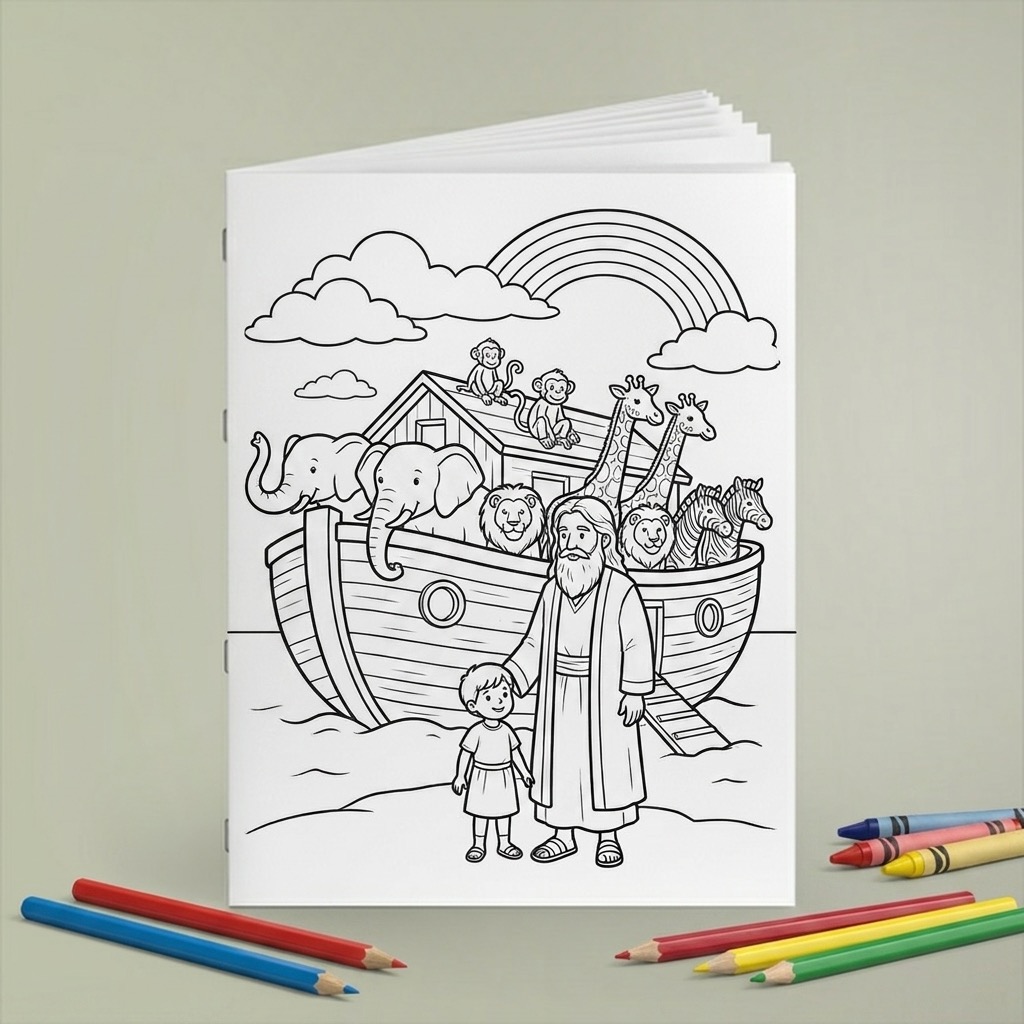
Coloring book 8.5″×11″
Formats: a 6"x6" board book with rounded safety corners for ages 2-4, a softcover 8"x8" photo book for ages 4-8, and a hardcover 8"x8" in square or landscape for ages 5-12. There is also an optional matching coloring book in black-and-white line art, which is a weekday activity - erev Shabbos or a weekday afternoon, never on Shabbos or Yom Tov, since coloring is melacha. The storybook itself is exactly right for the Shabbos table.
Every book ends with a dedicated discussion page of 10 questions that mix comprehension with middos, so the book does not end when the last page is turned.
Shabbos-table questions for Vayakhel-Pekudei
- Why did Moshe teach about Shabbos before he talked about building the Mishkan?
- What would you have brought to the Mishkan if you were there?
- Moshe had to tell people to stop giving. Have you ever seen people give too much of something?
- Betzalel was young and Hashem put him in charge. What are you good at that you could use for a mitzvah?
- Why did Moshe count all the gold and silver in front of everyone?
- Why does a job only count when it is completely finished?
- What did the cloud on the Mishkan show the Yidden?
- We say Chazak chazak v'nischazek when we finish a sefer. What is something you finished that you were proud of?
A weekday activity that fits this parsha
Take an empty jar and label it for a tzedakah cause your family picks together. Then do what Moshe did: at the end of the week, count what is inside out loud, in front of the children, and say where it is going. It takes four minutes and it teaches Pekudei better than any explanation.
For younger children, a building project works too. Give them blocks and a checklist of parts, and do not let them call it finished until every item on the list is there. Then talk about how the Mishkan needed all its parts before the cloud came.
Say it in one sentence
If you have thirty seconds before bed: "Everyone in Klal Yisrael helped build Hashem's house, they gave so much that Moshe said stop, Moshe counted every single coin in front of everybody so no one would wonder, and when it was completely finished, Hashem's cloud came down and stayed."
If you want to learn the two halves separately in a leap year, we have a full article on Parshas Vayakhel and another on Parshas Pekudei.

The Torah Tale book creator suggests next week's parsha with a live countdown to the order deadline for delivery before that Shabbos, and the whole process is eight short questions and about five minutes. Pick the story, upload one photo, choose the language and format, and create the book with your child building the Mishkan on every page.
Frequently asked questions
What is Parshas Vayakhel-Pekudei about in simple words?
Vayakhel-Pekudei is about building the Mishkan and finishing it. Moshe gathers all of Bnei Yisrael, teaches them about Shabbos, and asks for donations; the people bring so much that he has to tell them to stop. Betzalel and Oholiav lead the work, Moshe counts every donation publicly, and when the Mishkan is set up, a cloud fills it to show that Hashem's presence rests there.
Why are Vayakhel and Pekudei read together?
In most years the Jewish calendar joins Vayakhel and Pekudei into one double parsha, and in leap years they are read separately. Reading them together is natural because they tell one continuous story: Vayakhel is the building and Pekudei is the accounting and the completion. Together they finish Sefer Shemos, which is why the congregation says Chazak chazak v'nischazek at the end.
How do I explain Vayakhel-Pekudei to a 5-year-old?
Say it like this: Hashem asked the Yidden to build Him a beautiful home called the Mishkan, and everybody helped - some brought gold, some brought thread, some brought their best work. They brought so much that Moshe had to say thank you, we have enough. When it was all finished, a big cloud came down on the Mishkan to show that Hashem was happy and was staying with them.
What is the lesson of Vayakhel-Pekudei for children?
There are three that children can hold onto. First, Shabbos comes before even the holiest work, because Moshe taught Shabbos before the building began. Second, be honest with other people's money, because Moshe counted every donation in front of everyone even though nobody suspected him. Third, finish what you start, because the Mishkan only became a home for Hashem's presence once it was completely done.
Who was Betzalel and why do kids like him?
Betzalel ben Uri, from shevet Yehuda, was the master craftsman Hashem chose to lead the building of the Mishkan, together with Oholiav ben Achisamach of shevet Dan. Chazal tell us Betzalel was only a boy of about thirteen at the time. Children love that detail, because it shows that Hashem gives real responsibility to a young person who uses his talent well.
Can I get a personalized book for a double parsha like Vayakhel-Pekudei?
Yes. A double-parsha week produces one Torah Tale book that covers both parshiyos, with your child as the hero on every page. You choose the language (English, Hebrew or Yiddish) and the format, and every book ends with a discussion page of 10 questions about the story.