The Glowing Coal in Sefer Yeshayahu for Kids: Pure Lips & 'Hineni, Send Me'
A coal from the mizbeach touches Yeshayahu's lips, and he answers 'Hineni, send me.' Here is the story from Yeshayahu perek 6, its lesson for children, and how to explain it at ages 3-4, 6-7 and 9-12.
Published by Torah Tale.
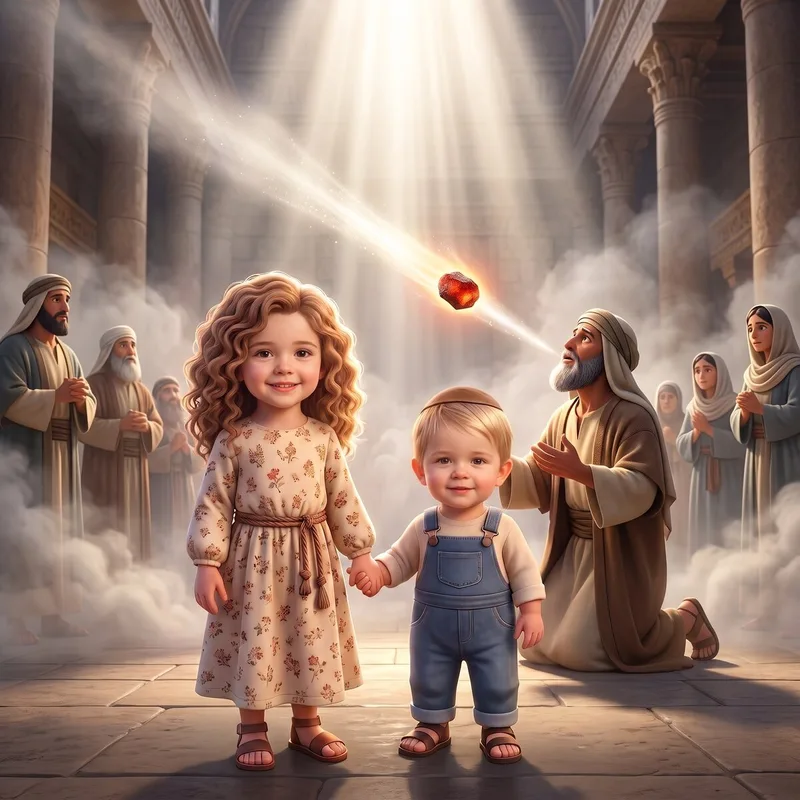
Create this book for your child
The glowing coal is the moment in Yeshayahu perek 6 when Yeshayahu HaNavi sees a vision, feels unworthy to speak, and a seraph touches his lips with a coal from the mizbeach. Then he hears 'Whom shall I send?' and answers 'Hineni, send me.' Children respond to it because it is about a person who feels small and is still given a job.
What happens in the story of the glowing coal?
The pasuk opens 'in the year King Uziyahu died.' Yeshayahu sees a vision of Hashem's glory, and the house is filled with smoke. Around him are the serafim, who call out to one another: 'Kadosh, kadosh, kadosh Hashem Tzevakos, melo chol ha'aretz kevodo.'
Yeshayahu is overwhelmed. He says that he is a man of unclean lips and that he lives among a people of unclean lips. He feels that he is not ready to stand in this place.
Then one of the serafim flies to him. In his hand is a glowing coal (a rizpah) that he took from the mizbeach with tongs. He touches it to Yeshayahu's mouth and says: 'Hinei naga zeh al sefasecha, vesar avonecha, vechatascha techupar.' The pasuk tells us that his avon is removed and his chattas is forgiven.
Next Yeshayahu hears the voice of Hashem asking, 'Whom shall I send, and who will go for us?' Yeshayahu answers, 'Hineni, shelacheini' - here I am, send me.
What is the lesson of the glowing coal for children?
There are three things a child can take from it, and each comes straight from the pesukim.
- Words matter. The coal touches Yeshayahu's lips, the part of him that will speak for Hashem. A child who hears this learns that what we say is important enough to be cleansed and guarded.
- Feeling unready is not the end. Yeshayahu says he is not worthy, and Hashem does not send him away. The pasuk gives him the coal and then gives him the shlichus.
- Hineni. The right answer to being called is to step forward and say 'here I am.'
The meforshim discuss in depth what Yeshayahu meant by 'unclean lips.' For a young child it is enough to say that he wanted his words to be as pure as possible before he spoke in Hashem's name.
Where do we say these words every day?
The words 'Kadosh, kadosh, kadosh Hashem Tzevakos, melo chol ha'aretz kevodo' come from Yeshayahu 6:3, and we say them in Kedushah in davening. Your child may have said them many times without knowing where they come from. Telling him that these are the very words the serafim called out in Yeshayahu's vision can make the next Kedushah feel different.
This perek is also the source of the haftarah of Parshas Yisro, so the story comes back each year, as the Parshas Yisro for Kids article describes for the parsha itself.
Is this the same coal as in the story of baby Moshe?
No, these are two separate stories that happen to share a coal. In Yeshayahu the coal is taken from the mizbeach by a seraph and touched to the navi's lips, as the pasuk describes. The story of baby Moshe and the coal is a midrash about his childhood, which you can read about in Baby Moshe and the Burning Coal for Kids.
It helps to name the difference if your child has already heard the other one. You can say, 'This coal is in Sefer Yeshayahu, in a vision, and that coal is a midrash about Moshe Rabbeinu.'
How do I explain the glowing coal at different ages?
Ages 3-4. Tell it very simply: Yeshayahu HaNavi saw something very special, and a malach touched his lips so that his words would be pure for Hashem. Then Hashem asked who would go, and Yeshayahu said 'Hineni.' Teach the single word Hineni and let your child say it back to you with a big smile when you call his name.
Ages 6-7. Children this age can hold the sequence: the vision, the serafim, the feeling of not being ready, the coal, and then the call. Ask, 'Why do you think the coal touched his lips and not his hands?' This leads naturally to the idea that what we say matters. It is also a good moment to point to the mitzvah of guarding our tongues, which you can follow up with Guarding My Tongue for Kids.
Ages 9-12. Older children can look at the pesukim themselves and notice the order: Yeshayahu speaks about himself and his people first, the coal comes next, and only then does he hear the call. Ask what it means to be ready for a shlichus and whether anyone ever really feels fully ready. You can also connect it to his other well-known prophecy for children, Yeshayahu's Vision of Peace.
The coal is a little scary for some children. You can reassure them that this was a vision, that the pasuk tells us the coal came to remove his avon, and that its purpose was a kindness.
What is a personalized Torah Tale book of this story like?
In a Torah Tale book of Sefer Yeshayahu - The Glowing Coal, your child's name and likeness appear on every page, illustrated in high-resolution 3D animated-film style. The story comes from the Nevi'im collection in the story picker, and the book is written with careful rabbinical guidance and strict tznius and reviewed by our team before it goes to print.
Up to eight siblings, ages 0 to 18, can appear in the same book. If you add parents, grandparents or other relatives, they appear with the children on a closing family page in every format.
The formats suit different ages: a 6x6 board book with rounded safety corners for ages 0-4, an 8x8 softcover for ages 4-8, and an 8x8 hardcover for ages 5-18. Softcover and hardcover open with a dedication page. An optional matching coloring book is available as a one-time add-on.

Softcover 8″×8″

Hardcover 8″×8″

Board book 6″×6″

Coloring book 8.5″×11″
Every book ends with a discussion page of ten questions about the story, mixing comprehension with middos. It turns the book from something read to a child into something talked about at the table.
What can we ask at the Shabbos table?
Reading the book at the Shabbos table is just right, and these questions are for talking only:
- What did Yeshayahu see, and how do you think he felt?
- Why did the seraph touch the coal to his lips?
- When Hashem asked 'Whom shall I send?', what did Yeshayahu answer?
- When was a time you wanted to say Hineni, even though you were nervous?
- What is one kind thing you can say tomorrow at home or in cheder?
For a weekday or erev Shabbos, the optional coloring book can go with the story. Coloring is never for Shabbos or Yom Tov, so keep it for a weekday afternoon or erev Shabbos, and save the book itself for reading on Shabbos.
Ready to make it your child's story?
Creating a book takes about five minutes: a free account and a few short questions covering each child's name, boy or girl, age and one photo, any siblings, the story, your community (asked once), the language and the printed format. Books come in English, Hebrew and Yiddish. When you are ready, you can create the book and let your child hear Yeshayahu's Hineni as his own.
Frequently asked questions
What is the story of the glowing coal in Sefer Yeshayahu?
In Yeshayahu perek 6, in the year King Uziyahu died, Yeshayahu has a vision of Hashem's glory and hears the serafim calling 'Kadosh, kadosh, kadosh.' He says he is a man of unclean lips living among a people of unclean lips. One of the serafim then flies to him with a coal from the mizbeach, touches it to his mouth, and tells him that his avon has departed and his chattas is forgiven.
What is the lesson of the glowing coal for children?
The story teaches that Hashem purifies a person who feels unworthy, and that a person who has been given that chance can answer 'Hineni' when he is called. It also gives parents a gentle way to talk about speech, since the coal touches Yeshayahu's lips. Children can take from it that their words matter and that they can always begin again.
How do I explain the glowing coal to a 4-year-old?
Keep it short and calm: Yeshayahu HaNavi had a special vision, he felt that his words needed to be cleaner, and a malach touched his lips with a coal from the mizbeach so he could speak for Hashem. Then Hashem asked who would go, and Yeshayahu said 'Hineni, here I am.' Stop there, and ask what your child would like to say to Hashem when he is called.
Is the glowing coal in Yeshayahu the same as the coal in the story of baby Moshe?
No, these are two different stories. The coal in Yeshayahu perek 6 is a pasuk in Nevi'im, taken from the mizbeach and touched to the navi's lips as part of his vision. The story of baby Moshe and the coal is a midrash about Moshe's childhood in Pharaoh's palace.
Is it appropriate to read this story to children on Shabbos?
Yes, reading a storybook with your child is entirely appropriate on Shabbos, and the questions in this article work well at the Shabbos table as talking only. Any coloring or drawing connected to the story should be kept for a weekday or erev Shabbos.