Baby Moshe and the Burning Coal for Kids: Midrash & Lesson
Baby Moshe, Pharaoh's crown and a burning coal: the Midrash behind Moshe Rabbeinu's heavy speech, what it teaches children about Hashem's hidden care, and how to tell it at ages 3-4, 6-7 and 9-12.
Published by Torah Tale.
Create this book for your child
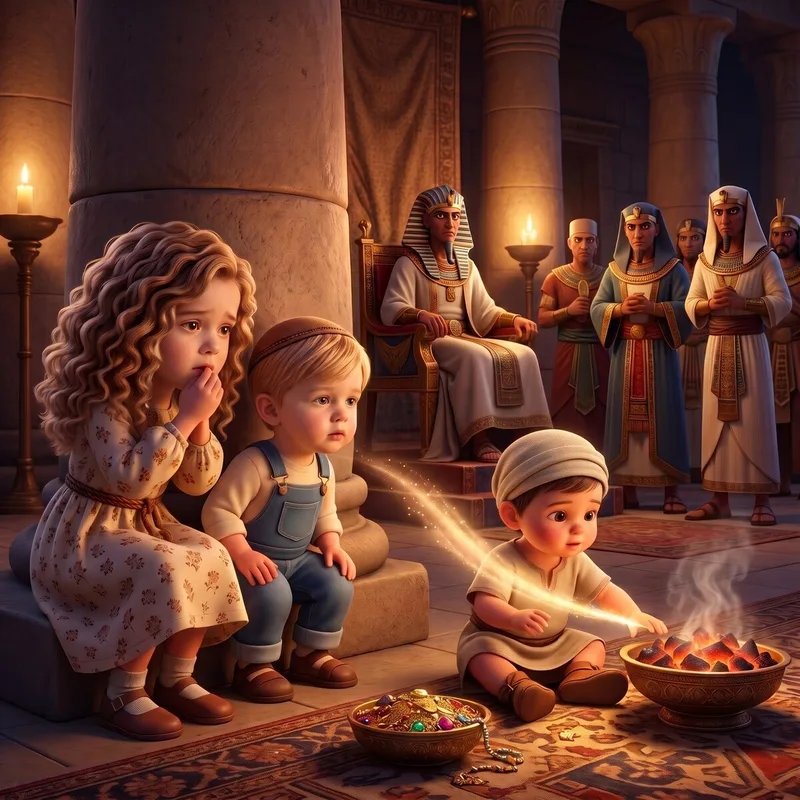
Baby Moshe and the burning coal is a Midrash about Moshe Rabbeinu as a small child in Pharaoh's palace: he took Pharaoh's crown, a test was set up with a coal, and Hashem's malach guided his hand so that his life was saved. Children are drawn to it because it has a crown, a king, a surprise and a safe ending, and parents value it because it shows that Hashem was watching over Moshe long before he knew he was a leader.
What is the story of baby Moshe and the burning coal?
The Torah tells us that after Moshe was drawn from the water, Batya, the daughter of Pharaoh, raised him as her son, and he grew up in the palace (Shemos 2:10). The Midrash fills in a moment from those years.
The Midrash relates that Pharaoh was holding Moshe, and the young child reached up, took Pharaoh's crown and put it on his own head. Pharaoh's advisers were troubled. They wondered whether this child was reaching for the kingdom, and they argued about what should be done.
One of the advisers suggested a test. A child this young has no real understanding, he said, so place a piece of gold and a burning coal in front of him. If he reaches for the gold, he knows what he is doing. If he reaches for the coal, he is only a child.
Chazal tell us that Moshe reached for the gold, and then Gavriel the malach came and moved his hand toward the coal. Moshe put it to his mouth, and his tongue was hurt. The advisers saw that he was only a child, and Pharaoh let him be.
Where does this Midrash come from, and what is pshat?
The source is Shemos Rabbah 1:26. It is a story Chazal tell behind the pesukim, so it is Midrash and not pshat, and it is worth saying that to children from the start: 'The Torah says Moshe grew up in the palace. The Midrash tells us a story about something that happened there.'
Keeping the two apart does not make the story smaller. It teaches a child that Chazal received a rich tradition about the Torah's people and that we listen to it with respect. If you are retelling it in a frum home, 'the Midrash relates' and 'Chazal tell us' are the right words to use.
What does the coal have to do with Moshe's heavy speech?
When Hashem sends Moshe to Pharaoh at the burning bush, Moshe answers with words the Torah records: ki kvad peh u'kvad lashon anochi, I am heavy of mouth and heavy of tongue (Shemos 4:10). That is explicit in the pasuk.
The Midrash connects those words with the coal. According to this tradition, Moshe's way of speaking goes back to that moment in the palace. It is Chazal's explanation, so we say 'the Midrash connects', not 'the Torah says'.
Children often notice something striking here. The man who would speak to Pharaoh, and teach Yidden the Torah, was a man who did not find speaking easy. It was part of who he was.
What is the lesson of the story for children?
The first lesson is about hashgachah. A little boy in a palace, with advisers deciding what to do about him, was not alone. The malach came, and Moshe was safe. Even a very young child can understand that Hashem watches over us when no one else knows we need it.
The second lesson is about difficulty. Moshe's speech was not easy for him, yet he became the leader who brought Yidden out of Mitzrayim. We learn from this that something hard about us does not mean we cannot do great things in Hashem's service. For a child who stutters, struggles to read, or is shy, this can be a quiet comfort.
The third is about not judging by a first impression. The advisers saw a child, and a child is what they decided he was. Hashem knew who Moshe would become.
How do I explain it to a 3-4-year-old, a 6-7-year-old and a 9-12-year-old?
Ages 3-4. Tell it in three or four short sentences. 'Moshe was a little boy in the king's palace. The king's helpers wanted to see if he was just a baby. Hashem sent a malach to take care of Moshe, and Moshe was safe.' Leave out the advisers' argument.
Ages 6-7. Add the crown and the two choices, the gold and the coal. Then ask: who was really taking care of Moshe? Many children this age enjoy picking out the moment the malach moves in, and they like being able to say it is a Midrash, not a pasuk.
Ages 9-12. Open the pasuk in Shemos 4:10 together and let the child see where Chazal connect the story to Moshe's words. Then ask the harder question: why might Hashem choose a leader whose speech was heavy? Let the child offer answers before you say anything.
A personalized book can fit these ages. Torah Tale offers a board book (6"x6", rounded safety corners, ages 0-4), a softcover photo book (8"x8", ages 4-8) and a hardcover photo book (8"x8", ages 5-18). The child's age is one of the short questions when you create the book.
What can we ask at the Shabbos table?
Reading is entirely appropriate on Shabbos, and so are questions around the table. These need no writing and no materials, only talking:
- Why do you think the advisers were worried when Moshe took the crown?
- What was the difference between the gold and the coal in the test?
- Who was really watching over Moshe, even though nobody could see?
- Moshe found speaking hard. What is something hard for you that Hashem might want you to do anyway?
- When have you felt safe even when something unexpected happened?
Younger children can answer the third question with just one word. Older children can take the fourth one seriously, and it is worth letting a parent answer it too.

Softcover 8″×8″

Hardcover 8″×8″

Board book 6″×6″

Coloring book 8.5″×11″
What is a personalized book of Baby Moshe and the Burning Coal like?
At Torah Tale this story is part of the Midrash & Aggadah collection, which tells the stories Chazal share behind the pesukim, each from its named source in the Gemara or Midrash. The book is written with careful rabbinical guidance and strict tznius, and our team reviews it before it goes to print.
Your child's name appears on every page, and from one uploaded photo your child's likeness is illustrated in high-resolution 3D animated-film style. Up to eight siblings, ages 0 to 18, can share one book. Softcover and hardcover books open with a dedication page. If you add parents, grandparents and other relatives with their photos, they appear with the children on a closing family page in every format.
Every book also ends with a discussion page of 10 questions about the story, mixing comprehension with middos: what happened, and what it asks of the child. That page is what turns the book from something you read to your child into something you talk about together.
An optional matching coloring book (8.5"x11", black-and-white line art) can be added to a book. Coloring is melacha, so it is for weekdays, such as a weekday afternoon or erev Shabbos, and not for Shabbos or Yom Tov. The storybook itself is just right for the Shabbos table.
Which other stories connect to this one?
The pesukim of Moshe's early years are in Parshas Shemos for Kids, where you can read about the basket, the palace and the burning bush. Another Midrash that children respond to is Avraham and His Father's Idols, which, like this one, begins with a child facing something bigger than himself. For the story of what Moshe went on to do, see The Pesach Story for Kids.
When you are ready, you can create the book with a free account and a few short questions about your child, the story, your community, the language and the format. The whole flow takes about five minutes.
Frequently asked questions
What is the story of baby Moshe and the burning coal?
The Midrash relates that when Moshe was a young child in Pharaoh's palace, he took Pharaoh's crown and put it on his own head. Pharaoh's advisers worried about what this meant, so a test was set up with a piece of gold and a burning coal. Gavriel the malach guided Moshe's hand to the coal, he put it to his mouth, and the advisers decided he was only a child.
Where does the burning coal story come from?
It comes from the Midrash, in Shemos Rabbah 1:26, and is not written in the pesukim. The Torah itself tells us only that Batya raised Moshe as her son (Shemos 2:10). When we tell the story we say 'the Midrash relates' so children learn the difference.
What does the burning coal have to do with Moshe's speech?
In Shemos 4:10 Moshe says to Hashem that he is heavy of mouth and heavy of tongue. Chazal connect this to the coal he touched to his mouth as a child. This is the Midrash's explanation, not something the pasuk states.
How do I explain this story to a 4-year-old?
Keep it simple: Moshe was a little boy in the king's palace, a test was made to see if he was just a baby, and Hashem sent a malach to keep him safe. You can end with 'Hashem was taking care of Moshe, even when nobody could see'. Leave out the details of the advisers' worry and focus on the safe ending.
Is the story too scary for young children?
It can be told gently, because the focus is that Hashem protected Moshe and that Pharaoh let him be. Skip the advisers' argument for little ones and do not dwell on the burn. Parents know their own child best, so adjust to what your child is ready for.
Is there a personalized book of this story?
Yes, Baby Moshe and the Burning Coal is in the Midrash & Aggadah collection at Torah Tale. Your child's name and likeness appear on every page in 3D animated-film style, and the book ends with a discussion page of 10 questions mixing comprehension with middos. Creating it takes a free account and a few short questions.