Avraham and His Father's Idols for Kids: Midrash & Lesson
Avraham Avinu left alone in his father's idol shop is a Midrash children remember for life. Here is the story as Chazal tell it, what it teaches, and how to talk about it at ages 2-4, 5-7 and 8-12.
Published by Torah Tale.
Create this book for your child
Avraham and his father's idols is a Midrash that tells how Avraham Avinu, left alone in Terach's shop, showed that a statue can neither eat nor speak nor move. Children love it because it is short, clear and a little funny, and because the hero wins by asking a simple question. It comes from Bereishis Rabbah 38:13, and Rashi brings part of it on the words "Ur Kasdim" (Bereishis 11:28).
What is the story of Avraham and his father's idols?
The Midrash relates that Terach made and sold idols. Once he had to go away, and he left Avraham to sell in his place.
A man came to buy. Avraham asked him how old he was, and the man answered fifty or sixty. Avraham said, in the words of the Midrash, "Woe to the man who is sixty and bows to something one day old." The man was ashamed and left.
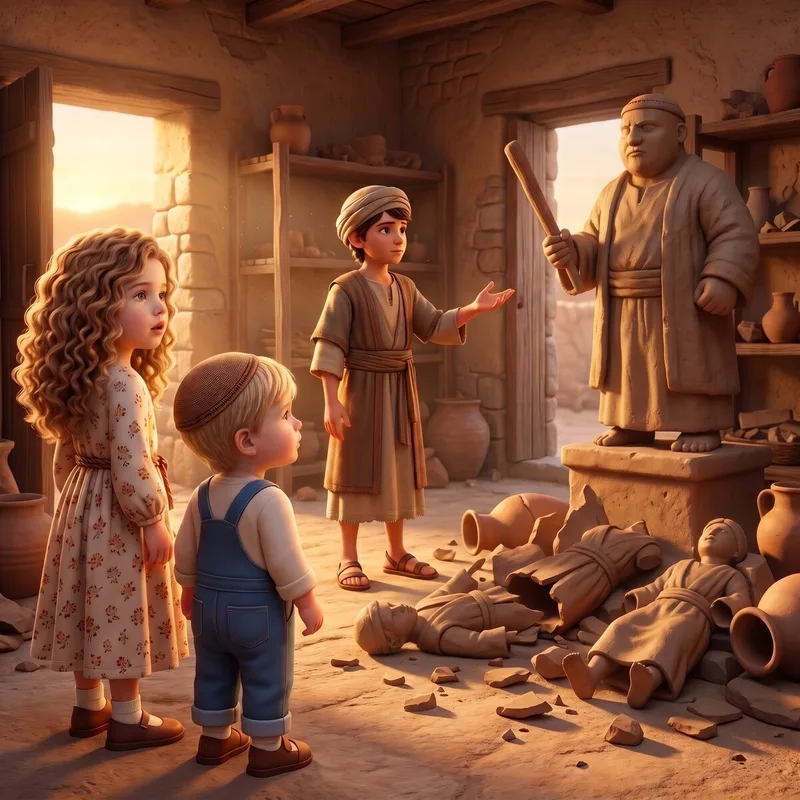
Then a woman came carrying a dish of fine flour. She said, "Take this and offer it to them." Avraham took a stick, broke the idols, and put the stick in the hand of the biggest one.
What did Terach say when he came back?
Terach returned and asked, "What have you done to them?" Avraham answered that he could not hide it from his father. A woman had brought fine flour, he said, and the idols began to argue over who would eat first. Then the biggest rose, took the stick and broke the rest.
Terach said, "Why are you making fun of me? Do they have any knowledge?" Avraham replied, "Do your ears not hear what your mouth is saying?"
That answer is the heart of the story. Avraham did not need a long speech. He let Terach hear his own words.
What happened after that?
The Midrash continues that Terach took Avraham and handed him over to Nimrod. Nimrod told Avraham to bow to fire, and Avraham answered with questions: water puts out fire, so should one not bow to water? Then clouds carry the water, and the wind scatters the clouds. Nimrod would not give way. He said he bowed only to fire and would throw Avraham into it.
Rashi on Bereishis 11:28 brings the story of the furnace, from which Avraham was saved. For young children it is enough to say that Hashem saved Avraham. The details can wait until they are older.
A note for precision: none of this is spelled out in the pesukim of Bereishis. It is Midrash. In Sefer Yehoshua (24:2) the pasuk itself says that Terach and his family served other gods, which is part of the background Chazal are explaining.
What is the lesson for children?
The first lesson is seichel. Avraham looked at what was in front of him and asked an honest question: how can something made yesterday be worth bowing to?
The second lesson is truth said calmly. Avraham spoke to the buyer and to his father quietly and plainly, and each of them heard it. A child can understand that being brave does not always mean being loud.
It is also worth saying clearly that this is a story about Avraham Avinu. We learn from it the courage to stand up for emunah. We do not learn that a child should break things or take matters into his own hands. If your child asks, this is a good place to say that for ourselves, a question to Abba, Ima or a rebbe is the right way.
How do I explain it to a 2-4 year old, a 5-7 year old and an 8-12 year old?
Ages 2-4: Say it in a few sentences. "Avraham saw that statues cannot talk or eat. Only Hashem made the whole world. Avraham told the truth, and Hashem took care of him." Let your child point to the stick and the big statue in the pictures.
Ages 5-7: Tell the shop scene in full, including the buyer who left ashamed and the line, "Do your ears not hear what your mouth is saying?" Children of this age enjoy catching Terach in his own words. Ask them why that answer worked.
Ages 8-12: Add Nimrod's questions about fire, water, clouds and wind, and notice how each answer names something stronger than the one before. You can also open the question of how to stand by what you know is true when someone with authority disagrees. Keep the focus on Avraham, and bring in your rav or teacher for any harder questions.
What is a personalized Torah Tale book of this story like?
In a Torah Tale book, your child is the hero. Their name and, from one uploaded photo, their likeness appear on every page, illustrated in 3D animated-film style. Up to eight siblings can appear in one book, ages 0 to 18.
The book is written with careful rabbinical guidance and strict tznius, and our team reviews it before it goes to print. Every book ends with a discussion page of 10 questions that mix comprehension with middos: what happened, and what it asks of your child. If you add parents and grandparents, they appear with the children on a closing family page in every format.

Softcover 8″×8″

Hardcover 8″×8″

Board book 6″×6″

Coloring book 8.5″×11″
The formats follow age. The 6"x6" board book with rounded safety corners is for ages 0-4, the 8"x8" softcover for ages 4-8, and the 8"x8" hardcover for ages 5-18. Softcover and hardcover books open with a dedication page. The books come in English, Hebrew and Yiddish. An optional matching coloring book is a weekday activity for erev Shabbos, a weekday afternoon or Chol HaMoed, and never for Shabbos or Yom Tov. The storybook itself is well suited to reading at the Shabbos table.
What questions can I ask at the Shabbos table?
These are for talking only, and they work from the youngest listener to the oldest:
- Why did the buyer leave the shop feeling ashamed?
- What did Avraham ask him that made him think?
- What did Terach say about the idols, and why did that prove Avraham's point?
- Is it easy or hard to say what is true when your family sees it differently? What helps?
- Why do you think Avraham stayed calm when he spoke to his father and to Nimrod?
- What is something in our home that shows we believe Hashem made the world?
Leave a little space after questions 4 and 6, since they invite a child to think about his own life.
Where does this story connect to the parsha?
The Midrash is learned on the pesukim at the end of Parshas Noach, where Terach's family is listed. Avraham's own journey begins in Parshas Lech Lecha. Reading the Midrash first can help a child see why Avraham is ready to follow Hashem's call.
To make this story into a book starring your child, you create a free account and answer a few short questions: each child's name, boy or girl, age and one photo, any siblings, the story, your community (asked once), the language and the format. It takes about five minutes. When you are ready, create the book.
Frequently asked questions
Where does the story of Avraham and his father's idols come from?
It comes from the Midrash, in Bereishis Rabbah 38:13, on the pasuk that says Haran died in the lifetime of his father Terach (Bereishis 11:28). It is not written in the pesukim of the Torah itself. Rashi on that pasuk also brings the story of Avraham and the furnace.
How do I explain Avraham and the idols to a 4-year-old?
Keep it short and concrete: Avraham saw that statues cannot talk, eat or move, and that only Hashem made the world. Say that Avraham was not afraid to say what was true. A child of this age needs the picture and one sentence, not the whole Midrash.
What is the lesson of Avraham and his father's idols?
One lesson is that Avraham used his seichel to recognize that only Hashem is real, and he said so plainly. Children can also learn to think carefully and to tell the truth even when it is hard. Parents can explain this as courage, and also remind a child that it is a story about Avraham Avinu, not an invitation to take things into their own hands.
Why did Avraham put the stick in the hand of the biggest idol?
According to the Midrash, Avraham broke the idols with a stick and put it in the hand of the largest one. When Terach asked what had happened, Avraham said the biggest idol had done it. Terach answered that the idols have no knowledge, and Avraham pointed out that Terach had just said it himself.
Is there a Torah Tale book about Avraham and his father's idols?
Yes. Torah Tale makes personalized storybooks in which your child is the hero, with their name and, from one uploaded photo, their likeness in 3D animated-film style. Every book ends with a discussion page of 10 questions about the story, mixing comprehension with middos. It comes in English, Hebrew and Yiddish, as a board book (ages 0-4), softcover (ages 4-8) or hardcover (ages 5-18).