Yeshayahu's Vision of Peace for Kids: The Wolf & the Lamb
Yeshayahu's vision of a peaceful world, with the wolf living beside the lamb and nations no longer learning war, retold for children with ways to explain it at ages 3-4, 5-7 and 9-12 and questions for the Shabbos table.
Published by Torah Tale.
Create this book for your child
The Vision of Peace is the navi Yeshayahu's picture of a future world where nations stop learning war and the wolf lives together with the lamb. Children connect with it quickly because the images are gentle and concrete: animals resting side by side, and a small child leading them. It is also one of the clearest ways to teach a child that Hashem has a plan for a peaceful world, and that we have a part in preparing for it.
What is the Vision of Peace in Sefer Yeshayahu?
Yeshayahu prophesied in the days of the kings Uziyahu, Yosam, Achaz and Chizkiyahu, as the first pasuk of the sefer tells us. The Vision of Peace is made up of two well-known passages from his nevuos.
In chapter 2, the navi speaks of the end of days, when many nations will say to one another to go up to the house of Hashem, because Torah will go out from Tzion. The pasuk tells us there that they will beat their swords into plowshares and their spears into pruning hooks, and that nation will not lift a sword against nation, nor will they learn war anymore.
In chapter 11, Yeshayahu speaks of a shoot growing from the stem of Yishai, and the meforshim understand this as Melech HaMashiach. Then comes the picture most children remember: the wolf and the lamb.
What happens in the Vision of Peace? The story for children
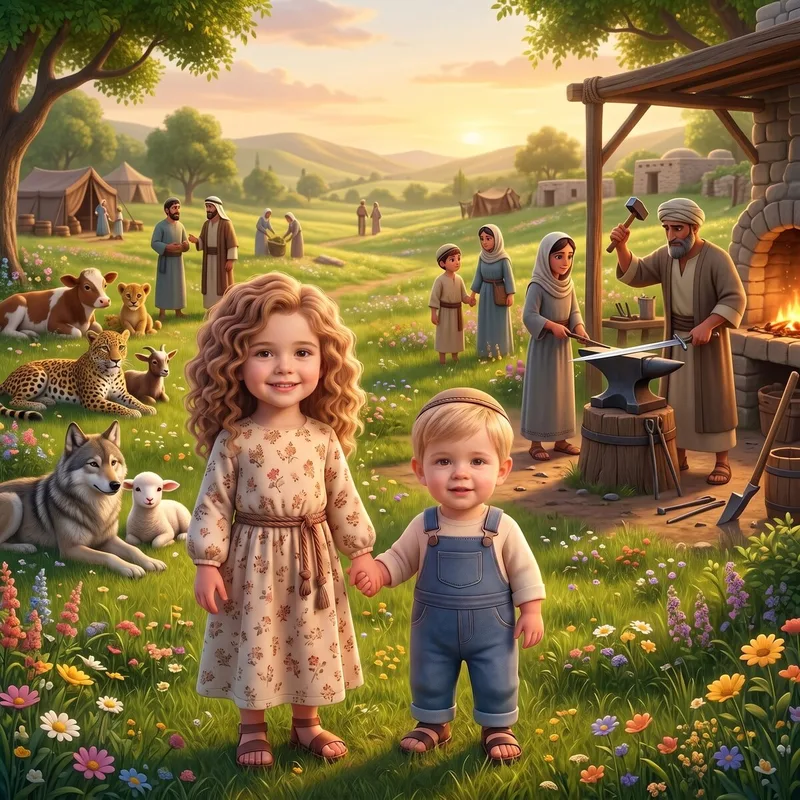
The pasuk says the wolf will dwell with the lamb, and the leopard will lie down with the young goat. The calf, the young lion and the fatling will be together, and a small child will lead them (Yeshayahu 11:6).
It goes on: the cow and the bear will graze together, their young will lie down side by side, and the lion will eat straw like the ox (11:7). Animals that never lived in peace will rest together, and no one will be afraid.
Then Yeshayahu says why. They will not harm and will not destroy on all of My holy mountain, for the earth will be filled with da'as Hashem as the waters cover the sea (11:9). For children, that is the heart of the story: the peace does not come from strength, it comes from knowing Hashem.
We tell it to children the way the pasuk says it, and leave how it will all unfold to Hashem and to our rabbanim. If your child asks a hard question, "ask Totty to check with a rav" is a perfectly good answer.
What is the lesson of the Vision of Peace?
There are three things a child can take from it, each tied to the words of the pesukim.
- Peace has a source. The pasuk connects the quiet of the world to the world being filled with da'as Hashem. Where Hashem's ways are known, people stop hurting each other.
- We hope for a better world. The days of Moshiach are something we look forward to and express in Ani Maamin. Children can learn to hope without being afraid.
- Peace starts small. We cannot make a wolf rest next to a lamb, but a child can make a quiet moment with a sibling, share a turn, or say sorry first. That is a middah worth practicing in the spirit of the vision.
The same theme of caring for each other runs through Loving Every Yid, a good companion to read after this story.
How do I explain the Vision of Peace to a 4-year-old, a 6-year-old and an 11-year-old?
Ages 3-4: Keep it to a few sentences. "One day Hashem will make the whole world peaceful. The wolf and the lamb will rest together, and nobody will get hurt. A little child will lead them." Let them act out the animals if they like.
Ages 5-7: Add the reason. "The pasuk says the world will be full of knowing Hashem, like the water fills the sea." Ask which animal they think finds it hardest to be calm, and what it would take. Then link it to home: what helps when two kids both want the same thing?
Ages 9-12: Show the two chapters side by side: nations putting down swords in chapter 2, and the animals in chapter 11. Ask why the pesukim put Torah going out from Tzion right next to peace. You can also mention that the haftarah of the last day of Pesach, Yeshayahu 10:32 to 12:6, includes this vision. Our Pesach story for kids is a nice way to link the two.
Questions to ask at the Shabbos table
These are all talking questions, so they suit a Shabbos meal or a long Yom Tov afternoon.
- Which animal in the vision surprises you most, and why?
- What does the pasuk say is the reason for the peace?
- Who leads the animals, and what do you think that says?
- What is something that makes it hard to be peaceful in our house, and what could help?
- If swords become plowshares, what would you want to grow?
If you need a one-sentence version for a young child, try: "Yeshayahu told us that one day the world will be so full of knowing Hashem that even the wolf and the lamb will rest together."
What is a personalized Torah Tale book of the Vision of Peace like?
In a Torah Tale book, your child is the hero. Their name and, from one uploaded photo, their likeness appear on every page, illustrated in high-resolution 3D animated-film style. This story comes from the Nevi'im collection, and up to eight siblings (ages 0-18) can appear in the same book, which suits a story about getting along.
Every book is written with careful rabbinical guidance and strict tznius, and reviewed by our team before it goes to print. Every book also ends with a discussion page of 10 questions about the story, mixing comprehension with middos, which turns it from something read to a child into something talked about at the table. If you add parents, grandparents or other relatives, they appear with the children on a closing family page, in every format.

Softcover 8″×8″

Hardcover 8″×8″

Board book 6″×6″

Coloring book 8.5″×11″
Choose by age: the 6x6 board book with rounded safety corners for ages 0-4, the 8x8 softcover photo book for ages 4-8, or the 8x8 hardcover photo book for ages 5-18. The softcover and hardcover open with a dedication page. Reading the book is just right for Shabbos and Yom Tov.
A weekday activity after reading
Coloring is melacha, so the optional matching coloring book (8.5"x11", black-and-white line art, a one-time add-on to a book) is for weekdays only: erev Shabbos, a weekday afternoon, the days before a Yom Tov, or Chol HaMoed. It is never for Shabbos or Yom Tov.
On a weekday, let your child color the scene and then retell the Vision of Peace in their own words. Ask them to pick one thing they will do to make things calmer at home this week.
Ready to make it? Create the book. It takes a free account and a few short questions (each child's name, boy or girl, age and one photo, any siblings, the story, your community, the language and the format), and about five minutes. Our guide on how to create a personalized Torah storybook walks through each step.
Frequently asked questions
What is the Vision of Peace in Sefer Yeshayahu?
It is Yeshayahu's prophecy of a future time of peace. In chapter 2 the nations stop making war and turn their swords into plowshares, and in chapter 11 the wolf dwells with the lamb and a small child leads them. The pasuk says the earth will be filled with da'as Hashem, and the meforshim connect this vision to the days of Moshiach.
What is the lesson of the wolf and the lamb for children?
The pasuk itself links the peace to knowing Hashem, so a child can learn that real peace grows where Hashem's ways are known and kept. It also gives children hope that a world without hurting is something Hashem promised. A practical middah to draw from it is working on peace at home, with siblings and friends, now.
How do I explain the Vision of Peace to a 4-year-old?
Keep it short and concrete: one day Hashem will make the whole world peaceful, and animals that never got along will rest together, with nobody getting hurt. Name the wolf and the lamb, and mention the small child who leads them. Then ask what your child does when a friend wants the same toy, so the idea connects to their day.
Is the Vision of Peace read on any Yom Tov?
Yes. The haftarah for the last day of Pesach is Yeshayahu 10:32 to 12:6, which includes the chapter 11 vision of the wolf and the lamb. Families can mention this to older children as a way to connect the vision to the Yom Tov.
Which Torah Tale format suits the Vision of Peace book?
Choose by your child's age: the 6x6 board book with rounded safety corners is for ages 0-4, the 8x8 softcover photo book is for ages 4-8, and the 8x8 hardcover photo book is for ages 5-18. Age is one of the short questions when you create the book. Every book ends with a discussion page of 10 questions and, if you add relatives, a closing family page.
Can I use the coloring book on Shabbos?
No. Coloring is melacha, so the optional matching coloring book is for weekdays, such as erev Shabbos, a weekday afternoon or Chol HaMoed. The storybook itself is different, and reading it at the Shabbos table or on a long Yom Tov afternoon is exactly right.