Standing Up for an Older Person (מפני שיבה תקום) for Kids
Mifnei seiva takum is a mitzvah a child can keep today, in public, with nothing but his own two feet. Here is what the pasuk says, what Rashi adds about the words v'yareisa me'Elokecha, how to explain it to a 4-year-old and to a 10-year-old, and five questions for the Shabbos table.
Published by Torah Tale.
Create this book for your child
מפני שיבה תקום is the mitzvah of standing up for an older person. The Torah states it in Parshas Kedoshim: "מפני שיבה תקום והדרת פני זקן ויראת מאלקיך אני ה'" (Vayikra 19:32). Stand up before a gray head, show honor to the face of a zaken, and fear Hashem. Children take to this one quickly, because it is a mitzvah they can keep this afternoon, in public, with nothing but their own two feet.
What does the mitzvah of mifnei seiva takum actually say?
The pasuk has two halves. The first, מפני שיבה תקום, speaks about שיבה, gray hair, which Chazal understand as a person who has reached seventy years. The second, והדרת פני זקן, speaks about a זקן, which Rashi explains as one who has acquired Torah wisdom, a talmid chacham, whatever his age.
The Gemara in Kiddushin (32b-33a) works through both halves, and the halacha is that we rise for both: for the elderly person and for the talmid chacham. Halacha also discusses the practical shape of it, such as standing as the person comes within four amos and sitting once he has passed. Those details belong to your rav, not to a blog post, and a child does not need them before he needs the habit.
What a child does need to hear is the simple version: when an older person comes near, you get up. Not because he asked. Because Hashem said so.
What happens in the Torah Tale story?
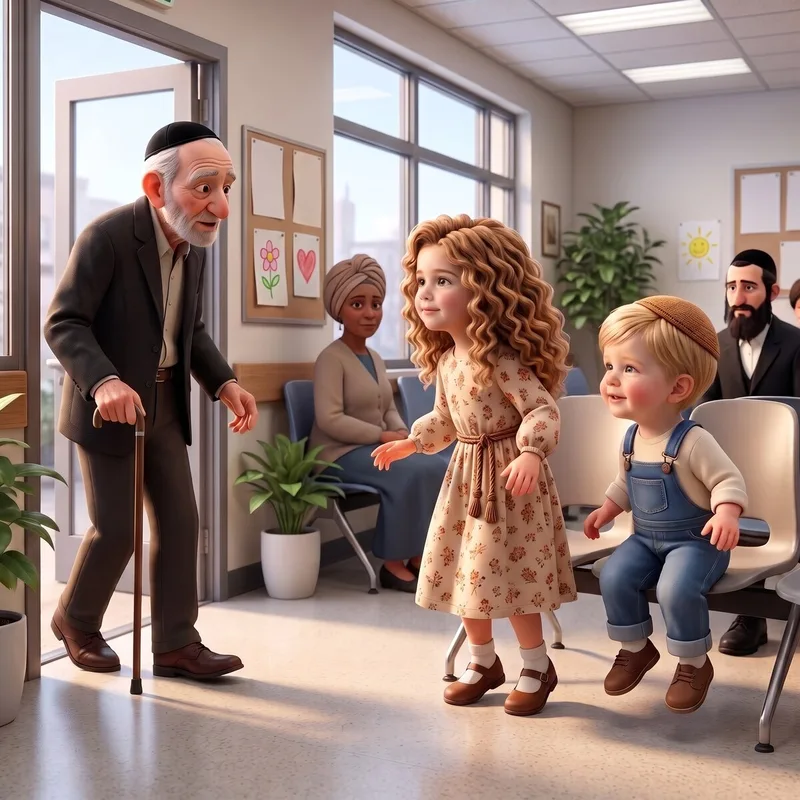
Standing Up for an Older Person belongs to Torah Tale's Mitzvos collection, which takes the mitzvos a child keeps and sets them in everyday life today rather than in a far-away time. So the mitzvah appears where a child actually meets it: in shul when an older man makes his way slowly to his seat, on the bus, in the grocery aisle, at a family simcha when a great-grandfather comes through the door.
The drama in a story like this is deliberately small. Nobody announces anything. The child is in the middle of something he cares about, he notices somebody older coming, and he stands. That is the whole plot, and children feel the weight of it precisely because they recognize the moment. They have all been in it.
Why the pasuk ends with "v'yareisa me'Elokecha"
This is the part worth saying out loud to an older child. Rashi on the pasuk explains that the Torah adds ויראת מאלקיך here because this is a mitzvah no one else can check. Nobody can prove that you saw the older person walking in. You can look down at your siddur, or get very interested in your shoelace, and not one person in the room will ever say a word.
Only the child himself knows whether he noticed and chose not to notice. That is why the Torah signs the mitzvah with yiras Shamayim. It is the same quiet territory as shemiras halashon: what you do when nothing is riding on it except Hashem knowing.
How to explain it to a 4-year-old, a 7-year-old and a 10-year-old
Age 3 to 4: keep it physical. "When somebody with white hair comes near us, we stand up. Hashem said older people are special." Then practice it once, at home, in a game: a parent walks past, the child pops up. Little children learn this mitzvah with their legs first, which is fine.
Age 6 to 7: add the reason. An older person has kept mitzvos, davened and lit Shabbos candles for seventy years or more. Standing up is how we say: all those years count for something, and we see them. At this age children also start noticing that adults do not always do it, and it is worth saying plainly that a mitzvah is a mitzvah whether or not the room is doing it.
Age 9 to 12: bring in the pasuk itself and Rashi's point about ויראת מאלקיך. Ask them why the Torah needed to add yiras Shamayim to a mitzvah that looks so easy. Most children get there on their own within a minute, and the answer they produce themselves is worth far more than the one you hand them.
What a personalized Torah Tale book of this story is like
Torah Tale prints the story with your own child as the one standing up. Their name and their likeness, built from a single uploaded photo, appear on every page, illustrated in high-resolution 3D animated-film style. Up to eight siblings can be in the same book, ages 0 to 18, which matters here: when the older brother is the one who stands, the younger one copies him for a week.

Softcover 8″×8″

Hardcover 8″×8″

Board book 6″×6″

Coloring book 8.5″×11″
The formats are a 6"x6" board book with rounded safety corners for ages 0-4, an 8"x8" softcover for ages 4-8, and an 8"x8" hardcover for ages 5-18. The softcover and hardcover open with a dedication page, and if you add parents and grandparents with their photos, they appear with the children on a closing family page in every format. For this particular mitzvah, that page does quiet work of its own.
Every book ends with a dedicated discussion page carrying 10 questions about the story, mixing comprehension with middos: what happened, and what it asks of the child. Books are ordered one at a time, or as a collection subscription on a monthly or yearly plan, four books a month in one delivery from that collection. A one-time order with US standard shipping arrives in about 12 business days, and we ship worldwide, with rates shown at checkout.
Five questions for the Shabbos table
Reading and talking are exactly right for Shabbos, so bring the book to the table and use these after the story:
- Who is the oldest person you know? What have they seen that you have not?
- Why do you think Hashem asked us to stand up, and not just to think nice thoughts about older people?
- Has anyone ever stood up for you? How did it feel?
- What makes it hard to stand up sometimes, even when you know you should?
- Rashi says nobody can tell whether you really saw the person coming. So why do it anyway?
Then give everyone one sentence to carry into the week: "If somebody older walks in, I stand." That is the whole mitzvah in seven words, and a child can hold it.
One practice for the week, and one for erev Shabbos
During the week, pick one place the family passes through regularly, in shul, at a bus stop, in the lobby of a building, and make it the spot where everyone practices. One place, consistently, beats a general resolution to be respectful. Pair it with a visit: bringing something over to an older neighbor is in the spirit of bikur cholim and of this mitzvah at the same time.
For a weekday afternoon or erev Shabbos, when coloring is permitted, the matching 8.5"x11" black-and-white coloring book lets a younger child go back over the scenes at their own pace while the story is still fresh. Keep it to weekdays and the hours before Shabbos.
If grandparents are part of this conversation in your home, our article on Bubby & Zaidy and Me pairs naturally with this one, and the mitzvah's home in the Torah is laid out in Parshas Kedoshim for kids.
Creating a book takes about five minutes: a free account and a few short questions, each child's name, boy or girl, age and one photo, any siblings, the story, your community (asked once), the language, English, Hebrew or Yiddish, and the printed format. You can create the book now and have your child read about the day he stood up, with his own face on the page.
Frequently asked questions
What does מפני שיבה תקום mean?
It means "stand up before a gray head." The pasuk in Vayikra 19:32, in Parshas Kedoshim, says "מפני שיבה תקום והדרת פני זקן ויראת מאלקיך אני ה'": stand up for an older person, show honor to the face of a zaken, and fear Hashem. It is a mitzvah of the body as much as of the heart, because respect that stays inside and never moves a chair is not what the Torah asked for.
At what age do you stand up for someone?
Chazal understand שיבה as a person who has reached seventy years, and the halacha is to stand for such a person. The second half of the pasuk, והדרת פני זקן, is understood as a talmid chacham, someone who has acquired Torah wisdom, and he is honored whatever his age. The practical details, such as how close the person must be and when you may sit down again, are discussed in halacha, so ask your rav.
How do I explain this mitzvah to a 4-year-old?
Say it in one sentence: "When somebody with white hair comes near, we stand up, because Hashem told us that older people are special." Then practice it once at home, with a parent walking past and the child standing. Four-year-olds learn this mitzvah with their legs long before they can explain it, and that is exactly the right order.
Why does the pasuk end with the words "and you shall fear your God"?
Rashi on Vayikra 19:32 explains that nobody else can know whether a person really noticed the older man walking in or honestly did not see him. A child can look down at the siddur, or suddenly become very busy with his coat, and no one will ever accuse him of anything. Because the mitzvah is left entirely to the heart, the Torah attaches ויראת מאלקיך to it.
Do children stand up for their parents and their rebbi too?
Honoring parents and honoring one's rebbi are their own mitzvos with their own halachos, separate from מפני שיבה תקום, and they apply whatever the parent's or rebbi's age. In practice the respect looks similar to a child: you stand, you make room, you do not sit in his seat. Ask your rav about the details that apply in your home and in your child's classroom.
Is there a children's book about this mitzvah?
Yes. Torah Tale's Standing Up for an Older Person is part of the Mitzvos collection, written with careful rabbinical guidance and set in everyday life today, and the child who receives it is the hero of the story, with their name and their likeness from one uploaded photo on every page. It comes as a 6"x6" board book with rounded safety corners for ages 0-4, an 8"x8" softcover for ages 4-8, or an 8"x8" hardcover for ages 5-18, in English, Hebrew or Yiddish.