Visiting Someone Sick (Bikur Cholim) for Kids: How to Explain the Mitzvah
Bikur cholim is a mitzvah even a young child can keep. Here is where it comes from, how to explain it to a 3-4 year old, a 6-8 year old and a 9-12 year old, and what to do when a visit is not possible.
Published by Torah Tale.
Create this book for your child
Bikur cholim, visiting someone who is ill, is a mitzvah children understand quickly because it is so concrete: someone is not well, and you go to cheer them up. It lands with young children because they already know how it feels to be sick, and they can do something real about it with a short visit, a few kind words and a tefillah.
What is bikur cholim, in simple words?
Bikur cholim means going to see a person who is unwell, finding out how they are, and helping if there is something they need. It is not only about being polite. It is a mitzvah, and part of it is making the sick person feel that someone is thinking of them.
The halacha also teaches that a visitor davens for the person who is ill. So the mitzvah is a visit, a bit of help and a tefillah together. If your child wants to know exactly what to say, ask your rav for the wording you use at home.
Where does bikur cholim come from in the Torah?
Chazal learn it from Avraham Avinu. In Parshas Vayeira the Torah tells us that Hashem appeared to Avraham in Elonei Mamre, as Avraham sat at the entrance of his tent in the heat of the day. Rashi, following Chazal, explains that this was to visit the sick, because Avraham was recovering from his bris milah.
The Gemara in Sotah (14a) uses this to teach the mitzvah of walking in Hashem's ways: just as Hashem visited the sick, so should we. For children this is a lovely idea, because the example comes from Chazal's picture of Hashem's own ways, and it was given for Avraham Avinu, the model of chesed. You can read more about that parsha in our article on Parshas Vayeira for kids.
What did Rabbi Akiva teach about visiting the sick?
The Gemara in Nedarim relates that a talmid of Rabbi Akiva fell ill and no one came to see him. Rabbi Akiva went in to visit, and the floor was swept and sprinkled for him. The talmid told him, 'Rebbi, you have given me life.'
Rabbi Akiva then taught that someone who does not visit the sick is like one who sheds blood. This is strong language, and it tells us how serious it is to leave a person alone in their illness.
For a child, the point to take is simple. A visit can help, and sometimes the help is as plain as tidying a room or sitting nearby.
How do I explain bikur cholim to a 3-4 year old, a 6-8 year old and a 9-12 year old?
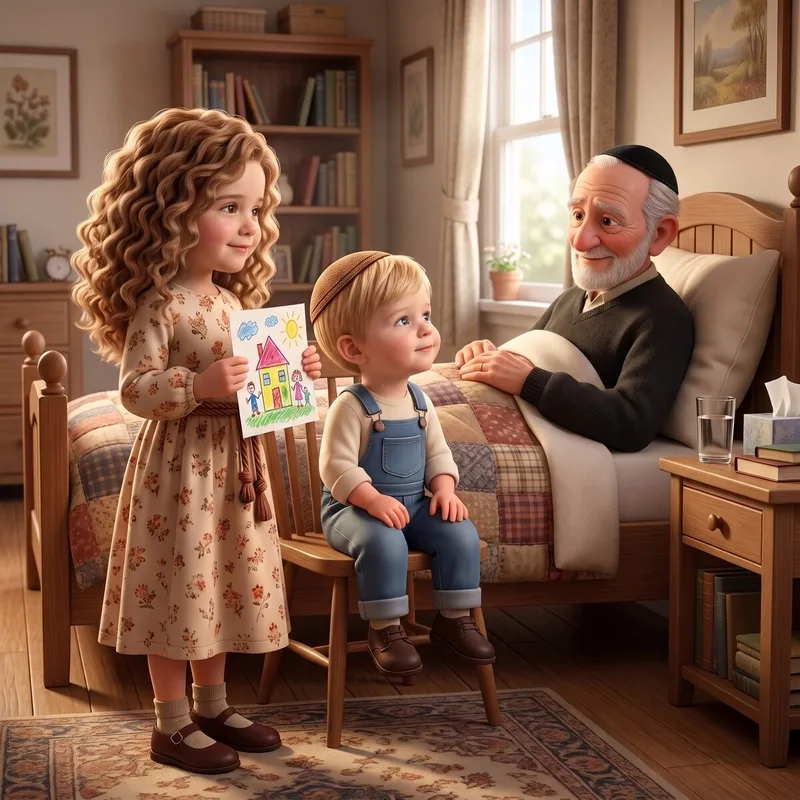
Ages 3 to 4. Use one sentence and one action. 'Zeidy is not feeling well. We are going to say hello and give him your picture.' Practice one line together, such as 'I hope you feel better,' and keep the visit short.
Ages 6 to 8. Tell the story of Avraham Avinu after his bris, and say that Chazal learn bikur cholim from it. Talk about what helps a sick person: quiet, a friendly face, a small job done for them. Ask, 'What would you want if you were stuck in bed?'
Ages 9 to 12. Bring in Rabbi Akiva and his talmid. Talk about reading the room: some people want company, and some are very tired and need rest. Older children can also learn that the mitzvah includes davening for the person, and that they can keep it even when a visit is not possible, with a card, a message through a parent and a tefillah.
What if the person is contagious, or a visit is not possible?
Children should not be taken to every sickbed. If the illness spreads easily, if the person is very weak, or if the family has asked for quiet, ask your rav what is right. A thoughtful no is part of the mitzvah, since the goal is to help.
There are still ways to keep the spirit of bikur cholim:
- Make a card on a weekday and have a parent pass it along.
- Ask a parent to give the person your good wishes.
- Say a tefillah for them by name.
- Offer to help the family, for example with a small job at home.
Cards and drawings are for weekdays or erev Shabbos, since drawing and writing are not done on Shabbos or Yom Tov.
What is a personalized Bikur Cholim book like?
The Visiting Someone Sick (ביקור חולים) book is part of our Mitzvos collection, which is about the mitzvos a child keeps, set in everyday life today. Your child is the hero: their name and, from one uploaded photo, their likeness appear on every page, in 3D animated-film style. Up to eight siblings can appear in the same book.
Every book is written with careful rabbinical guidance and strict tznius, and reviewed by our team before it goes to print. Reading it is entirely appropriate on Shabbos, so it can sit on the table with your other Shabbos books. If you add parents and grandparents with their photos, they appear with the children on a closing family page in every format.

Softcover 8″×8″

Hardcover 8″×8″

Board book 6″×6″

Coloring book 8.5″×11″
The formats are the 6x6 board book with rounded safety corners (ages 0-4), the 8x8 softcover (ages 4-8) and the 8x8 hardcover (ages 5-18). Softcover and hardcover open with a dedication page. A matching coloring book is an optional add-on, and it is for weekdays: erev Shabbos, a weekday afternoon or Chol HaMoed, never Shabbos or Yom Tov.
What can we talk about at the Shabbos table?
Every Torah Tale book ends with a dedicated discussion page of 10 questions, mixing comprehension with middos. That means the book is something you talk about, and not only something you read to your child. Even without the book, these questions are good Shabbos-table talk, and nothing needs to be written or drawn:
- Who do we know who is not feeling well right now?
- What do you like when you are sick? What do you not like?
- Why do you think Chazal learn this mitzvah from Avraham Avinu?
- What could you say in a visit that would make someone smile?
- When might it be better to send a card than to come?
- How can we daven for someone together right now?
Let the children answer first. A small child's answer often shows what they understand about kindness, and it gives you a way to praise the middah, not only the answer.
The same table is also a good place to talk about how we speak to and about people who are unwell. Our article on guarding my tongue goes into that, and loving every Yid covers the care for others that bikur cholim grows from.
How do we order a book for this story?
Creating a book takes about five minutes. You open a free account and answer a few short questions: each child's name, boy or girl, age and one photo, any siblings, the story, your community (asked once), the language and the printed format. Books are available in English, Hebrew and Yiddish.
You can order a single book, or a collection subscription to the Mitzvos collection if you would like more of its books over time. When you are ready, you can create the book and make the mitzvah of bikur cholim a story your child lives in.
Frequently asked questions
What is bikur cholim and why is it a mitzvah?
Bikur cholim means visiting a person who is ill, to see what they need and to cheer them. Chazal learn it from Avraham Avinu: the Torah tells us that Hashem appeared to him in Elonei Mamre, and Rashi explains, based on Chazal, that Avraham was recovering from his bris milah and this was a visit to the sick. The Gemara in Sotah (14a) teaches that we are to follow Hashem's ways, and so we visit the sick too.
How do I explain bikur cholim to a 4-year-old?
Keep it to one picture and one sentence: 'Someone is not feeling well, and we go to say hello so they feel happy.' Let your child choose something small to bring, such as a card made on a weekday or a flower from a parent. Rehearse one thing to say, like 'I hope you feel better,' so the visit feels easy.
Can young children visit someone who is sick?
Sometimes, but it depends on the illness, the person's energy and whether it is contagious, so ask your rav when in doubt. A short visit, a quiet child and a call ahead to see if it is a good time all help. When a visit is not right, a card, a message passed along by a parent, and a tefillah still keep the spirit of the mitzvah.
What should a child say or do when visiting someone sick?
Greet the person warmly, ask how they are feeling, and offer to help with something small. Keep the visit short and let the person lead, because a tired person may want quiet. The halacha also adds that the visitor davens for the sick person, so end with a warm wish for a refuah sheleimah.
Is there a personalized Torah book about visiting the sick?
Yes. Torah Tale has a Visiting Someone Sick (ביקור חולים) book in its Mitzvos collection, set in everyday life today and starring your child. Creating it takes a free account and a few short questions, and it ends with a discussion page of 10 questions about the story.