Parshas Kedoshim for Kids: Be Holy & the Corner of the Field
Parshas Kedoshim is the parsha where Hashem tells every single Yid, all together, "You shall be holy." Then it fills in what holy actually looks like: leaving the corner of your field for the poor, paying a worker on time, not carrying tales, standing up for an older person, and loving your fellow Yid like yourself.
Published by Torah Tale.
Create this book for your child
Parshas Kedoshim is the parsha where Hashem says two words that a child can carry for life: Kedoshim tihiyu, you shall be holy. And then, instead of leaving it abstract, the Torah spends the rest of the parsha explaining exactly what holy looks like. Leave the corner of your field for the poor. Do not hold back a worker's wages overnight. Do not carry tales. Stand up when an older person walks in. Love your fellow Yid like yourself. For children, this is one of the most usable parshiyos in the Chumash, because almost every mitzvah in it is something they can do before bedtime tonight.
What happens in Parshas Kedoshim?
Hashem tells Moshe Rabbeinu to speak to the entire congregation of Bnei Yisrael. Rashi points out that this parsha was said b'hakhel, with everyone gathered, because most of the body of the Torah depends on what is in it. This was not a message for the Kohanim alone or for the leaders alone. It was for every man, woman and child standing there.
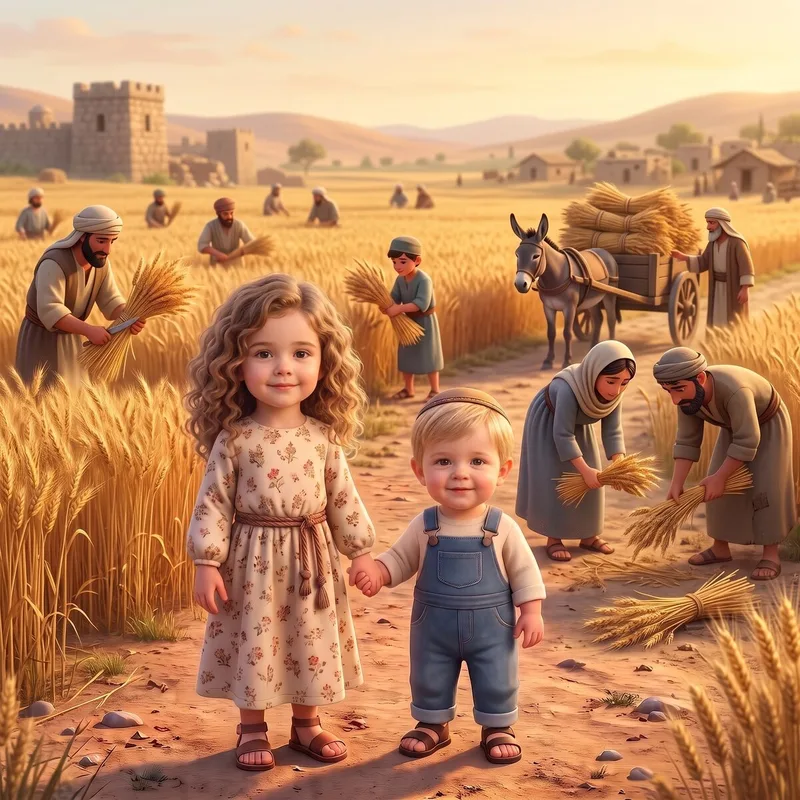
What follows is a long stream of mitzvos, most of them short, most of them about other people. Respect your mother and father. Keep Shabbos. Do not turn to idols. When you harvest your field, do not reap all the way to the edge: leave a corner, pe'ah, for the poor. Stalks that fall as you cut, leket, stay on the ground for the poor. Grapes that drop in the vineyard, peret, and the small unformed clusters, olelos, are not yours to gather. The poor person walks in and takes them himself, with no one handing him anything and no one watching him do it.
Then: do not steal, do not deny, do not lie to one another. Do not hold back a worker's wages overnight. Do not curse a deaf person, who cannot even hear you doing it, and do not place a stumbling block before a blind person. Rashi explains that this last one includes giving someone advice that is harmful to him and useful to you, because he cannot see what you are really doing.
Do not judge unfairly. Do not go about as a talebearer. Do not hate your brother in your heart. Do not take revenge and do not bear a grudge. And then the pasuk that Rabbi Akiva called a klal gadol baTorah, a great principle of the whole Torah: v'ahavta l'reiacha kamocha, love your fellow Yid like yourself.
The parsha also teaches honest weights and measures, the mitzvah of orlah (not eating the fruit of a new tree for its first three years), and the mitzvah to rise before an older person and honor a talmid chacham.
What does "be holy" mean for a child?
Children often assume holiness means something far away: a Kohen Gadol, a Beis HaMikdash, a sefer Torah behind a curtain. Parshas Kedoshim says something different. Hashem tells ordinary people, standing in an ordinary crowd, that they are supposed to be holy, and then lists what to do with their fields, their money, their mouths and their feet.
So the working definition to give a child is this: kedusha means not taking everything you could take. The farmer could reap the whole field. He leaves a corner. The person who knows a juicy piece of news could tell it. He keeps it. The one who was hurt last week could get back at the person this week. He does not. Holiness in this parsha is mostly made of the things a Yid chooses not to do.
That connects naturally to the lesson of tzaraas and the power of words earlier in Sefer Vayikra. Kedoshim gives the positive instruction that Tazria-Metzora gives the warning about.
How to explain Parshas Kedoshim at different ages
Ages 2 to 4
Pick one picture and stay with it: the farmer in his field. "The farmer cut all his wheat, but Hashem said to leave a little corner growing, so a poor family could come and take some. Hashem wants us to always leave a little for someone else." Then make it real at snack time by leaving a bit of their nosh for a sibling.
Ages 5 to 7
Teach the pasuk itself. V'ahavta l'reiacha kamocha, say it with them, and explain it as: the way you want to be treated is the way you treat somebody else. Add the mitzvah of standing up for an older person, because it is visible, physical, and a five-year-old can do it this Shabbos when a grandparent or an older neighbor comes in.
Ages 8 to 12
This age can handle the harder ones. Explain lo sikom v'lo sitor: revenge is refusing to lend him your bike because he did not lend you his, and holding a grudge is lending it while saying "see, I am not like you." Both are forbidden. Explain lifnei iver with Rashi's case of bad advice. And explain "do not hate your brother in your heart" as the Torah's instruction to speak to the person rather than quietly resenting him.
Mitzvos from Kedoshim your child can keep this week
- Leave a corner. Put aside part of an allowance or some snacks for tzedakah before the week is over.
- Stand up. Rise when a grandparent, a rebbi or an older neighbor walks into the room.
- Return it. Find one thing in the house that belongs to a sibling and give it back without being asked.
- Hold the story. Choose one piece of news about another child that they will not repeat at the Shabbos table.
- Pay on time. If you pay children for chores, pay the day they do it, and tell them which pasuk you are keeping.
Shabbos table questions for Parshas Kedoshim
- Why did Hashem say this parsha to everybody at once instead of only to the leaders?
- Why does the poor person pick up the leket himself instead of the farmer handing it to him?
- Why would the Torah need to tell us not to curse someone who cannot even hear us?
- What is the difference between taking revenge and holding a grudge?
- Rabbi Akiva said v'ahavta l'reiacha is a klal gadol baTorah. What do you think he meant?
- Name one mitzvah in this parsha that you kept this week without realizing it.
If the conversation keeps going, that is exactly the point. Every Torah Tale book ends with a dedicated discussion page carrying ten questions about the story, mixing comprehension with middos, so the book becomes something talked about at the table rather than only read aloud.
What a personalized Parshas Kedoshim book is like
In a Torah Tale book, your child is the hero of the parsha. Their name is in the text, and their likeness, illustrated in high-resolution 3D animated-film style from one photo you upload, appears on every page: standing in the crowd when Moshe Rabbeinu says Kedoshim tihiyu, at the edge of the field where the pe'ah is left, holding back the words that were not worth repeating. Up to eight siblings can appear in the same book.
Kedoshim is a parsha of many small mitzvos rather than one dramatic scene, which is precisely why seeing yourself inside it helps. A child who watches himself leave the corner of the field remembers the mitzvah differently than a child who hears about a farmer he has never met.

Softcover 8″×8″

Hardcover 8″×8″

Board book 6″×6″

Coloring book 8.5″×11″
Choose the format by age: the board book at 6"x6" with rounded safety corners for ages 0 to 4, the softcover 8"x8" for ages 4 to 8, or the hardcover 8"x8" for ages 5 to 18. Books come in English, Hebrew or Yiddish, and you can order more than one language. There is also an optional matching coloring book in black-and-white line art, which belongs to erev Shabbos, a weekday afternoon or Chol HaMoed, since coloring is melacha and not for Shabbos or Yom Tov. The storybook itself is perfect Shabbos reading.
In many years Acharei Mos and Kedoshim are read together, and a double-parsha week produces one book covering both. If you want the background on the first half, see Parshas Acharei Mos for Kids. The book creator always suggests next week's parsha with a live countdown to the order deadline for delivery before that Shabbos, and this guide walks through how to pick.
Creating the book takes about five minutes and a few short questions: name, boy or girl, age, one photo, siblings, story, your community, language and format. Every book is written with careful rabbinical guidance and strict tznius and reviewed by our team before printing. Create your child's Parshas Kedoshim book and let them see themselves keeping the mitzvos that make a Yid holy.
Frequently asked questions
What is Parshas Kedoshim about in simple terms?
Parshas Kedoshim is Hashem's instruction to the Jewish people to be holy, followed by a long list of mitzvos that show what holiness looks like in everyday life. It includes honoring parents, keeping Shabbos, leaving part of the harvest for the poor, paying workers on time, using honest weights, not speaking lashon hara, and loving your fellow Yid like yourself. Most of the mitzvos in the parsha are about how a person treats other people.
What is the lesson of Parshas Kedoshim for children?
The lesson is that being holy is not something that happens only in shul or only on Shabbos. Parshas Kedoshim teaches that a Yid becomes holy through ordinary moments: sharing, returning what is not yours, speaking carefully about others, and respecting parents and elderly people. Children can keep mitzvos from this parsha on a regular Tuesday afternoon.
How do I explain "v'ahavta l'reiacha kamocha" to a 5-year-old?
Say it like this: "Hashem says to love another Yid the same way you love yourself." Then make it concrete with something the child knows, such as not wanting to be left out of a game, and therefore not leaving someone else out. Young children understand the mitzvah best as a rule about fairness: what you would not want done to you, do not do to somebody else.
What is the mitzvah of lifnei iver in Parshas Kedoshim?
The pasuk says not to place a stumbling block before a blind person. Rashi explains that this includes giving someone advice that is bad for him while it happens to be good for you, because he cannot see the trap you set. For children it means not setting another child up to fail, not hiding something so a sibling gets blamed, and not talking a friend into doing something they will be punished for.
Is Parshas Kedoshim read together with Acharei Mos?
In many years Acharei Mos and Kedoshim are read together as a double parsha, and in other years they are read separately. When they are read together, a Torah Tale book for that week covers both parshiyos in one book.
Which Torah Tale format is right for my child for a parsha book?
Torah Tale offers a board book at 6"x6" with rounded safety corners for ages 0 to 4, a softcover photo book at 8"x8" for ages 4 to 8, and a hardcover photo book at 8"x8" for ages 5 to 18. There is also an optional matching coloring book in black-and-white line art, which is a weekday activity since coloring is melacha on Shabbos and Yom Tov.