Parshas Tazria-Metzora for Kids: Tzaraas, the Two Birds & Coming Home
Tazria-Metzora is the double parsha that teaches children what words can do. Here is how to retell it so it lands warmly instead of scaring anyone, with age-by-age scripts and ten minutes of Shabbos table talk.
Published by Torah Tale.
Create this book for your child - Parshas Tazria · Create this book for your child - Parshas Metzora
Parshas Tazria-Metzora is the double parsha in Sefer Vayikra that teaches children what words can do. It describes tzaraas, a mark that Hashem could send onto a person's skin, onto clothing, or onto the walls of a house, and the careful process by which a Kohen looked at the mark, waited, decided, and later brought the person back in. Chazal teach that tzaraas came mainly for lashon hara. That single idea, taught gently, turns a parsha that sounds technical into one of the most practical parshiyos of the year for a family with children.
What happens in Parshas Tazria-Metzora?
Tazria begins with the korbanos a mother brings to the Mishkan after a baby is born, and with the mitzvah of bris milah on the eighth day. Then the parsha turns to its main subject.
A person notices a white patch on his skin. He does not treat it and he does not ignore it. He goes to the Kohen. The Kohen looks at the mark closely: how white it is, whether the hair inside it turned white, whether it is spreading. Sometimes the Kohen can decide right away. Often he closes the person in for seven days, looks again, and only then decides.
If the Kohen declares the person tamei, that person leaves the three camps and sits outside, alone, until the mark goes. Chazal explain the measure: he used his words to separate one person from another, so he sits separated himself. Tzaraas could also appear on a garment, in which case the Kohen examined the cloth the same way.
Parshas Metzora picks up at the good part. The mark has healed, and now the person comes back. The Kohen goes out to him, outside the camp, to see him. Then comes a process with two kosher birds, a piece of cedar wood, a thread of crimson wool and ezov. One bird is slaughtered (shechted) and the other is set free over an open field. The person washes, waits, brings his korbanos, and rejoins the people.
At the end, the parsha describes tzaraas on a house in Eretz Yisrael. A greenish or reddish mark appears in the wall, the Kohen comes to look, the household's belongings are taken out first, and if the mark stays, the stones are removed. The Midrash relates that sometimes this was a kindness in disguise: the Emori nations had hidden gold inside those walls before the Yidden came, and taking the house apart is how it was found.
Is tzaraas a sickness? How do I explain it without scaring my child?
Say plainly, in the first sentence, that tzaraas was not an illness and was not catching. Children will assume otherwise if you do not say it, and a worried child stops listening to the rest.
The way it is taught in cheder and in a frum home is this: tzaraas was a message. Hashem loved the Yidden enough to send a visible sign when something had gone wrong in how a person spoke. A doctor could not help, and no cream could remove it, because the mark was not about skin. That is also why only a Kohen could declare tamei or tahor. The Kohen was not a dermatologist. He was the one who said the words.
Children find the order of events comforting once they hear it: the mark came, the person thought about what he had said, the mark went, and the Kohen walked out of the camp personally to bring him home. Nobody stayed outside forever. If you want the fuller treatment of each half on its own, we have written separately on Parshas Tazria and Parshas Metzora.
What is the lesson of Tazria-Metzora?
Chazal read the word metzora as motzi shem ra, one who brings out a bad name about another person. That is the lesson, and it is unusually concrete.
Rashi draws out the taharah itself. The person brings birds, because birds chirp and chatter all day, and his sin was chatter. He brings cedar, the tallest tree, because he held himself high above the person he spoke about. He brings ezov, a low little plant, because the way back is to make yourself small again. A seven-year-old can hold all three of those pictures in his head.
There is a second lesson hiding in the Kohen's week of waiting. He did not rush. He looked, he waited seven days, he looked again. A parsha about careless speech is built around a person who refuses to speak until he is sure. That contrast is worth pointing out at the table.
How do I explain Tazria-Metzora to a 4-year-old, an 8-year-old and a 12-year-old?
Ages 2 to 4. Keep it to one sentence and one picture. "Long ago, if someone said unkind words about a friend, Hashem sent a white mark so he would notice, and when he was sorry the mark went away and the Kohen brought him home." Do not describe the mark in detail. End on coming home.
Ages 5 to 8. Add the Kohen and the waiting. Describe him looking carefully, closing the person in for seven days, and looking again. Add the two birds: one is shechted, one flies away free. Then ask the child what the birds might be hinting at, and let him guess before you give Rashi's answer.
Ages 9 to 12. This is the age for the full structure: tzaraas on a house first, then on clothing, then on the body, a warning that moves closer and closer. Add Miriam, whom the Torah tells us to remember in Parshas Ki Seitzei, and the fact that she waited and the whole nation waited with her. Ask the harder question: why would a person who spoke badly about someone need to sit alone, rather than pay a fine or bring a korban straight away?
What is a personalized Torah Tale book of Tazria-Metzora like?
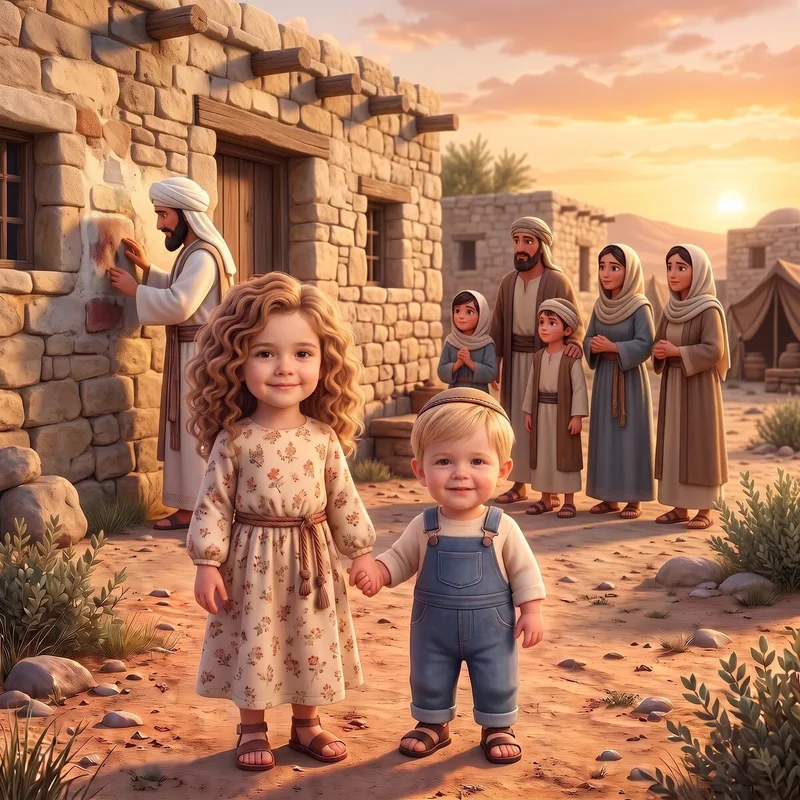
Torah Tale prints personalized Torah storybooks in which your child is the hero of the parsha. You upload one photo, and from it your child's likeness is illustrated in high-resolution 3D animated-film style on every page, with their name in the text. Up to eight siblings can appear in the same book.
In this parsha, that means your child is the one walking to the Kohen, watching him examine the mark, counting the seven days, and standing there when the second bird is let go over the open field. A parsha that can feel like a list of laws becomes a week your child lived through. Books are written with careful rabbinical guidance and strict tznius, and reviewed by our team before printing, which matters for a parsha like this one, where tone is everything.
Because Tazria and Metzora are usually read as one, the book creator handles it the way the shul does: a double-parsha week produces one book covering both. Books come in English, Hebrew or Yiddish, and you can order more than one language.

Softcover 8″×8″

Hardcover 8″×8″

Board book 6″×6″

Coloring book 8.5″×11″
Formats follow the child's age. The 6x6 board book with rounded safety corners suits ages 0 to 4. The 8x8 softcover fits ages 4 to 8. The 8x8 hardcover is built for ages 5 to 18. A matching 8.5x11 coloring book in black-and-white line art can be added, and that one is a weekday activity: erev Shabbos afternoon, a Sunday, or Chol HaMoed, never on Shabbos or Yom Tov itself. The storybook, on the other hand, is exactly right for the Shabbos table or a long Yom Tov afternoon.
Shabbos table questions and one thing to do this week
Every Torah Tale book ends with a dedicated discussion page carrying 10 questions about the story, mixing comprehension with middos. Here is a sample of the kind of thing that gets a table talking:
- Why did the person have to go to a Kohen and not to a doctor?
- Why do you think the Kohen waited seven days before deciding?
- What do chirping birds have to do with the way somebody spoke?
- The cedar is the tallest tree and ezov is a small low plant. What is the Torah hinting at?
- Why did the person sit outside the camp alone instead of just saying sorry?
- The Kohen walked out of the camp to see him. What does that teach us about how to treat somebody who made a mistake?
- Have you ever heard something about another child and chosen not to repeat it?
A weekday activity that works. Put a jar on the counter on Sunday. Every time someone in the house stops themselves from repeating something about another person, they drop in a coin, and at the end of the week it goes to tzedakah. Children catch on fast, and the jar does the mussar quietly without anyone being lectured. Pair it with the coloring book from the same parsha on a weekday afternoon, and the cedar, the ezov and the two birds stay in the house all week.
If your family has been going parsha by parsha through Sefer Vayikra, this one sits right after Parshas Shemini, and the shift is worth naming out loud: from what we put in our mouths to what comes out of them.

Making a book takes about five minutes and a few short questions: name, boy or girl, age, one photo, siblings, story, language and printed format. The creator suggests next week's parsha with a live countdown to the order deadline for delivery before that Shabbos, and you can also pick any story from the seven collections, including stories from across Nevi'im and Kesuvim, the Yamim Tovim and the stories of the tzadikim. Create the book and let your child be the one who walks back into the camp.
Frequently asked questions
What is the main lesson of Parshas Tazria-Metzora for children?
The main lesson is that words are real and they do real things. Chazal teach that tzaraas came mainly because of lashon hara, speech that hurt someone or pushed people apart. The parsha shows a person whose words separated others, and who then sat separated himself until he was ready to return. For a child, the takeaway is simple: what you say about another person matters as much as what you do to him.
How do I explain tzaraas to a young child without scaring him?
Say clearly that tzaraas was not a sickness and was not catching. It was a white mark that Hashem sent as a message, the way a note on the fridge is a message. Explain that the person went to the Kohen, who looked carefully and sometimes waited a whole week before deciding, and that the person did teshuvah and came back. Ending on the coming back is what keeps the story warm rather than frightening.
Why are Tazria and Metzora usually read together?
Both parshiyos are short and both deal with the same subject, so in most years they are read as one double parsha. In a Jewish leap year, when there are extra Shabbosos to fill, they are read separately. Torah Tale handles this the same way the shul does: a double-parsha week produces one book that covers both parshiyos together.
What happens at the beginning of Parshas Tazria?
Tazria opens with the korbanos a mother brings after a baby is born, and with the mitzvah of bris milah on the eighth day. Only after that does the parsha turn to the laws of tzaraas on a person's skin and on clothing. Parshas Metzora then continues with how the person became tahor again, and with tzaraas on the walls of a house in Eretz Yisrael.
What are the two birds in Parshas Metzora?
When the mark healed, the person brought two kosher birds, a piece of cedar wood, a thread of crimson wool and ezov. One bird was slaughtered (shechted) and the other was set free over an open field. Rashi explains that birds chirp constantly, which hints at the chatter of lashon hara, while the tall cedar and the low ezov hint at a person who was haughty and now makes himself small.
Which Torah Tale format is best for a parsha like this one?
For ages 0 to 4, the 6x6 board book with rounded safety corners is the right fit. Ages 4 to 8 usually do best with the 8x8 softcover, and ages 5 to 18 with the 8x8 hardcover. A matching black-and-white coloring book can be added for weekday use, such as erev Shabbos afternoon.