Parshas Tazria for Kids: Tzaraas, the Kohen & the Power of Words
Parshas Tazria is the parsha of tzaraas, the mark Hashem would send when a person spoke lashon hara. Here is how to retell it for children without frightening them, how to explain it at four and at ten, and what to ask at the Shabbos table.
Published by Torah Tale.
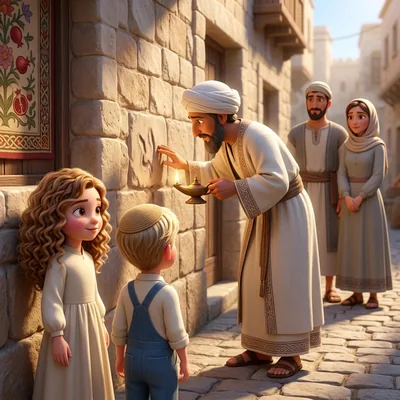
Parshas Tazria is the parsha of tzaraas, a white mark that Hashem would send on a person's skin or on his clothing when something needed fixing, most often the way he had been speaking about other people. It is one of the harder parshiyos to teach, and also one of the most useful, because children grasp the central idea immediately: words are not air. They are real, they land somewhere, and in the time of the Mishkan they left a mark you could actually see.
What happens in Parshas Tazria?
The parsha opens quietly. It gives the halachos of a mother after a baby is born, including the bris on the eighth day for a baby boy, and the korbanos she brings to the Mishkan when her days are complete. Rashi, quoting Chazal, points out the order: Parshas Shemini just finished teaching which animals are kosher, and now the Torah turns to the laws of a person, exactly as man was created last, after all the animals were already in the world.
Then the parsha turns to its main subject. A person notices a patch on his skin, white or very pale, different from the skin around it. He does not decide anything himself. He goes to a Kohen.
The Kohen looks carefully. There are signs the Torah gives him: whether the hair inside the patch has turned white, whether the mark looks deeper than the skin, whether it has spread. If the signs are clear, the Kohen says the word tamei. If the signs are clear the other way, he says tahor. And if it is not clear yet, the Kohen closes the person up for seven days and comes back to look again, and sometimes for another seven days after that.
The parsha then teaches something children find remarkable: clothing could get tzaraas too. A woolen garment, a linen one, a piece of leather could develop a greenish or reddish patch, and that garment was brought to the Kohen exactly the same way, looked at, set aside for seven days, washed, checked again. Tzaraas on the walls of a house comes in next week's parsha, Metzora.
A person declared a metzora left the camp for a time. He let his hair grow, tore his clothes, and called out so that others would know to keep their distance. Chazal teach that he called out for another reason as well: so that people would hear and daven for him.
What is tzaraas, and how do I explain it without frightening anyone?
Say this plainly and say it early: tzaraas was not a sickness. Nobody caught it from anybody. A doctor could not treat it and a cream would not help it. It was a message, sent by Hashem, that appeared where a person could not miss it.
Chazal tell us that tzaraas came above all for lashon hara, and they read the word metzora as motzi shem ra, a person who puts out a bad name about someone else. That is why the Kohen, the one whose work is bringing people close, is the one who handles it, and why the response is not medicine but teshuvah.
Children should also hear that this belonged to a particular time. Tzaraas appeared when Klal Yisrael lived around the Mishkan and later the Beis HaMikdash and the Shechinah was openly among them. A child with a rash today has a rash. Nobody needs to inspect it for white hairs.
What is the lesson of Parshas Tazria for kids?
Rashi explains why the metzora sits outside the camp, and it is the sentence worth repeating at your table: he separated people from one another with his words, so for a while he sits separated himself. Measure for measure, and completely understandable to an eight-year-old who has watched a whisper empty out a lunch table.
There is a second lesson sitting next to it. The person with the mark could not rule on himself. Even a great talmid chacham who knew every halacha of nega'im by heart had to bring it to a Kohen, because his own eyes were not the deciding ones. Children who are quick to declare themselves innocent in every argument can hear that one without a lecture attached.
And a third, which is really the kindest part: the whole process is built for healing. Seven days, look again. Seven more, look again. The Torah is not in a rush to call anybody tamei, and the metzora comes back. He is not finished.
How to explain Tazria at different ages
| Age | What to say |
|---|---|
| 2-4 | "Long ago, if someone said unkind words about a friend, Hashem would send a white spot on his skin so he would remember to talk nicely. The Kohen helped him fix it." Stop there. |
| 5-7 | Add the Kohen looking carefully, the seven days of waiting, and the surprise that even a coat could get tzaraas. Ask what the spot was trying to tell the person. |
| 8-10 | Add Rashi: he separated people, so he sits apart. Add that only a Kohen could declare it, no matter how much Torah the person knew. Add motzi shem ra. |
| 11-12 | Add the structure of hesger, the signs the Kohen checks, tzaraas on clothing, and the question of why the Torah gives so many pesukim to this. Let them argue it out. |
A Torah Tale book of Parshas Tazria is written for the age you choose in the ordering questions, so a four-year-old's version stays at the level of the first row and a ten-year-old's version carries the Rashi. If you have a wide age spread at home, up to four siblings can appear in one book together.
Shabbos table questions for Parshas Tazria
These work after the fish, and they do not require anyone to have learned the parsha first.
- Why do you think Hashem put the mark somewhere the person could see it, instead of just telling him?
- Why did the Kohen wait seven days instead of deciding right away?
- Rashi says he sits alone because he made other people feel alone. Has anyone ever made you feel left out with words?
- What is one thing you heard about somebody this week that you decided not to repeat?
- If clothing could get tzaraas, what do you think that was teaching?
- Who is someone you could say a good word about tonight?
Every Torah Tale book ends with a dedicated discussion page carrying ten questions about that story, mixing what happened with what it asks of the child. It is there so the book does not end when the last page is turned, and on a long Shabbos afternoon it tends to be the page that gets used most.
A weekday activity that makes it stick
Try this on a weekday afternoon or erev Shabbos. Give each child a small piece of paper and have them write or draw one good thing about every other person in the house, then read them out loud at supper. It takes ten minutes and it does more for shmiras halashon in a family than a month of reminders.
For younger children, the matching 8.5x11 coloring book in black-and-white line art gives them the same scenes to color while an older sibling learns the parsha out loud. Coloring is a weekday activity, so keep it for before Shabbos or a regular afternoon, never for Shabbos or Yom Tov itself.
Softcover 8″×8″
Hardcover 8″×8″
Board book 6″×6″
Coloring book 8.5″×11″
What a personalized Torah Tale book of Parshas Tazria is like
In a Torah Tale book your child is the one in the story. Their name is on every page and, from one photo you upload, their face is illustrated in high-resolution 3D Pixar style throughout. For Tazria that means your child is the one standing beside the Kohen as he looks at the mark, the one counting the seven days, the one who understands at the end why words needed guarding.
The whole flow is eight short questions: name, boy or girl, age, one photo, siblings, story, language, and printed format. Books come in English, Hebrew or Yiddish, and you can order the same story in more than one. Formats are the 6x6 board book with rounded safety corners for ages two to four, the 8x8 softcover for four to eight, and the 8x8 hardcover in square or landscape for five to twelve.

The book creator suggests next week's parsha with a live countdown to the order deadline for delivery before that Shabbos, and when the week is a double parsha, as Tazria-Metzora usually is, you get one book covering both. You can also pick any story you want from the seven collections, including the rest of Sefer Vayikra: Vayikra and Shemini are both there. If you are deciding which week to start with, this guide walks through it.
Every book is written with careful rabbinical guidance and strict tznius and reviewed by our team before it goes to print. The whole thing takes about five minutes. Create the book and let your child meet the Kohen who waited seven days before he said a word.
Frequently asked questions
What is the main lesson of Parshas Tazria for children?
The main lesson is shmiras halashon, guarding what we say. Parshas Tazria teaches that Hashem cares so much about how a Yid speaks that in the time of the Mishkan and the Beis HaMikdash He would send a visible mark, tzaraas, so that a person would notice his words and do teshuvah. For a child the takeaway is simple: words are real things that leave marks, and a person can choose which marks he leaves.
How do I explain tzaraas to a young child without scaring him?
Tell him that tzaraas was not a sickness and nobody could catch it from anybody. It was like a note from Hashem that appeared on a person's skin or on his coat, saying gently, please look at the way you have been talking. Make clear that it only happened in the time of the Mishkan and the Beis HaMikdash, when Klal Yisrael was on a very high level, and that a child today who gets a spot or a rash has nothing to worry about.
Why did a person with tzaraas have to go outside the camp?
Rashi explains that it was measure for measure. A person who spoke lashon hara pushed people apart from each other with his words, so for a while he lived apart himself and felt what separation is like. Chazal also teach that he would call out so that others would know to daven for him, which means that even then he was not forgotten by the community.
Why does Parshas Tazria begin with a baby being born?
Parshas Tazria opens with the halachos of a mother after a baby is born, including the bris on the eighth day and the korbanos she brings when the days are complete. Rashi, quoting Chazal, notes that the parsha of man comes right after Parshas Shemini's laws of which animals are kosher, just as man was created last, after all the animals. Children usually like that order: first the world, then the animals, then us.
Are Tazria and Metzora the same parsha?
They are two separate parshiyos that are read together as one double parsha in most years, and separately in a Jewish leap year. Tazria covers tzaraas on a person's skin and on clothing. Metzora continues with how the metzora becomes tahor again and adds tzaraas that could appear on the walls of a house.
Which Torah Tale format is best for Parshas Tazria?
For ages two to four, the 6x6 board book with rounded safety corners holds up to small hands. For ages four to eight, the 8x8 softcover photo book works well, and for ages five to twelve the 8x8 hardcover in square or landscape is the one that stays on the shelf for years. Every format ends with the same discussion page of ten questions about the story.