Parshas Acharei Mos for Kids: The Two Goats & Yom Kippur
Parshas Acharei Mos is the parsha of the holiest day in the holiest place. It teaches children that coming close to Hashem is possible, precious, and done the way Hashem asks.
Published by Torah Tale.
Create this book for your child
Parshas Acharei Mos is the parsha of the holiest day in the holiest place. It opens right after the death of Nadav and Avihu, Aharon's two sons, and tells Aharon that he may not walk into the Kodesh HaKodashim whenever he wishes. Once a year, on Yom Kippur, in plain white linen, with ketores and korbanos and words of viduy, he may enter and ask Hashem to forgive all of Klal Yisrael. For children this is one of the easiest parshios in Vayikra to feel, because every child already understands a door that stays closed and a day that is different from all the others.
What happens in Parshas Acharei Mos?
The parsha begins with the words "acharei mos," after the death of Aharon's two sons. We read about what happened to them in Parshas Shemini: they brought a fire into the Mishkan that Hashem had not asked for. Now Hashem speaks to Moshe and tells him to warn Aharon.
Aharon may not come into the Kodesh HaKodashim, the innermost room where the Aron stood, at any time he chooses. Only on Yom Kippur, and only according to the order Hashem lays out.
On that day the Kohen Gadol did not wear his gold garments. He immersed in a mikveh and dressed in four simple white linen garments. He brought a par, a bull, for himself and his household, and he said viduy over it.
Then came the two goats. Two goats that looked the same were stood at the entrance of the Mishkan, and the Kohen Gadol drew a goral, a lot, for them. One goat was "for Hashem" and was brought as a korban. The second was sent away, led by a man appointed for the task, out to the wilderness, and before it went the Kohen Gadol leaned his hands on it and said viduy for the sins of all of Klal Yisrael.
After the goral, the Kohen Gadol took a pan of coals and ketores and brought them into the Kodesh HaKodashim, and the room filled with a cloud of the ketores.
The parsha then teaches that korbanos may be brought only at the Mishkan and not out in the fields, that a Yid may not eat blood, and that the blood of certain animals and birds that are shechted must be covered with earth. It closes with the mitzvos of kedusha in family life, the laws that keep a Yiddishe home holy and separate from the ways of Mitzrayim and Canaan, together with the posuk "ushmartem es chukosai... v'chai bahem," that a Yid lives by the mitzvos.
Why could only one person go into the Kodesh HaKodashim?
Children ask this immediately, and the answer is worth saying out loud. It was not because Hashem wanted distance. The whole Mishkan existed so that the Shechinah would rest among the Yidden.
It was because the closest place had to stay the closest place. If anyone could walk in at any time, it would become an ordinary room. Once a year, one person, in white clothes, carrying the tefillos of an entire nation, is what keeps it holy.
There is a detail worth sharing with an older child. The Kohen Gadol, the greatest Yid alive, went in wearing plain linen, not gold. Chazal explain that gold recalls the eigel, and a prosecutor does not become a defender. On the day he came closest, he came simplest.
What is the lesson of Parshas Acharei Mos for kids?
The middah of this parsha is coming close the way you were asked to come close. Nadav and Avihu wanted closeness and brought what nobody requested. Aharon is given the exact path that Hashem does want. The parsha is not teaching children to stay away. It is teaching them that love has a shape.
A child understands this from their own home. Running into a parent's arms is welcome; opening a parent's briefcase is not, even with the best intentions. Wanting to help is not the same as helping.
The second lesson is teshuvah. The posuk in the middle of the parsha, ki vayom hazeh yechaper aleichem... lifnei Hashem tit'haru, is the source for what Yom Kippur does. Chazal relate that a thread of scarlet wool was tied in the Bais HaMikdash and would turn white when the avodah was accepted, a sign the Yidden could see with their own eyes that they had been forgiven. Children who have heard the Yom Kippur story will recognize the idea at once: a slate wiped clean, every single year.
How to explain Acharei Mos at different ages
Ages 2 to 4. Keep it to the room and the day. "In the Mishkan there was one special room. Nobody went in. One day a year, Aharon the Kohen put on white clothes and went in to talk to Hashem about all the Yidden." That is the whole story at this age, and it is enough.
Ages 5 to 7. Add the two goats and the goral. Children this age love the picture of two identical goats and a lot that decides. Add the viduy: Aharon said sorry out loud, not only for himself but for everybody. Ask them what it feels like when somebody says sorry for the whole family.
Ages 8 to 12. Now the full avodah fits: the mikveh, the white linen, the par, the ketores cloud, the sprinkling of the blood, the goat sent to the wilderness, and the Kohen Gadol's tefillah when he came out safely. Add the halachos at the end of the parsha in general terms: korbanos only in the Mishkan, not eating blood, covering the blood, and the mitzvos of kedusha that make a Yiddishe home different from the nations around it. An older child can handle the big idea: holiness is not only in the Kodesh HaKodashim, it is also in how a family lives.
Shabbos table questions for Parshas Acharei Mos
Five questions that work with a mixed-age table, and none of them need a sefer open:
- Why do you think Hashem told Aharon he could only go in one day a year, instead of letting him come in whenever he wanted?
- The Kohen Gadol wore plain white clothes on the holiest day. What does that teach us about being important?
- The two goats looked exactly the same, and a goral decided. What is something in your life that turned out completely differently than you expected?
- Aharon said viduy for the whole nation. Who says sorry for our family when we do something wrong?
- Name one place in our house that we treat as special. What makes it special, the room or the way we act in it?
A good follow-up activity for a weekday afternoon or erev Shabbos: let the children draw the Mishkan from the outside in, the chatzer, the Kodesh, and then the Kodesh HaKodashim with the Aron, labeling who could enter each one. Drawing and coloring are melacha, so this is a weekday project, never a Shabbos or Yom Tov one. The storybook itself is exactly the opposite: it belongs at the Shabbos table.
What a personalized Torah Tale book of Acharei Mos is like
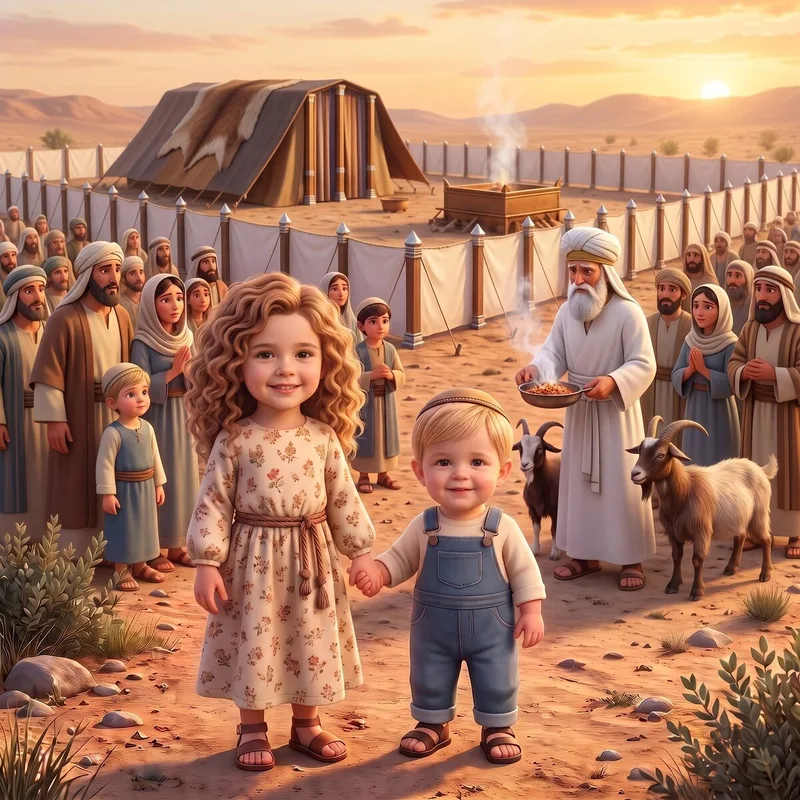
In a Torah Tale book, your own child is in the story. Their name is on every page, and from one uploaded photo their likeness is illustrated in high-resolution 3D animated-film style throughout. They are standing in the chatzer of the Mishkan as the Kohen Gadol goes in, watching the two goats, waiting with everyone else for him to come out. Up to eight siblings can appear in the same book, which matters for a story this quiet and this full of waiting.

Softcover 8″×8″

Hardcover 8″×8″

Board book 6″×6″

Coloring book 8.5″×11″
Choose the format by age: a 6"x6" board book with rounded safety corners for ages 0 to 4, an 8"x8" softcover for ages 4 to 8, or an 8"x8" hardcover for ages 5 to 18. Books come in English, Hebrew or Yiddish, and you can order more than one language. There is also an optional matching coloring book in black-and-white line art for a weekday afternoon.
Every book ends with a dedicated discussion page carrying 10 questions about the story, mixing comprehension with middos. For Acharei Mos those questions are what turn a parsha about an ancient avodah into a conversation about teshuvah and about doing things the way we were asked.

How to order the book in time for the parsha
The Torah Tale book creator suggests next week's parsha, not this week's, with a live countdown to the order deadline for delivery before that Shabbos. In a double-parsha week you get one book covering both, which is useful here, since Acharei Mos is often paired with Kedoshim. If you are not sure how to plan the weeks ahead, our guide on choosing the weekly parsha for your child's book walks through it.
Creating a book takes a free account and a few short questions: each child's name, boy or girl, age and one photo, any siblings, the story, your community, the language and the printed format. US standard shipping is $4.99 (free on one-time orders over $60) and takes 5 to 8 business days. We ship worldwide, with rates shown at checkout. Every book is written with careful rabbinical guidance and strict tznius, and reviewed by our team before it goes to print.
If your child is learning Acharei Mos in cheder or Bais Yaakov this year, or you want them to walk into shul on Yom Kippur already knowing what the Kohen Gadol did, this is the story to give them with their own name in it. The whole flow takes about five minutes. Create the book and have it on the table before Shabbos.
Frequently asked questions
What is Parshas Acharei Mos about?
Parshas Acharei Mos begins after the death of Aharon's two sons, Nadav and Avihu, and gives Aharon the instructions for entering the Kodesh HaKodashim. Hashem tells him he may not come in whenever he wishes, but only on Yom Kippur, dressed in plain white linen, with ketores and korbanos and viduy. The parsha then teaches that korbanos may be brought only in the Mishkan, that a Yid may not eat blood and must cover the blood of certain animals, and it ends with mitzvos of kedusha in family life that set Yidden apart from the nations around them.
How do I explain Acharei Mos to a 5-year-old?
Tell your child that in the Mishkan there was one special room that nobody was allowed to walk into, like a room with the door closed all year. One day a year, on Yom Kippur, Aharon the Kohen Gadol put on simple white clothes and went in to ask Hashem to forgive all of the Yidden. Then say the one-sentence point: Hashem loves us and wants us close, and He tells us exactly how to come close so that it stays special.
What is the lesson of Parshas Acharei Mos for children?
The main lesson is that closeness to Hashem is real and available, but it has rules, and the rules are what keep it precious. Nadav and Avihu came close in a way they were not asked to; Aharon was taught the way that Hashem did want. For a child this translates into everyday life: doing the mitzvah the way it is supposed to be done, at the right time, is part of loving Hashem, not a limit on it.
What were the two goats in Acharei Mos?
Two goats were brought on Yom Kippur and stood at the entrance of the Mishkan. A goral, a lot, was drawn, and one goat was brought as a korban to Hashem while the second was sent away into the wilderness. The Kohen Gadol leaned his hands on the second goat and said viduy over it for all of Klal Yisrael, and Chazal teach that this was part of how the sins of the Yidden were carried away on Yom Kippur.
Why is Parshas Acharei Mos connected to Yom Kippur?
The first part of the parsha is the Torah's description of the Yom Kippur avodah in the Mishkan and later in the Bais HaMikdash, including the white garments, the ketores, the two goats and the viduy. Part of the parsha is read in shul on Yom Kippur itself, and the Yom Kippur davening retells this avodah in detail. Learning Acharei Mos with children before Yom Kippur makes the davening they hear in shul far more familiar.
What age is a Torah Tale book of Acharei Mos good for?
Torah Tale prints three formats, plus an optional coloring book, so the same story fits different ages: a 6"x6" board book with rounded safety corners for ages 0 to 4, an 8"x8" softcover for ages 4 to 8, and an 8"x8" hardcover for ages 5 to 18. Acharei Mos works especially well from around age five, when a child can hold the idea of a place that is special because it is kept apart. Every book ends with a discussion page of 10 questions that mix comprehension with middos.