Bobby & Zaidy and Me for Kids: Grandparents & What They Teach
Bobby & Zaidy and Me is a Torah Tale story about a child and their grandparents at home. Here is what it is about, what the Torah says about grandparents, and how to talk about it by age.
Published by Torah Tale.
Create this book for your child
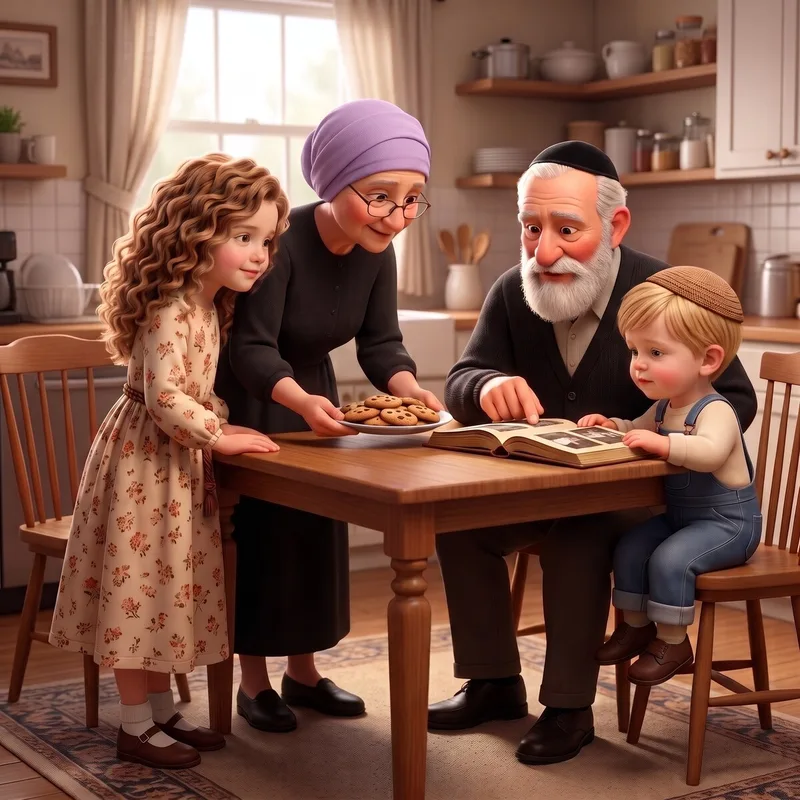
Bobby & Zaidy and Me is a Torah Tale story from the Family collection, set at home today, about a child and the grandparents who love them: what they do together and what a grandparent teaches. It works for children because it is about people they already know, and in a personalized book the child is the one in the story. (The book's title spells it Bobby; in this article we write Bubby.)
What is the Bobby & Zaidy and Me story about?
This is not a story from the time of the Avos. It is set in an ordinary home, today. Your child, with their own name and likeness, spends time with Bubby and Zaidy, and the story follows what they do together and what a grandparent passes on.
It belongs to the same Family collection as Mommy and Me and Totty and Me. Its subject is the everyday relationship, not a single dramatic event, so it is easy to connect to what your own child's Bubby and Zaidy actually do. For the parent side of the same collection, see Mommy and Me.
What does the Torah say about grandparents and grandchildren?
The Torah speaks about this directly. In Devarim 4:9 we are told to make Hashem's words known to our children and to our grandchildren. A grandparent is part of the chain of Torah, not only a visitor.
The pasuk in Mishlei 17:6 says that grandchildren are the crown of the elderly. In Devarim 32:7, in Parshas Ha'azinu, the Torah says to ask your father and he will tell you, and your elders and they will say it to you. You can read more in Parshas Ha'azinu for Kids.
We also see it in Parshas Vayechi. The Torah tells us that Yosef brought Ephraim and Menashe close to Yaakov, whose eyes had grown heavy with age, and that Yaakov kissed and embraced them (Bereishis 48:10). Yaakov then said that he had not expected to see Yosef's face, and Hashem had shown him Yosef's children too. See Parshas Vayechi for Kids.
The Torah also tells us to rise before a person with grey hair and to honor the elderly (Vayikra 19:32). A child who learns to stand up for Zaidy is practicing a mitzvah the Torah states in plain words.
What is the lesson for children?
The lesson is that a grandparent has something to give, and a child has something to give back. Bubby and Zaidy teach, and the child listens, helps and spends time with them. The relationship goes both ways.
For a young child, that can be as small as sitting together, listening to a story or doing something side by side. The book puts a face on it: this is how it looks when we are with the people who love us.
How do I explain it to a 3 or 4-year-old, a 6 or 7-year-old and a 9 to 12-year-old?
- Ages 3 to 4: Keep it personal. Say, this is the story about you, Bubby and Zaidy. Point to the pictures, name what is happening and ask what your child likes to do at Bubby and Zaidy's.
- Ages 6 to 7: Ask what Bubby or Zaidy has taught them. It might be a song, a way of doing something, or something about Shabbos. Help them put it in a sentence, such as Zaidy taught me how to wait patiently.
- Ages 9 to 12: Talk about the chain. Your grandparents taught you, you teach your child, and your child will one day teach theirs. Encourage them to ask their grandparents about when they were children.
What can we ask at the Shabbos table?
Reading is a fine thing to do on Shabbos, and so is simply talking. These questions need nothing but conversation:
- What is something Bubby or Zaidy does that makes you feel special?
- What is something Bubby or Zaidy taught you?
- Who taught Zaidy that? Who taught Bubby?
- What can you do for Bubby and Zaidy that would make them happy?
- What would you like to teach your own grandchildren one day?
If you want to go further, do it on a weekday. Ask Bubby and Zaidy a few questions about their own childhood on a weekday call or visit, and jot down the answers so they do not get lost. Writing belongs to the weekdays, not Shabbos or Yom Tov.
What is a personalized Bobby & Zaidy and Me book like?
Your child is the hero. Their name and, from one uploaded photo, their likeness appear on every page, illustrated in 3D animated-film style. Up to eight children (siblings) can be in the same book, ages 0 to 18.
If you add Bubby and Zaidy with their photos, they appear with the children on a closing family page, in every format. Softcover and hardcover books also open with a dedication page.

Softcover 8″×8″

Hardcover 8″×8″

Board book 6″×6″

Coloring book 8.5″×11″
Every book ends with a discussion page of 10 questions mixing comprehension with middos: what happened, and what it asks of the child. That page turns the book into something you talk about at the table.
There are three formats, and you choose by your child's age:
- Board book, 6x6 with rounded safety corners, ages 0-4.
- Softcover photo book, 8x8, ages 4-8.
- Hardcover photo book, 8x8, ages 5-18.
You can also add a matching 8.5x11 coloring book in black-and-white line art. It is a one-time add-on to a book, and coloring is a weekday activity, so save it for an afternoon during the week or erev Shabbos, never Shabbos or Yom Tov.
How do I order it?
You make a free account and answer a few short questions: each child's name, boy or girl, age and one photo, any siblings, the story, your family's community (asked once), the language and the printed format. Languages are English, Hebrew and Yiddish. The whole thing takes about five minutes.
Every book is written with careful rabbinical guidance and strict tznius, and reviewed by our team before it goes to print. If Bubby and Zaidy live far away, we ship worldwide, with rates shown at checkout.
Ready to make it? You can create the book for your child and pick Bobby & Zaidy and Me from the Family category in the story picker.
Frequently asked questions
What is the Bobby & Zaidy and Me story about?
It is a Torah Tale story from the Family collection, set at home today. It follows a child and their grandparents through what they do together and what a grandparent teaches. Your child appears in it by name and likeness.
What does the Torah say about the bond between grandparents and grandchildren?
The Torah tells us to make Hashem's words known to our children and to our grandchildren (Devarim 4:9). The pasuk in Mishlei 17:6 says that grandchildren are the crown of the elderly. In Parshas Vayechi, Yaakov Avinu draws Ephraim and Menashe close, kisses them and embraces them.
How do I explain the story to a 4-year-old?
Keep it simple and personal: this is the story about you, Bubby and Zaidy. Point to the pictures, name what the three of them are doing, and ask what your child likes to do with their own grandparents. Short and warm is enough at this age.
Can Bubby and Zaidy appear in the book?
Yes. A family can add parents, grandparents and other relatives with their photos. The story itself stars the children, and the grown-ups you add appear with them on a closing family page in every format.
Which format is best for this story?
Choose by your child's age. The board book is 6x6 with rounded safety corners for ages 0-4, the softcover is 8x8 for ages 4-8, and the hardcover is 8x8 for ages 5-18. An optional matching 8.5x11 coloring book can be added, and it is a weekday activity, never for Shabbos or Yom Tov.
Can we read the book on Shabbos?
Yes. Reading the storybook is entirely appropriate on Shabbos and Yom Tov, and a book about Bubby and Zaidy fits the Shabbos table well. The discussion page at the end gives you 10 questions to talk through together.