The Rif (הרי״ף) for Kids: Rabbeinu Yitzchak Alfasi & His Halachos
The Rif, Rabbeinu Yitzchak Alfasi, gathered the halachic conclusions of the Gemara into one work. Here is who he was, what he wrote, and how to explain him to a 4-year-old, a 7-year-old and an 11-year-old.
Published by Torah Tale.
Create this book for your child
The Rif is Rabbeinu Yitzchak Alfasi, a Rishon who lived about a thousand years ago and gathered the halachic conclusions of the Gemara into one work, so that a Yid could find what to do. Children connect to him because the idea is simple: he took something enormous and made the way through it clearer, for the sake of others.
Who was the Rif (הרי״ף)?
The name Rif is formed from the initials of Rabbi Yitzchak Alfasi, and Alfasi points to Fez, in Morocco, where he lived and taught for many years. He was born around the year 1013 and lived to about ninety.
He is counted among the Rishonim, the great Torah leaders who came after the period of the Geonim. If your child has already met a Gaon such as Rav Saadia Gaon, the Rif is the next step in the chain. He learned and taught the Gemara that was brought to its close in the days of Ravina and Rav Ashi.
What did the Rif write, and why does it matter?
His great work is known as Halachos HaRif, or Sefer HaHalachos. It follows the order of the Gemara, masechta by masechta, and brings the halachic conclusion of each sugya. He left out much of the long back-and-forth, the aggadic passages, and a good deal that did not apply in practice in his day.
One way to picture it for a child is that the Gemara is a huge sea of learning and the Rif drew a clear route through it. That picture is only an explanation for children, not something stated in the sources.
The work was relied on for generations. The Ran wrote a commentary on the Rif, and the Rosh wrote his own halachic work on the Gemara in a similar spirit. Rav Yosef Karo, in the Beis Yosef, relied on the Rif, the Rambam and the Rosh as his three pillars for deciding halacha, and many editions of Shas print the Rif at the end of the masechtos.
Why did the Rif leave Fez?
Accounts of his life say that around 1088, when he was already in his seventies, he had to leave Fez after being denounced. He settled in Lucena, in Spain, where he headed a yeshiva.
His talmid, Rav Yosef ibn Migash, learned from him there and later succeeded him. The Rif was niftar around 1103. For a child, the point is gentle and clear: even when he had to leave his home late in life, he kept teaching Torah.
What is the lesson of the Rif for kids?
The first lesson we can take from the Rif is that Torah is meant to be shared. He did not keep his learning for himself, but arranged it so that ordinary Yidden could know how to keep the mitzvos.
The second is that making things clear takes real work. To leave out what is not needed, you have to understand all of it first. That is worth saying to a child who is proud of knowing a lot, because knowing is the beginning and helping others know is the next step.
At home this looks small. A child who shows a younger brother where the place is in the siddur, or explains a new bracha to a friend, is living in that spirit.
How do I explain the Rif to a 4-year-old, a 7-year-old and an 11-year-old?
- Around 4: "The Rif was a very great Torah teacher. He wrote a book to help Yidden know what Hashem wants us to do, and he made it easier to find the answers." One or two sentences are plenty.
- Around 7: Use the picture of a route through the sea. "The Gemara is like a huge sea of learning. The Rif drew a clear route, so people could find their way." Then ask, "Who helped you find your way when you were learning something new?"
- Around 11: Talk about what he included and what he left out, and why later Rishonim like the Ran and the Rosh built on his work. Ask, "Why does a clear summary take so much knowledge?" You can mention that Rav Yosef Karo relied on the Rif together with the Rambam and the Rosh.
A child who has already heard about Rabbeinu Gershom will enjoy hearing that the Rif also lived in the era of the early Rishonim.
What is a personalized Torah Tale book about the Rif like?
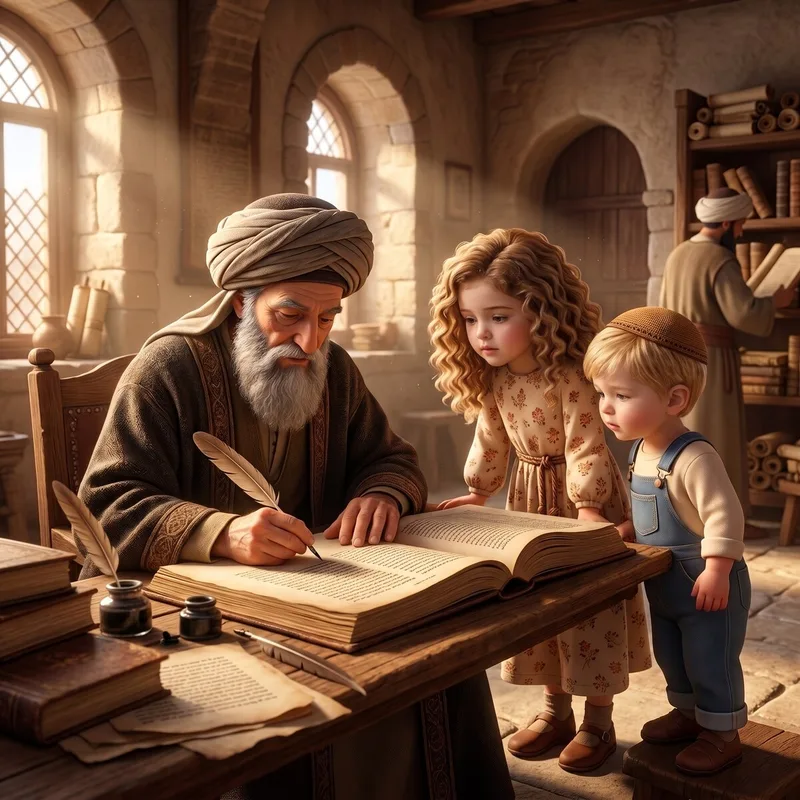
The Rif is a story in the Stories of Tzaddikim collection, which covers Jewish leaders across the last two thousand years. In a Torah Tale book, your child's name and likeness, made from one uploaded photo, appear on every page, illustrated in 3D animated-film style. Up to eight children, ages 0 to 18, can appear in one book, so siblings can share it.

Softcover 8″×8″

Hardcover 8″×8″

Board book 6″×6″

Coloring book 8.5″×11″
Every book ends with a dedicated discussion page of ten questions that mix comprehension with middos, asking what happened and what it asks of the child. That page turns a book you read to your child into one you talk about together. The books are written with careful rabbinical guidance and strict tznius, and reviewed by our team before they go to print.
The formats are a softcover photo book 8"x8" (ages 4-8), a hardcover photo book 8"x8" (ages 5-18) and a board book 6"x6" with rounded safety corners (ages 0-4). The books come in English, Hebrew and Yiddish. An optional matching coloring book is a weekday activity, for erev Shabbos or an afternoon during the week, never for Shabbos or Yom Tov.
You can also choose a collection subscription on one of two plans: Monthly, with four books a month in one delivery, or Yearly, with the whole collection paid once. Our guide on how to create a personalized Torah storybook walks through the steps.
What can we talk about at the Shabbos table?
Reading a storybook is entirely appropriate on Shabbos. These questions are for talking only, with nothing to write or draw:
- Why do you think the Rif wrote a book that tells us what to do?
- Who helps you find your way when you are learning something new?
- What is something you learned this week that you could explain to a younger child?
- The Rif had to leave Fez and still kept teaching Torah. What helps you keep going when things change?
- What does it mean to make something clear for someone else?
You can also end with one simple closing question: "Who can you help understand something this week?" Let each child answer in his or her own words.
When you are ready, create the book. You will make a free account and answer a few short questions: each child's name, boy or girl, age and one photo, any siblings, the story, your community (asked once), the language and the printed format. The whole thing takes about five minutes.
Frequently asked questions
Who was the Rif and why is he important?
The Rif was Rabbeinu Yitzchak Alfasi, a Rishon who lived in Fez and later in Lucena, Spain, and who died around 1103. He wrote Halachos HaRif, which gathers the halachic conclusions of the Gemara in the order of the masechtos. Later Rishonim and poskim built on his work, and many editions of Shas print it.
What does Rif stand for?
Rif is formed from the initials of Rabbi Yitzchak Alfasi (הרי״ף). The name Alfasi points to Fez, the city in Morocco where he lived and taught for many years.
How do I explain the Rif to a 4-year-old?
You can say that the Rif was a very great Torah teacher who wrote a book to help Yidden know what Hashem wants us to do. He made it easier to find the answers. A short, simple line like this is enough at that age, and you can add more as your child grows.
What is the lesson of the Rif for children?
One lesson we can take from the Rif is that learning Torah is meant to be shared with others. He took a vast subject and made the way through it clearer for Yidden who needed to keep the halacha. A child can live this out by helping a younger sibling or friend understand something they have learned.
Why did the Rif move from Fez to Spain?
Accounts of his life say that around 1088 he had to leave Fez after being denounced, and he settled in Lucena, Spain. There he headed a yeshiva, and Rav Yosef ibn Migash learned from him and later succeeded him. For children, it is enough to say that he kept teaching Torah wherever he lived.
Does Torah Tale have a personalized book about the Rif?
Yes, the Rif is a story in the Stories of Tzaddikim collection. Your child's name and likeness, from one uploaded photo, appear on every page in 3D animated-film style, and the book ends with a discussion page of ten questions. It is written with careful rabbinical guidance and strict tznius, and reviewed by our team before it goes to print.