Rav Saadia Gaon for Kids: Translating the Torah & Defending Emes
Rav Saadia Gaon was the Gaon of Sura who made the Torah understandable to Yidden of his generation and stood firm for the truth. Here is the story, the lesson, how to tell it to ages 3-4, 5-7 and 8-12, and questions for the Shabbos table.
Published by Torah Tale.
Create this book for your child
Rav Saadia Gaon was a Gaon who lived over a thousand years ago, and his story is about making the Torah clear and staying loyal to emes. Children connect to it because it begins with a simple idea they already understand: if someone does not understand, you help them understand.
Who was Rav Saadia Gaon?
Rav Saadia was born in Egypt and grew up to be a great talmid chacham. He became the Gaon of the yeshiva in Sura, in Bavel, which means he was one of the leading Torah teachers of his generation. He is part of the era of the Geonim, which is why his story belongs to Sefer Geonim.
He is known for three things in particular. He translated the Torah into Arabic, he wrote Emunos VeDeios, and he defended the Torah she'be'al peh. Each one is a different way of caring for the Torah and for Yidden.
What is the story of Rav Saadia Gaon, in a few words for children?
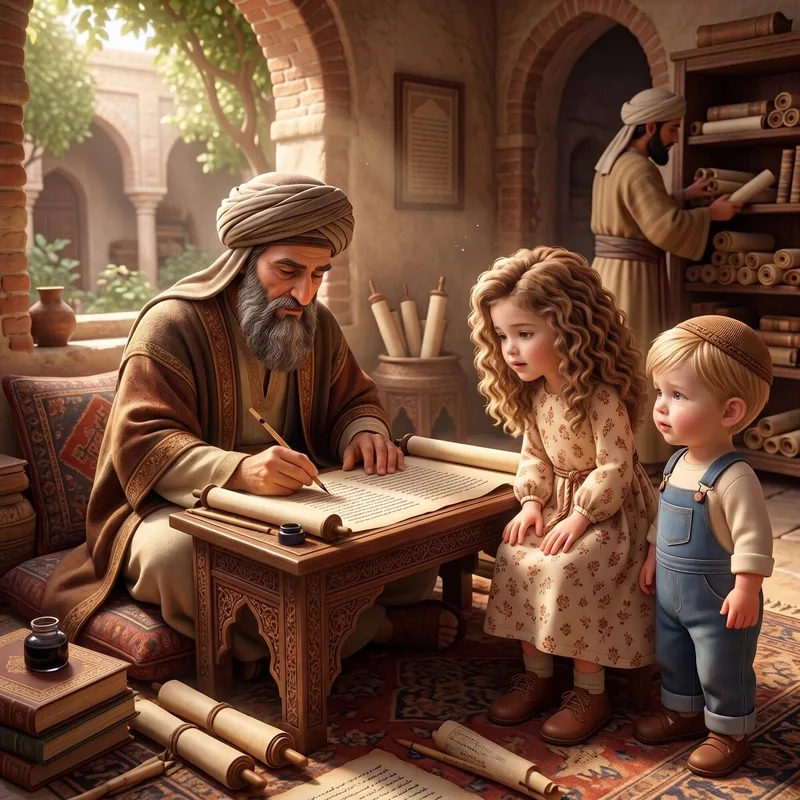
Many Yidden of his time spoke Arabic. They heard the pesukim of the Torah, but not everyone could follow them easily. Rav Saadia translated the Torah into Arabic so that they could understand what the words said.
He also wrote Emunos VeDeios, a sefer that explains what we believe in a clear and orderly way. He wanted a Yid to be able to understand not only what we believe but why.
In his day there were people who accepted only the written Torah and did not accept the Torah she'be'al peh, the explanations Hashem gave Moshe Rabbeinu along with it. Rav Saadia spoke and wrote to show that the Torah is one whole, and that the Mesorah is how we know what the pesukim mean. He did not stay quiet when emes was in question.
As the story is usually told, there was also a time when he held firm on a matter he believed was not right, even though it cost him his position as Gaon for a time. He later returned to lead the yeshiva. When you tell it to children, keep it simple: he chose emes even when it was hard.
What is the lesson of Rav Saadia Gaon for kids?
There are three lessons, and you can choose the one that fits your child right now.
- Help others understand. What you know is meant to be shared, and kindly explaining something to someone is a way of giving.
- Stay loyal to emes. It can be hard to say what is true when others disagree, and Rav Saadia is a model of doing it with care.
- Torah is for everyone. The Torah belongs to every Yid, in whatever language he speaks.
These are the lessons we take from his life. They are not statements from the sources about any one detail of his story.
How do I explain Rav Saadia Gaon to a 3-4 year old, a 5-7 year old, and an 8-12 year old?
Ages 3-4. Keep it to one sentence: Rav Saadia Gaon was a very smart, very good Yid who helped everyone understand the Torah. Then ask, Who can you help understand something today?
Ages 5-7. Tell about the translation. Some Yidden spoke Arabic, so he put the Torah into Arabic. Ask your child what it feels like when someone explains something you did not understand, and when you were the one doing the explaining.
Ages 8-12. Add Emunos VeDeios and the defense of the Torah she'be'al peh. Talk about why it takes courage to say what is true when others disagree, and how to do it respectfully. Ask what it means that the written Torah and the Mesorah go together.
What are good Shabbos-table questions about Rav Saadia Gaon?
Reading is a lovely thing to do at the Shabbos table, and these questions need only talking:
- Why did Rav Saadia translate the Torah into Arabic?
- Has someone ever explained something to you so that you finally understood? How did that feel?
- What is something you know well that you could teach someone else?
- Why is it sometimes hard to say what is true?
- How can we say the truth kindly?
- How do we know what the pesukim mean? (A good moment to talk about the Mesorah.)
For a child who likes a challenge, try this: ask them to explain this week's parsha, or a pasuk they know, in their own simple words as if to a younger cousin. It is just what Rav Saadia did, on a smaller scale.
What is a personalized Rav Saadia Gaon book like?
Torah Tale makes personalized Torah storybooks in which the child is the hero. Your child's name appears throughout and, from one uploaded photo, their likeness appears on every page in high-resolution 3D animated-film style. Up to eight siblings, ages 0 to 18, can appear in the same book. The book about Rav Saadia Gaon is in the Stories of Tzaddikim collection, Sefer Geonim.
Every book ends with a dedicated discussion page of 10 questions about the story, mixing comprehension with middos: what happened, and what it asks of the child. That is the page that turns a book you read to a child into one you talk about together. Every book is written with careful rabbinical guidance and strict tznius and is reviewed by our team before it goes to print.
Which format should I choose?
Torah Tale has three formats: a 6x6 board book with rounded safety corners for ages 0-4, an 8x8 softcover photo book for ages 4-8, and an 8x8 hardcover photo book for ages 5-18. The child's age is one of the short ordering questions. Softcover and hardcover books open with a dedication page.

Softcover 8″×8″

Hardcover 8″×8″

Board book 6″×6″

Coloring book 8.5″×11″
If you add parents, grandparents and other relatives with their photos, they appear with the children on a closing family page in every format. An optional matching 8.5x11 coloring book in black-and-white line art can be added to a one-time order. Coloring is a weekday activity, so it fits erev Shabbos or a weekday afternoon, not Shabbos or Yom Tov. The book itself is perfect for reading on Shabbos.
Where does Rav Saadia Gaon fit with other stories from Sefer Geonim?
Rav Saadia Gaon is one of the Geonim, the leaders who carried the Torah forward after the Gemara was completed. If your child enjoys his story, read about Rav Amram Gaon and the siddur and Rav Yehudai Gaon, the blind Gaon of Sura. Each shows a different way of loving Torah and Yidden. You may also like Rav Ashi and passing Torah on.
To choose the story, the book creator's story picker lists them under Stories of Tzaddikim.
Ready to give your child a book where they are part of Rav Saadia Gaon's story? It takes about five minutes to create the book.
Frequently asked questions
Who was Rav Saadia Gaon?
Rav Saadia Gaon was a Gaon who lived over a thousand years ago. He was born in Egypt and became the Gaon of the yeshiva in Sura in Bavel. He is remembered for translating the Torah into Arabic, for writing Emunos VeDeios, and for defending the Torah she'be'al peh.
Why did Rav Saadia Gaon translate the Torah into Arabic?
Many Yidden in his time spoke Arabic, and a translation helped them understand the pesukim they heard and learned. Rav Saadia wanted the words of the Torah to be clear to the people who were reading them. For children, this is a simple picture of caring that others can understand Torah too.
What is Emunos VeDeios?
Emunos VeDeios is a sefer by Rav Saadia Gaon that explains the beliefs and ideas of the Torah in an organized and clear way. You can tell a child that he wrote it so that Yidden would understand what we believe and why. It is a good example of using words to make the Torah clearer.
How do I explain Rav Saadia Gaon to a 5-year-old?
Say that Rav Saadia Gaon was a very great talmid chacham who loved the Torah and wanted everyone to understand it. He made a translation so Yidden could understand the pesukim, and he stayed true to the Torah even when it was hard. Then ask your child who they could help understand something today.
Which Torah Tale collection has the Rav Saadia Gaon book?
The Rav Saadia Gaon book is part of the Stories of Tzaddikim collection, Sefer Geonim. Your child's name and likeness appear in the story, illustrated in 3D animated-film style. Creating a book takes a free account and a few short questions at torahtale.com/create.