Rav Amram Gaon for Kids: The Siddur & Teaching Yidden to Daven
Rav Amram Gaon led the yeshiva in Sura and sent Yidden in Spain an order of tefillos for the whole year. Here is how to tell his story to a 4, 7 or 10-year-old, with questions for the Shabbos table.
Published by Torah Tale.
Create this book for your child
Rav Amram Gaon was the head of the great yeshiva in Sura, in Bavel, over a thousand years ago, and he is remembered above all for the Seder Rav Amram, the order of tefillos he sent to Yidden in Spain who had asked how to daven. Children connect with him because the story is easy to hold: a Yid far away asks a question, and a Torah leader answers with care so that every Yid can say the words properly.
Who was Rav Amram Gaon?
After the days of Ravina and Rav Ashi, the Gemara was complete, and the leadership of Torah in Bavel passed to later generations of scholars. The heads of the two great yeshivos there, in Sura and in Pumbedisa, were known as Geonim. Rav Amram Gaon led the yeshiva in Sura.
Yidden in distant communities sent the Geonim their halachic questions, and the Geonim wrote back. Their letters are called teshuvos, and they kept Yidden in many lands learning and davening in the same way. If your child has met Ravina and the closing of the Gemara, Rav Amram Gaon is a natural next step in the story of Torah being passed on.
What is the Seder Rav Amram and why did he write it?
The Seder Rav Amram is a collection of tefillos for the weekday, Shabbos and the Yamim Tovim, with the halachos that go with them. Tradition records that he sent it in answer to a request from the Jewish community of Spain, who wanted to know the proper order of tefillah. It is counted among the earliest complete orders of tefillos that we have.
In those days a siddur was copied by hand, so a complete order of davening, sent from Bavel to Spain, was a precious gift. Later poskim and later siddurim drew on it. When your child opens a siddur on Shabbos morning, there is a long chain of Yidden behind the words, and Rav Amram Gaon is one link in it.
What does this story teach children?
There are three lessons a parent can draw out simply.
- Tefillah has words and an order. We do not make it up on the spot. Yidden were taught how to daven, and we are still learning.
- Caring about Yidden far away. The Yidden in Spain were not his neighbors. Someone asked, and a Rav took the time to answer them fully.
- Answering with patience. A good answer takes care. He did not send a short reply; he sent a whole Seder.
These are lessons from the story as it is taught, not additional details about his life. If a child asks something we do not know, such as what he looked like or what his day was like, it is fine to say, "We only know what he taught us."
How do I explain Rav Amram Gaon to a 4-year-old, a 7-year-old and a 10-year-old?
A 4-year-old. Use one sentence and a siddur in your hand: "Yidden far away wanted to know the right words for davening, and a great Rav named Rav Amram wrote them down and sent them." Let your child hold the siddur and find the page with Modeh Ani or Shema. For more on teaching the first words of the day, see Modeh Ani for kids.
A 7-year-old. This child can follow the journey. Explain that Rav Amram was the head of a yeshiva in Bavel, that Yidden in Spain sent him a question, and that he answered with a whole Seder of tefillos. Ask, "What if nobody had written the words down for them?"
A 10-year-old. This child can hear the bigger idea: Yidden in many different places daven together because Torah leaders were careful to teach and to answer. You can talk about why the order of the tefillos matters, and why a Rav keeps answering questions from people he may never meet.
Questions to ask at the Shabbos table
Reading a storybook on Shabbos is entirely appropriate, and talking is the best part. These questions work for a table with mixed ages:
- Who asked Rav Amram Gaon a question, and what did they want to know?
- Why do you think it mattered to have the words of tefillah written down?
- When you daven, which part is hardest for you to keep up with?
- What question could you ask a Rav or a teacher this week?
- How can we help a Yid who lives far away feel close to us?
For a weekday activity, such as an afternoon before Shabbos, let your child choose one tefillah from the siddur and talk about what each part means. A coloring page of the story is also a weekday activity only, never for Shabbos or Yom Tov.
What is the Torah Tale book about Rav Amram Gaon like?
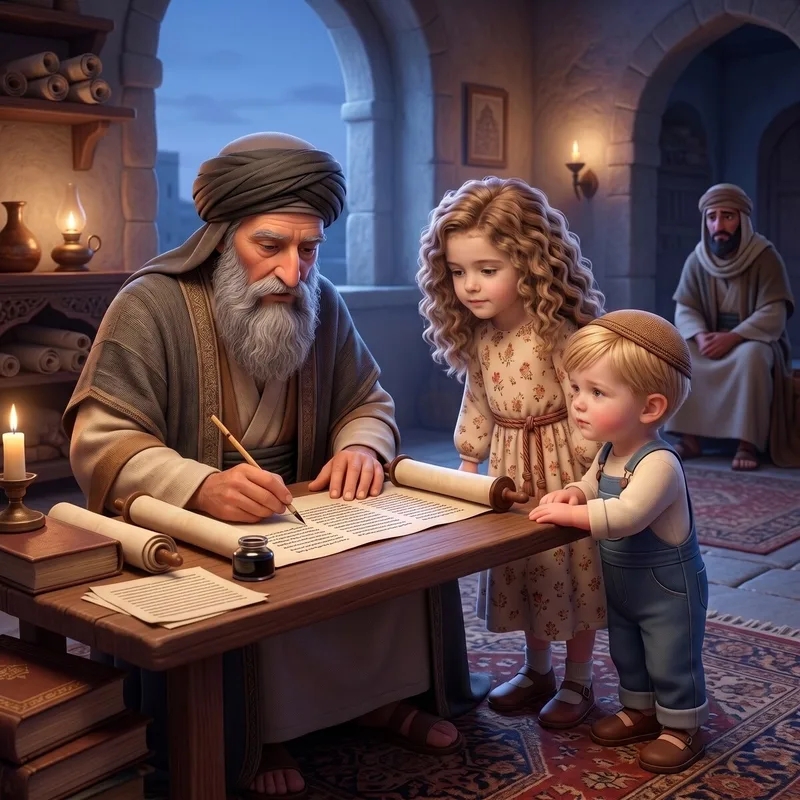
The Rav Amram Gaon book is from the Stories of Tzaddikim collection, in the Sefer Geonim. Your child's name and, from one uploaded photo, their likeness appear on every page, illustrated in 3D animated-film style. Up to eight children, ages 0 to 18, can appear in the same book, so siblings can share one.

Softcover 8″×8″

Hardcover 8″×8″

Board book 6″×6″

Coloring book 8.5″×11″
There are three formats: a 6x6 board book with rounded safety corners for ages 0-4, an 8x8 softcover for ages 4-8 and an 8x8 hardcover for ages 5-18. The softcover and hardcover open with a dedication page. An optional matching coloring book, 8.5x11 in black-and-white line art, can be added as a weekday activity. If you add parents, grandparents and other relatives with their photos, they appear with the children on a closing family page in every format.
Every book ends with a discussion page of 10 questions mixing comprehension with middos, what happened and what it asks of the child. That page is what turns a book read to a child into one talked about at the table. Every book is written with careful rabbinical guidance and strict tznius, and reviewed by our team before it goes to print.
Creating a book takes about five minutes. You open a free account and answer a few short questions: each child's name, boy or girl, age and one photo, any siblings, the story, your community (asked once), the language and the format. Languages are English, Hebrew and Yiddish.
If you would like your child to hear about Rav Amram Gaon with their own name in the story, you can create the book and choose the Rav Amram Gaon story from the Stories of Tzaddikim.
Frequently asked questions
Who was Rav Amram Gaon?
Rav Amram Gaon was the head of the yeshiva in Sura, in Bavel, in the period of the Geonim, over a thousand years ago. He is remembered for his responsa and above all for the Seder Rav Amram, an order of tefillos for the whole year. Later generations drew on his Seder when they set the text of the siddur.
What is the Seder Rav Amram?
The Seder Rav Amram is a collection of the tefillos for weekdays, Shabbos and the Yamim Tovim, together with the halachos that go with them. Tradition records that he sent it in answer to a request from the Jewish community of Spain. It is counted among the earliest complete orders of tefillos that we have.
What is a Gaon?
A Gaon was the head of one of the great yeshivos of Bavel, in Sura or in Pumbedisa, after the Gemara was completed. Yidden in far-off communities sent the Geonim their halachic questions, and the Geonim answered in letters. Rav Amram Gaon is one of the best-known Geonim.
How do I explain Rav Amram Gaon to a 4-year-old?
Keep it to one picture: Yidden far away wanted to know the right words for davening, and Rav Amram, a great Rav, wrote them down and sent them. You can add that when we open a siddur, we are using words that Yidden have been saying for a very long time. That is enough for this age.
Is Torah Tale's Rav Amram Gaon book suitable for young children?
Torah Tale offers a 6x6 board book with rounded safety corners for ages 0-4, an 8x8 softcover for ages 4-8 and an 8x8 hardcover for ages 5-18. Your child's age is one of the short questions when you create the book. Every book ends with a discussion page of 10 questions mixing comprehension with middos.