Ravina for Kids: Sof Hora'ah, Rav Ashi & the Last Link in the Gemara
Ravina was an Amora whom the Gemara pairs with Rav Ashi as 'the end of hora'ah'. Here is what that means, what children can take from it, and questions to ask at the Shabbos table.
Published by Torah Tale.
Create this book for your child
Ravina was an Amora, one of the Sages of the Gemara, and the Gemara names him together with Rav Ashi as 'the end of hora'ah'. Children connect with him because the idea is simple: Torah is handed from person to person, and each person has a place in the chain.
Who was Ravina?
Ravina is one of the Amoraim, the teachers whose discussions fill the Gemara. His name appears throughout the Bavli, often in the same pages as Rav Ashi. The meforshim discuss which Ravina is meant in different places, since the name appears more than once in the Gemara.
For a young child, you do not need to settle this. What matters is that Ravina is one of the Chachmei HaGemara whose Torah we still learn today.
What does the Gemara say about Rav Ashi and Ravina?
In Bava Metzia 86a the Gemara says: 'Rebbi and Rabbi Nassan are the end of Mishnah. Rav Ashi and Ravina are the end of hora'ah.' It is a short line, but it places the two of them at the close of an era.
Rebbi, who is the subject of our article on Rabbi Yehuda HaNasi, stands at the close of the Mishnah. Rav Ashi and Ravina stand at the close of the period of the Gemara. You can read about Rav Ashi and his yeshiva in Sura in a separate article.
What does 'sof hora'ah' mean?
The words mean 'the end of hora'ah', and the meforshim discuss exactly how to understand them. The simple understanding is that Rav Ashi and Ravina were among the last of the great teachers of the Gemara, after whom that period closed.
If your child asks what hora'ah is, you can say it is teaching Torah and ruling what to do. Then explain that the Gemara as we have it reached its close in their time. We will not add details beyond this, because the Gemara itself says no more in this line.
What can children learn from Ravina?
The Gemara does not tell us in this line about Ravina's personality, so we should be careful not to invent it. What we can say is what we learn from the fact itself: Ravina is named together with Rav Ashi. They are remembered as a pair.
- Being a link. Torah did not begin with us and does not end with us. Every child who learns is another link.
- Learning with others. Two names stand together at the close of the Gemara. Torah grows when people learn together.
- Handing it on. What we learn is meant to be passed to the next child, the next class, the next generation.
How do I explain Ravina to a 4-year-old, a 7-year-old and a 10-year-old?
Age 4: Say it in one sentence. 'Ravina was a wise teacher of Torah, and his Torah is in the Gemara that big boys and men learn.' Then ask who teaches your child Torah, and thank that person together.
Age 7: Explain the chain. The Torah went from Moshe Rabbeinu to the Yidden after him, and the Chachmei HaGemara learned, taught and passed on their Torah so that it would never be lost. Ravina and Rav Ashi are named at the end of that Gemara. Ask: who is the next link after us?
Age 10 to 12: Bring the source. Show the line in Bava Metzia 86a if you have the Gemara at home, or tell it to them, and compare 'end of Mishnah' with 'end of hora'ah'. Ask what it means to stand at the end of something and what it asks of us who come after.
What questions can we ask at the Shabbos table?
Reading and talking are right for Shabbos, so these questions need no pen, paper or screen.
- Who taught you something in Torah this week?
- Why is it good that Rav Ashi and Ravina are named together?
- What is something you began and finished?
- Who could you teach something to?
- Why do you think the Gemara keeps the names of the Sages who said each thing?
For a weekday activity, you can cut paper strips and join them into a chain, with each link carrying the name of someone who taught your child. That is a weekday or erev Shabbos activity only, since cutting and writing are melacha on Shabbos and Yom Tov.
What is the personalized Torah Tale book about Ravina like?
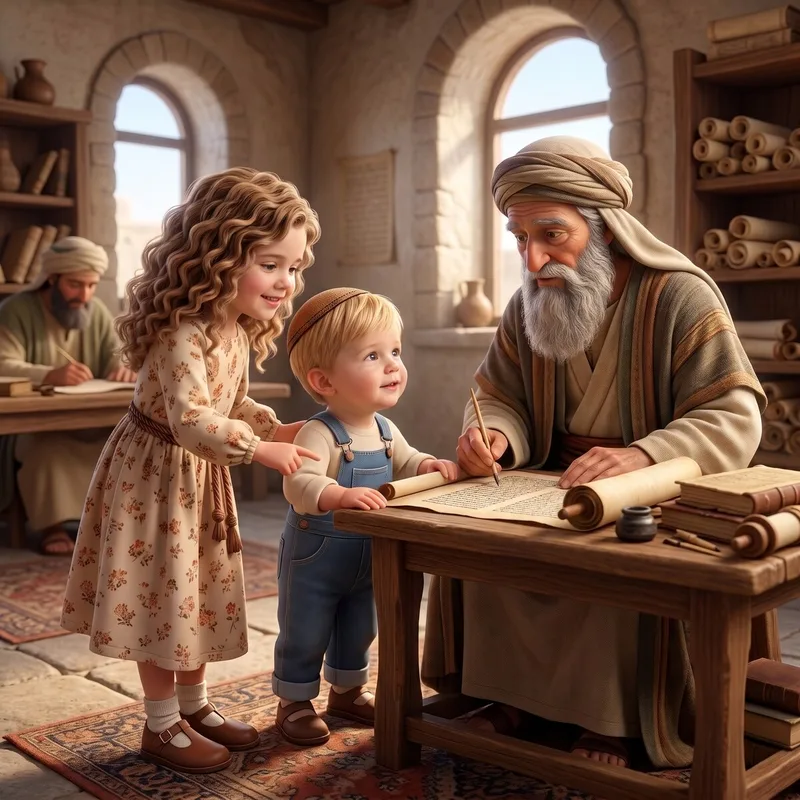
Torah Tale's Ravina story is part of the Stories of Tzaddikim collection, together with the Sefer Amoraim stories. Your child's name and likeness, from one uploaded photo, appear on every page, illustrated in 3D animated-film style. Up to eight children can appear in the same book.

Softcover 8″×8″

Hardcover 8″×8″

Board book 6″×6″

Coloring book 8.5″×11″
The formats are a softcover photo book 8"x8" (ages 4-8), a hardcover photo book 8"x8" (ages 5-18) and a board book 6"x6" with rounded safety corners (ages 0-4). An optional matching coloring book 8.5"x11" is available as a weekday activity. Softcover and hardcover open with a dedication page. If you add parents and grandparents, they appear with the children on a closing family page in every format.
Every book ends with a discussion page of ten questions that mix comprehension with middos. It turns the book into something you talk about at the table. Every book is written with careful rabbinical guidance and strict tznius, and is reviewed by our team before it goes to print.
If you would like to read more Amoraim stories first, see Rava and Rav Huna.
When you are ready, you can create the book for your child. It takes a free account and a few short questions: each child's name, boy or girl, age and one photo, any siblings, the story, your community, the language and the format.
Frequently asked questions
Who was Ravina?
Ravina was one of the Amoraim, the Sages of the Gemara. The Gemara in Bava Metzia 86a pairs him with Rav Ashi, saying 'Rav Ashi and Ravina are the end of hora'ah.' The meforshim discuss exactly which Ravina is meant, since the name appears more than once in the Gemara.
What does 'sof hora'ah' mean?
The Gemara uses it for Rav Ashi and Ravina, just as it says Rebbi and Rabbi Nassan are 'the end of Mishnah.' Simply put, it marks them as standing at the close of the period of the Gemara. For a child you can say that they were among the last of the great teachers whose words became part of the Gemara we learn today.
How do I explain Ravina to a 4-year-old?
Keep it to one picture: the Gemara is a very long chain of Torah that was passed from teacher to student, and Ravina was a faithful link near the end of it. You can add that because of Chazal, we can learn the same Torah today. Then ask your child who teaches them Torah, and thank that person together.
What is the lesson of Ravina for children?
We learn from Ravina to be a faithful link in the chain of Torah: to learn with others, to finish what we start, and to hand it on to the next child. It also teaches that Torah is built by many people working together, as Rav Ashi and Ravina are named together in the Gemara.
Is there a personalized Torah Tale book about Ravina?
Yes. It is part of the Stories of Tzaddikim collection, with the Sefer Amoraim stories, and your child's name and likeness appear in it, illustrated in 3D animated-film style. Creating it takes a free account and a few short questions, and every book ends with a discussion page of ten questions about the story.