Rabbi Yehuda HaNasi for Kids: Rebbi, the Mishnah & Rachamim
Rabbi Yehuda HaNasi, known as Rebbi, arranged the Mishnah and, as the Gemara tells it, learned rachamim for every creature. Here is the story, the lesson, and how to tell it to a 4-year-old, a 7-year-old and an 11-year-old.
Published by Torah Tale.
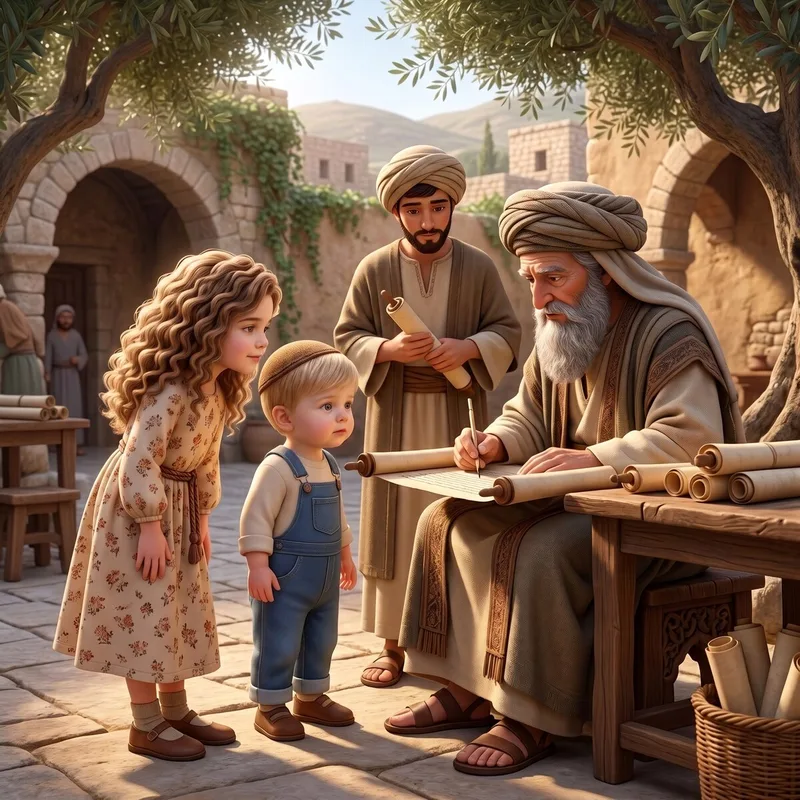
Create this book for your child
Rabbi Yehuda HaNasi, known simply as Rebbi, was the leader of Klal Yisrael in Eretz Yisrael who arranged the Mishnah, and the Gemara tells a short story about him that children remember: a calf, a few young weasels, and the pasuk about Hashem's rachamim on all His creatures. It lands with children because it is about something they understand, being gentle with a small, frightened animal.
Who was Rabbi Yehuda HaNasi?
Rebbi was a Tanna, one of the Sages of the Mishnah, and he was the Nasi, the head of the Jewish people in Eretz Yisrael. He is also called Rabbeinu HaKadosh, our holy teacher. The Gemara in Kiddushin (72b) tells us that he was born on the day Rabbi Akiva was niftar, as if the Torah was passed on from one great teacher to the next.
If your child already knows the story of Rabbi Akiva, that is a lovely place to connect the two. The teachings of Tannaim like Rabbi Akiva and Rabbi Meir fill the pages of the Mishnah that Rebbi arranged.
Why did Rebbi write down the Mishnah?
The Mishnah is the heart of the Torah Shebe'al Peh, the Oral Torah. It is arranged in six sedarim, and every Yid who learns Gemara is learning a discussion of the Mishnah. As the Rambam explains in his introduction to the Mishneh Torah, Rebbi gathered the teachings into one organized work so that the Torah Shebe'al Peh would not be forgotten. Until then, it had been learned by heart and passed from teacher to student.
For a child, this can be put very simply: Rebbi made sure that what the Chachamim taught would stay with Klal Yisrael for every generation, including ours.
What is the story of Rebbi and the calf?
This is told in the Gemara, Bava Metzia 85a. One day a calf was being taken to be slaughtered. It came to Rebbi, hid its head in the corner of his robe, and cried. Rebbi said to it, 'Go, for this you were created.'
Chazal tell us that in Heaven they said: since he showed no rachamim here, let suffering come upon him. The Gemara says this went on for thirteen years. It was not a punishment for a wicked man, of course. Hashem is exacting with tzaddikim to a hair's breadth (Yevamos 121b), and a leader like Rebbi was held to the very highest standard.
Then, the Gemara relates, one day Rebbi's maidservant was sweeping the house and saw some young weasels. She began to sweep them away. Rebbi said, 'Leave them. It is written, v'rachamav al kol maasav, His mercy is on all His creations' (Tehillim 145:9). In Heaven they said: since he is merciful, let us have mercy on him. And Rebbi was healed.
What is the lesson of this story for children?
The first lesson is rachamim. Hashem's rachamim reaches every creature He made, and we are asked to walk in His ways by being gentle too. That includes a pet, a snail on the path, and a baby cousin who is crying.
The second lesson is the care a person takes with what is small. In Pirkei Avos (2:1) Rebbi himself teaches us to be as careful with a light mitzvah as with a weighty one. Children often think a small kindness does not count, and Rebbi's story shows that a small moment can matter very much.
The third is humility about Torah. The Gemara in Ketubos (103b) tells that near the end of his life Rebbi raised his ten fingers to Heaven and said that he had toiled in Torah with all ten fingers and had not taken worldly benefit even with his smallest finger. A child can hear this as: a great person is great because he serves Hashem, not because he is important.
How do I explain Rebbi to a 4-year-old, a 7-year-old and an 11-year-old?
Age 4. Use one picture and one sentence: 'Rebbi was a very great rabbi, and he taught that Hashem loves all His animals, so we are kind to them too.' Ask your child to show how to pet a cat gently.
Age 7. Tell the story in order: the calf, the robe, the weasels, the pasuk. Then ask what Rebbi understood the second time that he had not seen the first time. Children this age are good at noticing that even a tzaddik grows.
Age 11. Add the bigger picture. Explain why the Mishnah was arranged and why Chazal say Hashem is exacting with the righteous. Ask what it means that someone with so much Torah was still expected to show rachamim in a small moment, and what that says about how we should treat people, not only animals.
What can we talk about at the Shabbos table?
Reading and talking are perfect for Shabbos. Here are questions to pass around, with no pencil or paper needed:
- What did the calf do when it came to Rebbi, and what did the weasels need?
- What does 'v'rachamav al kol maasav' mean in your own words?
- When did someone show you rachamim this week?
- Is there a small mitzvah in our house that is easy to skip? How can we be careful with it?
- Why do you think the Mishnah was arranged so that it would not be forgotten?
For a quick weekday follow-up, a parent can ask at supper, 'Who did you show rachamim to today?' That one question can turn the story into a small habit.

Softcover 8″×8″

Hardcover 8″×8″

Board book 6″×6″

Coloring book 8.5″×11″
What is a personalized Torah Tale book about Rabbi Yehuda HaNasi like?
Rabbi Yehuda HaNasi is one of the stories in the Stories of Tzaddikim collection. In a Torah Tale book, your child's name and, from one uploaded photo, their likeness appear on every page, illustrated in 3D animated-film style. You can include up to eight children in one book, ages 0 to 18.
Every book ends with a dedicated discussion page of 10 questions that mix comprehension with middos, which makes it easy to turn a bedtime read into a conversation. If you add parents, grandparents and other relatives, they appear with the children on a closing family page in every format. Softcover and hardcover books also open with a dedication page.
Choose the format by your child's age: a 6"x6" board book with rounded safety corners for ages 0-4, an 8"x8" softcover for ages 4-8, or an 8"x8" hardcover for ages 5-18. The books come in English, Hebrew and Yiddish. An optional matching 8.5"x11" coloring book in black-and-white line art is a good weekday activity, such as erev Shabbos or a weekday afternoon, and never for Shabbos or Yom Tov itself. The storybook is the one to read at the Shabbos table.
Every book is written with careful rabbinical guidance and strict tznius, and reviewed by our team before it goes to print. If you want to see how the steps work, there is a walkthrough in how to create a personalized Torah storybook.
Creating a book takes about five minutes: a free account and a few short questions covering each child's name, boy or girl, age and one photo, any siblings, the story, your community, the language and the format. When you are ready, you can create the book and make Rebbi's lesson of rachamim a story your child is part of.
Frequently asked questions
Who was Rabbi Yehuda HaNasi?
Rabbi Yehuda HaNasi, called Rebbi, was a Tanna and the Nasi, the leader of Klal Yisrael in Eretz Yisrael. He arranged the Mishnah, the written foundation of the Torah Shebe'al Peh that the Gemara later explains. He is also called Rabbeinu HaKadosh.
Why did Rebbi write the Mishnah?
As the Rambam explains in his introduction to the Mishneh Torah, Rebbi gathered the teachings of the Tannaim into one organized work so that the Torah Shebe'al Peh would not be forgotten. Until then it had been learned by heart and passed from teacher to student.
What is the story of Rebbi and the calf?
The Gemara in Bava Metzia 85a tells that a calf being led to slaughter hid its head in Rebbi's robe and cried, and Rebbi said, 'Go, for this you were created.' Chazal say suffering then came upon him, until the day he told his maidservant to leave some young weasels alone, saying 'v'rachamav al kol maasav.' After that he was healed.
What is the lesson of Rabbi Yehuda HaNasi for children?
The central lesson is rachamim, being kind to every creature Hashem made. Another lesson is that people who are great in Torah are held to a very high standard, and that we should take even a 'light' mitzvah seriously, as Rebbi himself teaches in Pirkei Avos.
How do I explain Rebbi to a 4-year-old?
Keep it to one picture: Rebbi was a very great rabbi who loved Hashem's animals, and he taught that we must be kind to every creature. Then ask a simple question, such as how your child can be gentle with a pet, a bug or a baby sibling.