Rabbi Meir for Kids: The Sofer, One Letter & "Don't Look at the Jug"
Rabbi Meir was a leading talmid of Rabbi Akiva, a sofer by trade, and the voice behind countless Mishnayos. Here is his story told the way children can hold it, with the single-letter lesson from Eruvin, Bruriah's answer in Berachos, "do not look at the jug" from Pirkei Avos, how to say it at ages 3-4, 6-7 and 9-12, and questions for the Shabbos table.
Published by Torah Tale.
Create this book for your child
Rabbi Meir was one of the greatest Tannaim, a leading talmid of Rabbi Akiva who helped rebuild Torah in the generation after the churban of the Beis HaMikdash. Children take to him quickly because his life hands them three clear pictures: a sofer leaning over parchment where a single letter matters, a husband who learned to daven that trouble should end rather than that people should, and a rebbi who said not to look at the jug but at what is inside it.
Who was Rabbi Meir, and why was he called Meir?
Rabbi Meir lived in a generation that had to put Torah back together after terrible years. He was one of the talmidim of Rabbi Akiva, and the Gemara (Sanhedrin 14a) relates that Rabbi Yehuda ben Bava gave semicha to Rabbi Meir and his colleagues at the risk of his own life, so that the chain of Torah would not be broken.
The Gemara in Eruvin 13b says something striking: his name was Rabbi Nehorai, and he was called Meir because he lit up the eyes of the Chachamim in halacha. The same sugya records that Rabbi Yehuda HaNasi said he became as sharp as he was because he saw Rabbi Meir only from behind, and had he seen him from the front he would have been sharper still.
There is one more fact worth telling a child who is already learning Mishnayos. The Gemara (Sanhedrin 86a) teaches in the name of Rabbi Yochanan that an unattributed Mishnah, one that simply says what the halacha is without naming a Tanna, is Rabbi Meir. So his voice is in the Mishnah far more often than his name is.
Many families also know him as Rabbi Meir Baal HaNes, from the episode in Avodah Zarah 18a in which a yeshuah came through the words "Elaka d'Meir aneini." That is where the widespread minhag of giving tzedakah and saying those words when something is lost comes from, and why so many homes keep a pushka with his name on it. The details of the minhag are worth asking your rav about.
The sofer who knew that one letter changes everything
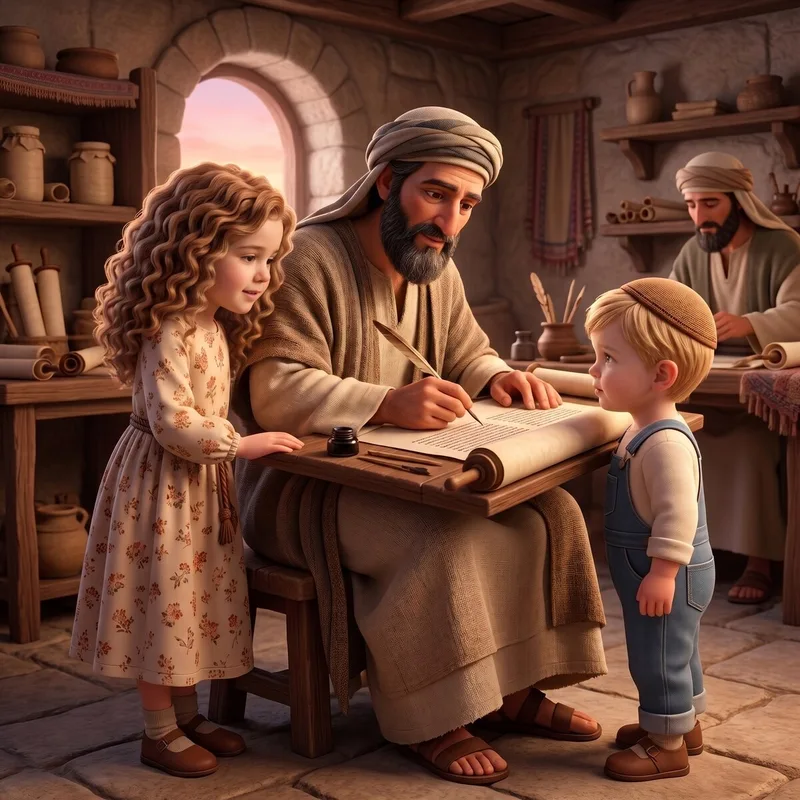
Rabbi Meir earned his bread as a sofer. The Gemara in Eruvin 13a relates that Rabbi Yishmael asked him what his work was, and when Rabbi Meir answered that he was a scribe, Rabbi Yishmael told him to be very careful, because it is heavenly work: leave out one letter or add one letter, and you affect the entire world. Rabbi Meir answered that he adds a certain ingredient called kankantum to his ink so that the letters cannot be erased.
This is the detail children remember longest, and it is easy to make concrete. One letter can turn a word into a completely different word. A person who writes holy letters cannot be "almost" careful, because the sefer is either kosher or it is not.
From there the step to a child's own life is short and honest. The way a child says one word to a sibling, the one brachah said with attention instead of mumbled, the one line of a Mishnah learned properly: small units are what the whole thing is built from. Rabbi Meir did not become great in addition to his careful work. He became great through it.
Bruriah's answer: daven for the trouble to end
The Gemara in Berachos 10a relates that there were troublemakers in Rabbi Meir's neighborhood who caused him a great deal of grief, and Rabbi Meir davened that they should be gone from the world. His wife Bruriah, a daughter of Rabbi Chanina ben Teradyon and herself known for her Torah, pointed him to the pasuk in Tehillim 104:35: it asks that chata'im, sins, should end from the earth, not chot'im, sinners. Daven instead that they do teshuvah, she said. Rabbi Meir davened for them, and they did teshuvah.
For children this is one of the clearest lessons in all of Chazal about ahavas Yisrael. You are allowed to want the hurting to stop. What you want to disappear is the behavior, not the boy who did it. A child who can hold that distinction at seven will handle a lot of recess differently at ten.
"Do not look at the jug": Rabbi Meir in Pirkei Avos
In Pirkei Avos 4:20 Rabbi Meir says: do not look at the jug, but at what is inside it. There is a new jug full of old wine, and an old jug that does not even have new wine in it. He also teaches in Avos 4:10 to limit your business dealings and busy yourself with Torah, and in the sixth perek that one who learns Torah lishmah merits many things.
The jug line is the one to use at home. Children judge each other by very visible things: the new coat, the lunchbox, who is fast at sports, who stammers over a pasuk. Rabbi Meir, who spent his days with ink and parchment, is exactly the right person to say that what counts is what is inside the container.
How to explain Rabbi Meir at different ages
- Ages 3-4: "Rabbi Meir wrote the holy letters of the Torah, and he was careful with every single one." Let them see you point at letters in a siddur and name a few.
- Ages 6-7: Add the jug. Fill a plain cup and a fancy cup with water and ask which water tastes better. Then say Rabbi Meir's words: look at what is inside, not at the outside.
- Ages 9-12: Tell the story from Berachos 10a with the pasuk in front of them, and show them the difference one letter makes between chata'im and chot'im. Then tell them that when they learn a Mishnah with no name on it, they are often hearing Rabbi Meir.
What a personalized Torah Tale book about Rabbi Meir is like
Rabbi Meir's story is part of the Stories of Tzaddikim collection, Sefer Tannaim, which carries the Jewish leaders of the last two thousand years. In a Torah Tale book, your own child is in the story: their name and, from one uploaded photo, their likeness appear on every page, illustrated in high-resolution 3D animated-film style. Up to eight siblings, ages 0 to 18, can appear in the same book.

Softcover 8″×8″

Hardcover 8″×8″

Board book 6″×6″

Coloring book 8.5″×11″
There are three formats: a 6x6 board book with rounded safety corners for ages 0-4, an 8x8 softcover for ages 4-8, and an 8x8 hardcover for ages 5-18. The softcover and hardcover open with a dedication page, and if you add parents and grandparents with their photos, they appear with the children on a closing family page in every format. Every book ends with a discussion page carrying ten questions about the story, mixing comprehension with middos, which is what turns it from a book read to a child into a conversation at the Shabbos table.
Creating one takes about five minutes: a free account and a few short questions, each child's name, boy or girl, age and one photo, any siblings, the story, your community (asked once), the language (English, Hebrew or Yiddish) and the format. Every book is written with careful rabbinical guidance and strict tznius and reviewed by our team before it goes to print.

You can order a single book, or subscribe to the collection. Stories of Tzaddikim can be taken as a collection subscription, monthly or yearly ($30 off when you pay for the year, four books a month in one delivery from that collection), or as a single book. One-time orders ship with US standard shipping at $5.99, free on orders of $75 or more, and arrive in about 12 business days; we ship worldwide, with rates shown at checkout.
Five questions for the Shabbos table, and one thing to do during the week
These are talking questions, meant for the table on Shabbos, and they work whether or not you have the book in front of you:
- Rabbi Meir's work was writing letters. What is one thing you do where being careful really matters?
- If one extra letter can change a word, what is one extra word that can change a whole conversation?
- Bruriah said to daven that the bad behavior should stop. Why is that different from davening that a person should be punished?
- Who is someone you once judged by the outside and then found out you were wrong about?
- Rabbi Meir was called Meir because he lit up other people's eyes. Who in our family or class makes things clearer for everyone else?
For a weekday afternoon or erev Shabbos, when writing is permitted: sit with your child, write one short word, then rewrite it with one letter changed and read both out loud. Three minutes of that teaches the Eruvin story better than any explanation. A matching coloring book, 8.5x11 in black-and-white line art, can be added to a book as a one-time add-on for the same kind of weekday session, before Shabbos rather than on it. For a different tzaddik to pair it with, see Rabban Yochanan ben Zakkai, who saved Torah a few generations earlier.
If your child is holding a book in which they stand in Rabbi Meir's world, the lesson about one careful letter stops being about somebody far away. You can create the book in about five minutes.
Frequently asked questions
Who was Rabbi Meir?
Rabbi Meir was one of the great Tannaim, living in the generation after the churban of the Beis HaMikdash. He was a leading talmid of Rabbi Akiva and one of the talmidim who received semicha from Rabbi Yehuda ben Bava, keeping the chain of Torah unbroken in a very hard time. He earned his living as a sofer, and the Gemara in Sanhedrin 86a teaches in the name of Rabbi Yochanan that an anonymous Mishnah is his teaching.
Why was he called Rabbi Meir?
The Gemara in Eruvin 13b says that his name was really Rabbi Nehorai, and that he was called Meir because he lit up the eyes of the Chachamim in halacha. For children, that is a lovely way to say it: when he explained something, everyone else suddenly saw clearly. Nehorai and Meir both carry the idea of light.
Why do people say "Rabbi Meir Baal HaNes"?
The Gemara in Avodah Zarah 18a relates an episode in which a yeshuah came through the words "Elaka d'Meir aneini" (the G-d of Meir, answer me). From there comes the widespread minhag of giving tzedakah and saying those words when something is lost or when a person needs help, and many homes keep a Rabbi Meir Baal HaNes pushka on a shelf. For the details of how the minhag is practiced in your family, ask your rav.
How do I explain Rabbi Meir to a 5-year-old?
Say it in one sentence: Rabbi Meir wrote holy letters for a living, and he was so careful that he knew even one extra letter could change everything. Then add his other famous lesson in words a five-year-old owns: you cannot tell what is inside a jug by looking at the outside, and you cannot tell what is inside a person by looking at his clothes. Children this age do not need the Gemara citations, only the two pictures.
What is the lesson of Rabbi Meir for children?
Three lessons come through clearly. Small things are not small: one letter written carefully or carelessly matters, and so does one word a child says. People are not their outsides: Rabbi Meir taught not to look at the jug but at what is in it. And when someone is making your life hard, the goal is for the bad behavior to stop, not for the person to be hurt, which is what Bruriah showed Rabbi Meir from the pasuk in Tehillim.
Is there a Torah Tale book about Rabbi Meir?
Yes. Rabbi Meir is part of the Stories of Tzaddikim collection, Sefer Tannaim, and the book stars your own child: their name and, from one uploaded photo, their likeness appear on every page, illustrated in high-resolution 3D animated-film style. Up to eight siblings can appear in the same book, ages 0 to 18, and every book ends with a discussion page of ten questions about the story, mixing comprehension with middos. It comes as a 6x6 board book with rounded safety corners for ages 0-4, an 8x8 softcover for ages 4-8, or an 8x8 hardcover for ages 5-18.