Rabbi Yishmael ben Elisha for Kids: The Lamp & the Thirteen Middos
Rabbi Yishmael ben Elisha made a mistake, admitted it and wrote it down. Here is the story, the thirteen middos we say every morning, and how to talk about it with a 4-year-old, an 8-year-old and an 11-year-old.
Published by Torah Tale.
Create this book for your child
Rabbi Yishmael ben Elisha was a kohen and a Tanna whose name children meet in davening, because the Baraisa of Rabbi Yishmael, with its thirteen middos for learning Torah, is part of Shacharis. His best-known story for children is a small one: he made a mistake on Shabbos, admitted it, and wrote it down. It lands with kids because it shows that even a great person can say 'I was wrong' simply and without excuses.
Who was Rabbi Yishmael ben Elisha?
Rabbi Yishmael ben Elisha was one of the Tannaim, the sages of the Mishnah and the Baraisos, and he was a kohen. He lived in the time of Rabbi Akiva, and the Gemara often brings their different approaches to learning the pesukim, each introduced with 'Rabbi Yishmael omer' and 'Rabbi Akiva omer'. If your child already knows Rabbi Akiva's story, this is a natural next tzaddik to meet.
The Mechilta on Sefer Shemos that carries his name is named for his Beis Medrash. He is also counted among the Asarah Harugei Malchus, the ten Tannaim whom we remember on Yom Kippur. Young children do not need the details. One sentence is enough: he was a great Torah teacher who gave his life as a Yid.
What is the story of Rabbi Yishmael and the lamp?
The Chachamim made a protective rule that one should not read by the light of a lamp on Shabbos, in case a person tilts the lamp to make the light better. Chazal tell us in Maseches Shabbos (12b) that Rabbi Yishmael ben Elisha said he would read by the lamp and not tilt it.
Then it happened: he did tilt it. He said, 'How great are the words of the Chachamim, who said not to read by the light of a lamp.' He did not argue that he had been careful enough, and he did not explain it away.
The Gemara adds that he wrote in his notebook that he, Yishmael ben Elisha, had read and tilted the lamp on Shabbos, and that when the Beis HaMikdash is rebuilt he will bring a fat chatas. A chatas is the korban brought for a mistake made without meaning to. He wrote it down so he would not forget and would be ready to make it right.
What are the thirteen middos of Rabbi Yishmael?
Many siddurim include the Baraisa of Rabbi Yishmael in Shacharis, after the korbanos, and it comes from the opening of the Sifra. It lists thirteen ways the Torah is expounded. Here 'middos' means rules of learning, not character traits, and it is worth telling children so there is no confusion.
The first is a kal vachomer: if something is true in an easier case, it is certainly true in a harder one. Others include gezeirah shavah and binyan av. You do not need to teach all thirteen to a child. Saying 'these are the tools the Chachamim use to learn the Torah' is enough to make the words in davening feel familiar.
What is the lesson of Rabbi Yishmael's story for children?
The first lesson is honesty about our own mistakes. The Gemara shows a great Tanna who does not hide his mistake. He names it, he says the Chachamim were right, and he plans how to fix it.
The second is respect for rules made to protect us. The Chachamim's rule was made so that a person would not tilt the lamp, and Rabbi Yishmael saw for himself how true it was. Children also know the feeling of 'I'll be careful, I won't do it', and then doing it anyway. That is a very human moment, and it is good for them to see that a tzaddik had it too.
Pirkei Avos (3:12) records a teaching of Rabbi Yishmael, usually understood to be Rabbi Yishmael ben Elisha: be yielding to a superior, pleasant to the young, and receive every person with joy. It fits the same character, a person who is easy to be around and does not insist on being right. For a related lesson in saying sorry, see Rabban Gamliel of Yavneh.
Chazal also record, in Berachos 7a, a tefillah of Rabbi Yishmael when he went in to offer ketores: that Hashem's mercy overcome His anger and that Hashem treat His children with mercy, beyond the letter of the law. It is a lovely thing to tell older children, since it shows what he asked for.
How do I explain Rabbi Yishmael ben Elisha to a 4-year-old, an 8-year-old and an 11-year-old?
For a 4-year-old
Keep it to four sentences. Rabbi Yishmael was a very smart rabbi. One Shabbos he did something the Chachamim said not to do. He said, 'The Chachamim were right.' Then he wrote it in his notebook so he would remember to make it right.
For an 8-year-old
Explain what a protective rule is: the Chachamim made a rule to keep people far from a mistake. Ask, 'Why do you think the Chachamim said not to read near the lamp?' Then ask what it takes to say 'I was wrong' out loud, and why writing it down mattered.
For an 11-year-old
Talk about the difference between making a mistake and hiding it. Bring the thirteen middos and show one kal vachomer, so they see that he was a person who taught how to think, not only how to behave. Ask how a person keeps a high standard without being hard on others, which is the spirit of 'receive every person with joy'.
What is a personalized Torah Tale book about Rabbi Yishmael like?
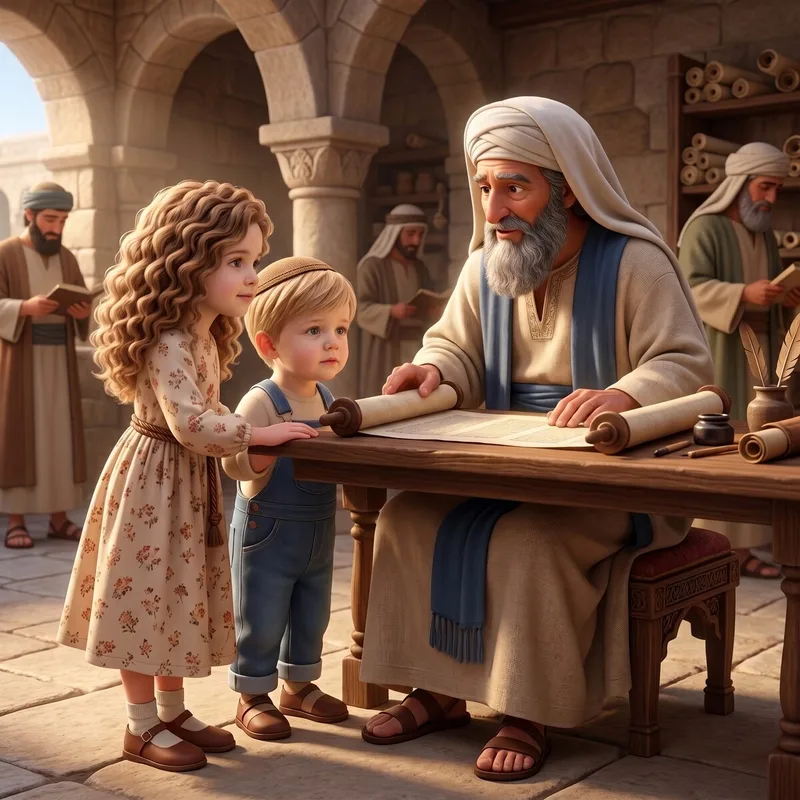
Torah Tale's Stories of Tzaddikim collection has a book about Rabbi Yishmael ben Elisha. Your child's name and, from one uploaded photo, their likeness appear on every page in 3D animated-film style, and up to eight siblings, ages 0 to 18, can be in the same book. Every book is written with careful rabbinical guidance and strict tznius, and reviewed by our team before it goes to print.

Softcover 8″×8″

Hardcover 8″×8″

Board book 6″×6″

Coloring book 8.5″×11″
Choose the format by your child's age: a 6x6 board book with rounded safety corners for ages 0-4, an 8x8 softcover for ages 4-8, or an 8x8 hardcover for ages 5-18. The softcover and hardcover open with a dedication page. If you add parents, grandparents and other relatives with their photos, they appear with the children on a closing family page in every format.
Every book also ends with a discussion page of 10 questions about the story, mixing comprehension with middos. That is what turns the book from something read to a child into something talked about at the table. Reading a storybook is entirely appropriate on Shabbos, so it can sit on the Shabbos table. The optional matching coloring book is a weekday activity, for erev Shabbos or a weekday afternoon, never for Shabbos or Yom Tov.
What can we talk about at the Shabbos table?
These are for talking only, so they work at the table with no materials. Pick one or two and let the conversation go.
- What did Rabbi Yishmael say the moment he tilted the lamp?
- Why do you think the Chachamim made a rule to keep us far from a mistake?
- Is it easy or hard to say 'I was wrong'? When did you last say it?
- Why do you think he wrote it in his notebook?
- What does it mean to receive every person with joy, and who can we welcome that way this week?
You can also go first: tell about a small mistake of your own and how you fixed it. Children remember that far longer than any lecture.
Ready to make it personal? Create the book in about five minutes with a free account and a few short questions, and your child becomes part of the story of Rabbi Yishmael ben Elisha.
Frequently asked questions
Who was Rabbi Yishmael ben Elisha?
Rabbi Yishmael ben Elisha was a kohen and one of the Tannaim, the sages of the Mishnah. He is known for the Baraisa of Rabbi Yishmael, the thirteen middos by which the Torah is expounded, which we say in Shacharis. The Mechilta on Sefer Shemos that carries his name is also connected to his Beis Medrash, and he is counted among the Asarah Harugei Malchus.
What is the story of Rabbi Yishmael and the lamp?
The Gemara in Shabbos 12b tells that Rabbi Yishmael ben Elisha said he would read by the light of a lamp on Shabbos without tilting it. Then he did tilt the lamp, and he said how great are the words of the Chachamim, who had forbidden reading by lamplight as a protection. He wrote in his notebook that when the Beis HaMikdash is rebuilt he will bring a chatas.
What is the lesson of Rabbi Yishmael ben Elisha for children?
The main lesson is honesty about our own mistakes. Even a great Tanna did not hide what happened or make excuses, and he said that the Chachamim were right. Children can learn that saying 'I made a mistake' is a sign of greatness, and that rules made to protect us are there for a reason.
How do I explain the thirteen middos of Rabbi Yishmael to a child?
Tell a young child that they are thirteen rules, like a toolbox, that help the Chachamim understand the pesukim. For an older child, give one example: a kal vachomer says that if something is true in an easier case, it is certainly true in a harder one. Make clear that here 'middos' means rules of learning, not character traits.
Is there a Torah Tale book about Rabbi Yishmael ben Elisha?
Yes, it is in the Stories of Tzaddikim collection. Your child's name and, from one uploaded photo, their likeness appear in 3D animated-film style, and every book ends with a discussion page of 10 questions mixing comprehension with middos. Creating it takes a free account and a few short questions, and starts at torahtale.com/create.