Rabban Yochanan ben Zakkai for Kids: Yavneh, the Coffin & Saving Torah
How Rabban Yochanan ben Zakkai left besieged Yerushalayim and asked for Yavneh so that Torah learning could go on, with ways to tell it to a 3-4 year old, a 6-7 year old and a 9-12 year old.
Published by Torah Tale.
Create this book for your child
Rabban Yochanan ben Zakkai was a great Tanna who lived when Yerushalayim was under siege and the Beis HaMikdash was about to be destroyed. The Gemara in Maseches Gittin relates how he left the city and asked for one small place, Yavneh, where Torah learning could go on. Children connect with it because it is a story of a wise Rebbe who stays calm, thinks ahead and protects the Torah.
What is the story of Rabban Yochanan ben Zakkai?
The Gemara in Gittin (56a-b) tells us that Roman armies, led by Vespasian, surrounded Yerushalayim. Inside the city there were biryonim, armed men who would not allow anyone to leave. Rabban Yochanan ben Zakkai wanted to speak with the Roman commander about saving what could be saved.
He had his talmidim spread word that he was ill, and then that he had passed away. Rabbi Eliezer and Rabbi Yehoshua carried him out of the city, one at his head and one at his feet. At the gate the guards wanted to check, but the talmidim said that people would say they had harmed their own Rebbe, and the gate was opened.
Rabban Yochanan was, of course, alive. Once outside, he went to Vespasian and greeted him with the words "Shalom alecha, melech." The Gemara relates that while they spoke, a messenger arrived with news that Vespasian had been chosen as the new emperor.
Why did he ask for Yavneh?
Vespasian told Rabban Yochanan to ask for whatever he wished. According to the Gemara, he asked for Yavneh and its chachamim, for the family of Rabban Gamliel, and for doctors to heal Rabbi Tzadok.
It was not a big request, and that is what children notice. He did not ask for riches or power. He asked for a place where chachamim could sit and learn, so that the Torah would not stop.
Yavneh then became a center of Torah learning. We learn from this that Torah can keep growing even in a very hard time, as long as someone cares enough to make a place for it.
What middos does this story teach?
There are a few, and you can pick the one that fits your child today.
- Thinking ahead and staying calm. He did not panic. He made a careful plan and asked for what Torah needed most.
- Caring about Torah. The Gemara shows how much it mattered to him that learning would continue.
- Respect and friendliness. The Gemara (Berachos 17a) says that no one ever greeted him first, not even a non-Jew in the marketplace. He always said Shalom first.
- Humility. In Pirkei Avos (2:8) he teaches that if you have learned much Torah, do not take credit for yourself, because that is what you were created for.
- Kindness. Avos D'Rabbi Nasan relates that when Rabbi Yehoshua cried over the ruined Beis HaMikdash, Rabban Yochanan comforted him: we have another kapparah, gemilus chasadim, as the pasuk says "ki chesed chafatzti v'lo zavach."
How do I explain Rabban Yochanan ben Zakkai to a 3-4 year old, a 6-7 year old and a 9-12 year old?
Ages 3-4. Keep it very simple: "Rabban Yochanan was a very wise Rebbe. He wanted all the Yidden to keep learning Torah. He asked for a special place called Yavneh, and the chachamim learned there." Skip the siege details. Mention that he was alive and well all along.
Ages 6-7. Tell the plan: the biryonim, the talmidim who carried him out, and the greeting "Shalom alecha, melech." Children this age love the clever part, so let them tell it back to you. Then ask why Yavneh mattered.
Ages 9-12. Talk about the choice he made. He could have asked for something for himself. What does it mean to choose what will last? You can also learn the Mishnah in Avos and the Gemara in Berachos together, and ask what it takes to greet everyone first.
What is a personalized Torah Tale book of this story like?
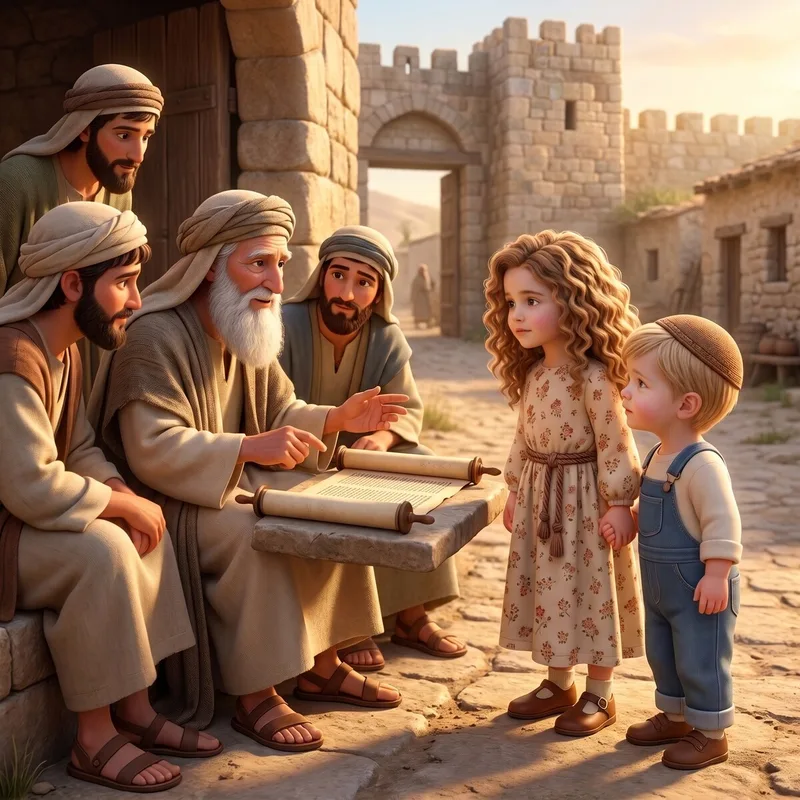
The Rabban Yochanan ben Zakkai book is in the Stories of Tzaddikim collection, in the Sefer Tannaim group. Your child's name and, from one uploaded photo, their likeness appear on every page, illustrated in 3D animated-film style, so your child becomes part of the story. Up to eight children can appear in the same book.
Every book is written with careful rabbinical guidance and strict tznius, and reviewed by our team before it goes to print. Every book also ends with a discussion page of 10 questions that mix comprehension with middos, so the story leads naturally into a conversation. If you add parents and grandparents, they appear with the children on a closing family page in every format.

Softcover 8″×8″

Hardcover 8″×8″

Board book 6″×6″

Coloring book 8.5″×11″
Which format fits which age?
The 6x6 board book with rounded safety corners is for ages 0-4. The 8x8 softcover is for ages 4-8, and the 8x8 hardcover is for ages 5-18. Softcover and hardcover books open with a dedication page. A book is a fine thing to read at the Shabbos table or on a long Yom Tov afternoon.
There is also an optional matching coloring book, 8.5"x11" in black-and-white line art. Coloring is melacha, so it is a weekday activity, such as an erev Shabbos afternoon, never something for Shabbos or Yom Tov.
What can we ask at the Shabbos table?
These are questions for talking, with no preparation needed. Choose the ones that suit the ages around your table.
- Why do you think Rabban Yochanan did not ask Vespasian for something big?
- What do you think the talmidim felt as they carried their Rebbe?
- Why is a place to learn Torah worth asking for?
- Who do you greet first at shul, in school or on the street? Is it easy?
- What are some ways we can do gemilus chasadim this week?
If your family already learned about other great leaders of Klal Yisrael, you might connect the story to how a personalized Torah storybook is made, or look at personalized Jewish gifts for kids if you are choosing a gift for a birthday or Yom Tov.
Is this story too frightening for children?
It can be told gently. The central facts are that Rabban Yochanan was safe, his talmidim were loyal, and Torah went on. You do not need to describe the siege in detail. If your child asks, say that the Beis HaMikdash was destroyed, that it was very sad, and that Rabban Yochanan helped Klal Yisrael continue learning.
When you are ready, create the book for your child. It begins with a free account and a few short questions: each child's name, boy or girl, age and one photo, any siblings, the story, your community (asked once), the language and the printed format. It takes about five minutes.
Frequently asked questions
What is the story of Rabban Yochanan ben Zakkai about?
It is the story of a great Tanna who lived while Yerushalayim was under siege. The Gemara in Gittin relates that he was carried out of the city by his talmidim and asked Vespasian for Yavneh and its chachamim, so that Torah learning could continue after the Beis HaMikdash was destroyed.
What is the lesson of Rabban Yochanan ben Zakkai for children?
Children can learn that Torah is worth protecting, that a calm and wise person can help in a hard time, and that kindness matters. His own words in Avos teach humility about learning, and the Gemara says he greeted everyone first.
How do I explain the coffin to a young child?
Say plainly that Rabban Yochanan ben Zakkai was alive and well. His talmidim carried him out in a way that made the guards believe he had passed away, so that he could leave the city safely and help the Yidden. For a 3 or 4 year old, keep it short and focus on the happy ending in Yavneh.
Why did Rabban Yochanan ben Zakkai ask for Yavneh?
The Gemara relates that when Vespasian offered him a request, he asked for Yavneh and its chachamim, along with the family of Rabban Gamliel and doctors to heal Rabbi Tzadok. Yavneh became a place where Torah learning continued.
What age is a Rabban Yochanan ben Zakkai storybook right for?
Torah Tale offers a 6x6 board book with rounded safety corners for ages 0-4, an 8x8 softcover for ages 4-8 and an 8x8 hardcover for ages 5-18. The child's age is one of the short questions when you create the book, and the story is shown with your child as the hero.