Rava for Kids: Setting Times for Torah, Honest Work & Abaye
Rava was an Amora in Bavel whose learning and honesty are still taught to children. Here is his story, what he taught, and how to explain him to a 3-4, 6-7 or 10-12 year old.
Published by Torah Tale.
Create this book for your child
Rava was one of the great Amoraim of Bavel, a rosh yeshiva whose words about honesty and setting times for Torah are still taught to children today. Children connect to him because his message is simple: learn with all your heart, and let it show in how you act.
Who was Rava in the Gemara?
Rava was an Amora in Bavel in the fourth century, and he taught Torah in Mechoza. The Amoraim are the Sages of the Gemara, who explained the Mishnah and worked out how to keep it in daily life. Rava's name is quoted so often beside Abaye's that the Gemara speaks of them together, 'Abaye and Rava'.
When the two of them disagreed, the halacha follows Rava, except in six cases that students remember with the letters of Yaal Kigam. For a child, the point is not who won. It is that two Torah scholars learned and questioned each other in order to understand what Hashem wants from us.
Rava's story is one of the stories of tzaddikim in the Sefer Amoraim. If your child has already met Rav Huna or Rav, Rava is a natural next step: you can read about Rav Huna and about Rav (Abba Aricha) as well.
What is the story of Rava for kids?
There is not one single tale of Rava but several pictures from the Gemara, and children remember them well. The first is in Shabbos 88a. The Gemara relates that Rava was once sitting so deeply absorbed in a sugya that he pressed his finger under his foot without noticing that it was hurting.
A Tzeduki who saw this spoke sharply about Yidden saying naaseh before nishma, the words of Shemos 24:7. Rava answered that Yidden came to Hashem with temimus, wholeheartedly. The scene is meant to show how completely Rava lived in his learning, not to be copied. Tell your child plainly that nobody should ever hurt themselves to learn, and that the picture is about how much he cared.
The second picture is in Shabbos 31a, where the Gemara brings Rava's words about the day a person is brought to judgment in the next world. The third is in Brachos 17a, where Rava says what all learning is for. Both are worth telling next.
What did Rava teach about honesty and setting times for Torah?
In Shabbos 31a the Gemara brings Rava's words that when a person comes before the Beis Din Shel Maalah, he is asked a series of questions. The first two are נשאת ונתת באמונה, did you deal faithfully with others in business, and קבעת עתים לתורה, did you set times for Torah. The Gemara lists more questions after these, so it is worth telling children these are the first two of a longer list.
For a child, this turns into something very ordinary. Honest dealing means telling the truth, giving back the right change and keeping your word. Setting times for Torah means that learning has a fixed place in the day, whether it is five minutes before bed or a parsha with Totty on Shabbos. You can find a gentle follow-up in our article on always telling the truth.
In Brachos 17a, Rava says that the goal of wisdom is teshuvah and good deeds. A person should not learn Torah and then act disrespectfully toward his father, his mother, his rebbi or someone greater than himself in wisdom. This is the core of the story: learning is meant to change us.
What is the lesson of Rava for children?
The lesson has two halves that belong together. The first is to give Torah real time and real attention, the way Rava did. The second is to let the Torah you learn make you more honest, more respectful and more careful with others.
It is easy for a child to think of Torah as something that happens at a desk. Rava's words in Brachos 17a stretch the picture to the playground, the dinner table and the way a child speaks to a parent or a teacher. We learn from this that a good talmid is not only one who knows, but one who acts.
How do I explain Rava to a 4-year-old, a 7-year-old and a 10-year-old?
- Ages 3-4: Say one sentence. 'Rava was a great Torah teacher who loved learning so much that he had special times for it, and he was always honest.' Then ask, 'When is your learning time?' Let your child answer in their own words.
- Ages 6-7: Tell the picture of Rava so absorbed in his learning that he did not notice his hurt finger, and add that nobody should hurt themselves, it only shows how much he cared. Then give the two questions from Shabbos 31a: was I honest, and did I set a time for Torah. Children this age love having two clear questions to answer about their day.
- Ages 10-12: Bring Brachos 17a and ask what it means that wisdom is teshuvah and good deeds. Talk about Abaye and Rava learning together and disagreeing respectfully. Ask how they can disagree with a friend or a sibling in the same spirit, and connect it to naaseh v'nishma in Shemos 24:7.

Softcover 8″×8″

Hardcover 8″×8″

Board book 6″×6″

Coloring book 8.5″×11″
What is a personalized Torah Tale book about Rava like?
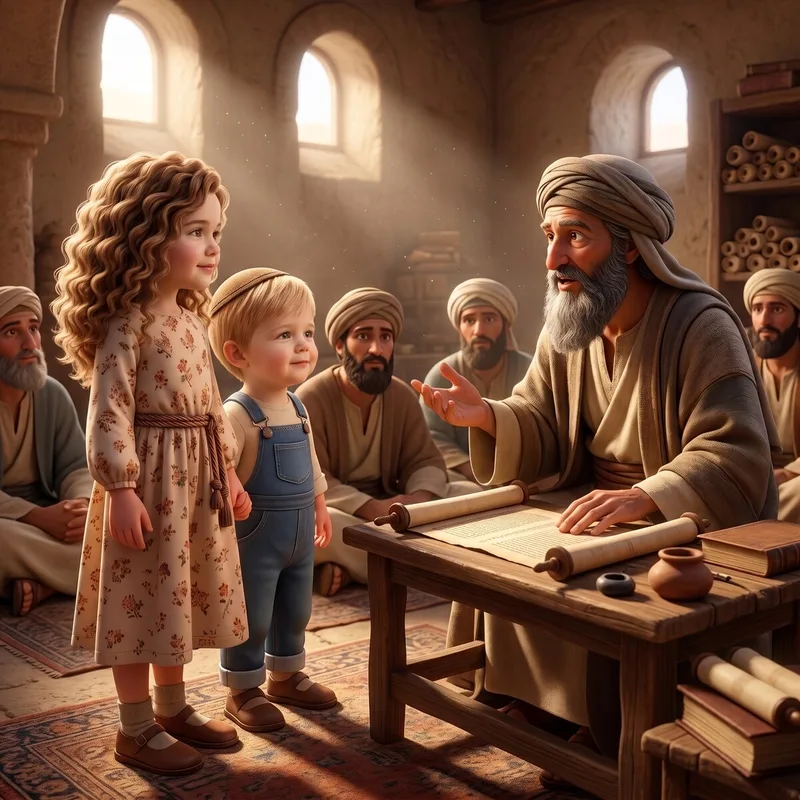
Torah Tale makes personalized Torah storybooks in which your child is the hero. Their name and, from one uploaded photo, their likeness appear on every page, illustrated in 3D animated-film style. Rava's story is in the Stories of Tzaddikim collection, in the Sefer Amoraim. Every book is written with careful rabbinical guidance and strict tznius, and it is reviewed by our team before it goes to print.
The format follows the child's age. The board book is 6x6 with rounded safety corners, for ages 0-4. The softcover is 8x8, for ages 4-8, and the hardcover is 8x8, for ages 5-18. Up to eight siblings, ages 0 to 18, can appear in the same book. Softcover and hardcover open with a dedication page, and if you add parents and grandparents, they appear with the children on a closing family page in every format.
Every book also ends with a discussion page of 10 questions that mixes comprehension with middos: what happened, and what it asks of the child. That page is what turns Rava's story into something talked about at the table. Reading the book is entirely appropriate on Shabbos.
There is also an optional matching coloring book, 8.5x11 in black-and-white line art. Coloring is a weekday activity, so keep it for an afternoon during the week or for erev Shabbos, never for Shabbos or Yom Tov itself.
What can we ask at the Shabbos table about Rava?
These are for talking, not for writing, which makes them right for the Shabbos table. Choose two or three and let everyone answer, including the youngest.
- When is your set time for Torah each day, and what would make it easier to keep?
- What does it mean to deal honestly with someone, even when nobody is watching?
- Why did Rava say that learning Torah must lead to teshuvah and good deeds?
- How can you disagree with a friend the way Abaye and Rava disagreed, to find the truth?
- Who is someone you should show extra respect to this week, because of what Rava taught in Brachos 17a?
- What is one thing you learned this week that you did differently because of it?
Adults can answer first, to show that these are questions for everyone. A child who hears a parent say 'I am trying to set a better time for learning' will take the question seriously.
When you are ready, creating a book takes about five minutes: a free account, a few short questions and one photo. You can create the book and choose Rava's story from the Stories of Tzaddikim.
Frequently asked questions
Who was Rava in the Gemara?
Rava was one of the great Amoraim of Bavel, living in the fourth century, and he taught Torah in Mechoza. He is quoted throughout the Gemara, very often together with Abaye. The Amoraim are the Sages who explained and discussed the Mishnah.
What is the lesson of Rava for children?
The simplest lesson is that Torah learning and good behavior belong together. Rava taught that a person is asked whether he was honest in his dealings and whether he set times for Torah, and that the goal of wisdom is teshuvah and good deeds. Children can take this home as two habits: learn every day, and be honest and respectful.
How do I explain Rava to a 4-year-old?
Keep it to one sentence: Rava was a very great Torah teacher who loved learning so much that he set aside special times for it, and he was always honest. Then ask your child when their own learning time is, such as before bed or at the Shabbos table. At this age the habit matters more than the details.
Who was greater, Rava or Abaye?
Both were great Amoraim, and the Gemara is full of their discussions with each other. The halacha follows Rava against Abaye except in six cases, which the Gemara's students remember with the letters Yaal Kigam. It is better to tell children that they learned and argued together in order to understand the Torah, not to decide who was greater.
Is Rava the same person as Rav?
No. Rav, also called Abba Aricha, was an earlier Amora of Bavel and the founder of the yeshiva in Sura. Rava lived later, in the fourth century, and taught in Mechoza. Their names look similar, so it helps to tell children that Rava came a few generations after Rav.
Can I order a personalized Torah Tale book about Rava?
Yes. Rava is in the Sefer Amoraim, part of the Stories of Tzaddikim collection. You create a free account, answer a few short questions, upload one photo, and your child appears by name and likeness in the book. The book is available in English, Hebrew and Yiddish.