Rav (Abba Aricha) for Kids: Rebbi, the Yeshiva in Sura & Teachings
Rav, also called Abba Aricha, was one of the first Amoraim. He learned from Rebbi in Eretz Yisrael and brought Torah back to Bavel. Here is his story, three of his teachings, and how to talk about him with a 4-year-old and an 8-year-old.
Published by Torah Tale.
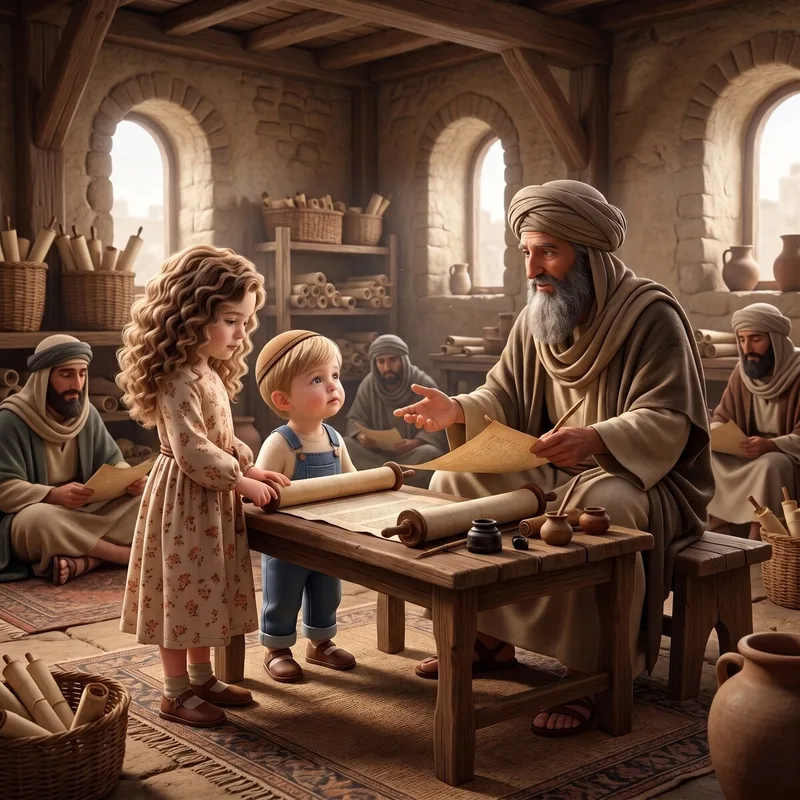
Create this book for your child
Rav, also called Abba Aricha, was one of the first Amoraim, the sages whose teachings fill the Gemara. He learned Torah from Rebbi in Eretz Yisrael, then returned to Bavel and established the yeshiva in Sura. Children connect to his story because it is the story of a talmid who goes to learn, comes home, and teaches others.
Who was Rav, and why is he called Abba Aricha?
Rav's name was Abba, and he is known as Abba Aricha, which is usually understood as Abba the tall. In the Gemara he is simply called Rav, the great teacher, and the words 'Amar Rav' introduce a very large number of halachos and lessons.
He lived in the generations after the Mishnah was compiled, which is why he belongs to the Amoraim and not the Tannaim. Torah Tale places his story in the Stories of Tzaddikim collection, in Sefer Amoraim, the Jewish leaders of the last two thousand years.
What is the story of Rav, told simply for children?
Rav grew up in Bavel, and he went to Eretz Yisrael to learn Torah from Rebbi, Rabbi Yehuda HaNasi. A relative of his, Rabbi Chiya, was also among the great Torah scholars of that generation. You can read more about Rebbi and the Mishnah in our article on Rabbi Yehuda HaNasi.
After learning from Rebbi, Rav returned to Bavel. There he established the yeshiva in Sura, where talmidim gathered to learn from him. Rav Huna was one of his talmidim. Rav's contemporary in Bavel was Shmuel, who taught Torah in Nehardea, and the Gemara often records the discussions of Rav and Shmuel together.
For a child, the shape of the story is easy to hold on to. A talmid travels to learn, brings what he learned home, and shares it. Torah keeps going because someone is willing to carry it and teach it.
What did Rav teach that a child can understand?
Rav's teachings in the Gemara are many. Three of them are especially easy to bring to the table, and each is attributed here to Rav as the Gemara does.
- Keep learning and doing mitzvos, even when your reasons are not perfect yet. Rav Yehuda said in Rav's name that a person should always engage in Torah and mitzvos even for the wrong reasons, because that leads him to do them for their own sake (Pesachim 50b). For a child, this means that when he is asked to learn or do a mitzvah, and does it, he has already done something good.
- A home should feel safe. Rav Yehuda also said in Rav's name that a person should not instill excessive fear in his household (Gittin 6b). This one is really for parents, and it is a good reminder when the house is busy and everyone is tired.
- Do not shame someone in public. The Gemara teaches in Rav's name how seriously we must take the embarrassment of another person in front of others (Bava Metzia 59a). Even a young child understands that it hurts to be laughed at.
Our article on loving every Yid goes well with the third idea.
How do I explain Rav to a 4-year-old and to an 8-year-old?
Age 4: Say it in one sentence. 'Rav traveled far away to learn Torah from his rebbi, and then he came back and taught other Yidden.' Then ask, 'Who teaches you new things?' and let your child answer. Keep the first conversation short and happy.
Age 8: Add the names and places. Rebbi was in Eretz Yisrael, Rav went back to Bavel, and he established the yeshiva in Sura. Ask why it mattered that he brought Torah to a place where it needed to be strengthened. This is a good age to bring in the saying about doing mitzvos even when the reasons are not perfect, and to ask what that means for getting up to daven or sitting down to learn when we do not feel like it.
Ages 10 to 12: Look together at the idea of a rebbi and a talmid, and at how a talmid stays loyal to what he learned while taking responsibility to teach. An older child can also talk about how Rav and Shmuel each led Torah learning in their own city.
What can we talk about at the Shabbos table?
These are talking questions only, and they fit a Shabbos or Yom Tov table well.
- Why do you think Rav traveled to learn from Rebbi?
- What do you want to learn from someone older than you?
- When is it hard to do a mitzvah, and what helps you do it anyway?
- Why is it so painful when someone is embarrassed in front of others?
- How can our house be a place where everyone feels safe and happy?
Let the children answer first. A parent who shares a short story of his own rebbi often gets the best conversation of the evening.
What is the Torah Tale book about Rav like?
It is a personalized storybook in which your child is the hero, with their name and, from one uploaded photo, their likeness illustrated in high-resolution 3D animated-film style. Up to eight siblings, ages 0 to 18, can appear in the same book. If you add parents and grandparents with their photos, they appear with the children on a closing family page in every format.
Every book ends with a discussion page of 10 questions about the story, mixing comprehension with middos. That page turns a book you read to your child into something talked about at the table. Every book is written with careful rabbinical guidance and strict tznius, and reviewed by our team before it goes to print.

Softcover 8″×8″

Hardcover 8″×8″

Board book 6″×6″

Coloring book 8.5″×11″
Which format and language should I choose?
Choose by your child's age. The board book is 6x6 with rounded safety corners, for ages 0-4. The softcover photo book is 8x8, for ages 4-8, and the hardcover photo book is 8x8, for ages 5-18. Softcover and hardcover open with a dedication page. The book can be ordered in English, Hebrew or Yiddish.
There is also an optional matching coloring book, 8.5x11 in black-and-white line art. Coloring is melacha, so it is a weekday activity: an afternoon during the week, erev Shabbos, or Chol HaMoed. The storybook itself is exactly right to read on Shabbos and Yom Tov.
Creating a book takes about five minutes. You need a free account and a few short questions: each child's name, boy or girl, age and one photo, any siblings, the story, your community (asked once), the language and the format.
If your child is learning about the Gemara's sages, you may also like our stories of Rabbi Akiva and Rabban Yochanan ben Zakkai.
Ready to make Rav's story your child's own? You can create the book in a few minutes.
Frequently asked questions
Who was Rav in the Gemara?
Rav, whose given name was Abba and who is also called Abba Aricha, was one of the first Amoraim. He learned from Rebbi in Eretz Yisrael and then returned to Bavel, where he established the yeshiva in Sura. His teachings appear throughout the Gemara, often with the words 'Amar Rav.'
What is the lesson of Rav for children?
One lesson is that a child who is learning Torah and doing mitzvos is already on the right path, even if his reasons are not perfect yet. The Gemara brings this in Rav's name (Pesachim 50b). Another is that a home should feel safe, and that we must be very careful not to embarrass someone in public.
How do I explain Rav to a 4-year-old?
Keep it simple: Rav was a talmid who traveled to learn Torah from his rebbi, then came home and taught many other Yidden. Then ask your child who teaches him new things and how he says thank you. At this age the idea that learning is something to be proud of is enough.
Is Rav the same as Rabbi Yehuda HaNasi?
No. Rabbi Yehuda HaNasi, known as Rebbi, compiled the Mishnah. Rav was his talmid, and Rav's own teachings are quoted in the Gemara, which was learned in the generations after the Mishnah.
Which Torah Tale format suits a Rav book?
Torah Tale offers a board book 6x6 with rounded safety corners for ages 0-4, a softcover photo book 8x8 for ages 4-8, and a hardcover photo book 8x8 for ages 5-18. Choose by your child's age. An optional matching coloring book 8.5x11 can be added, and it is a weekday activity.