Rabbeinu Gershom Me'or HaGolah for Kids: Takanos, Privacy & Kindness
Rabbeinu Gershom, the Me'or HaGolah of Mainz, is remembered for takanos that protect people's feelings and privacy. Here is how to tell his story to a 4-year-old, a 7-year-old and an 11-year-old.
Published by Torah Tale.
Create this book for your child
Rabbeinu Gershom ben Yehudah, known as Me'or HaGolah, the light of the exile, was a great Torah leader who taught in Mainz about a thousand years ago. He is remembered for takanos that protect people, such as not opening another person's letters and not shaming someone who returned to Yiddishkeit. Children connect with him because his rules are about everyday kindness, privacy and respect, things they already feel strongly about.
Who was Rabbeinu Gershom Me'or HaGolah?
Rabbeinu Gershom ben Yehudah lived in Ashkenaz, in the city of Mainz (Magenza in Hebrew), around the year 1000. He is often counted among the first of the Rishonim, the Torah leaders who came after the Geonim. Many talmidim came to learn from him.
He is remembered for his learning and for his takanos. A takanah is an enactment made by Torah leaders for the good of the community, and the ones attributed to him came with a cherem, a serious ban, so that people would treat them with full respect.
If your child already knows about the Geonim, you can connect the two. Earlier Torah leaders such as Rav Amram Gaon guided Yidden in Bavel, and Rabbeinu Gershom led Torah learning in Ashkenaz.
What does Me'or HaGolah mean?
Me'or HaGolah means the light of the exile. Golah is the word for the time Yidden live outside Eretz Yisrael, and a me'or is a source of light.
A simple way to say it to a child: a candle in a dark room helps everyone see where to walk. Rabbeinu Gershom's Torah and his takanos gave Yidden in Ashkenaz that kind of light, so they knew how to live with kindness and care for one another.
What were Rabbeinu Gershom's takanos?
Klal Yisrael has long attributed several takanos to Rabbeinu Gershom. Four are the best known, and each one is about protecting a person.
- Not marrying a second wife while the first is alive, so that a wife's home and security are protected.
- Not sending a wife away against her will, so that a marriage is not ended unfairly.
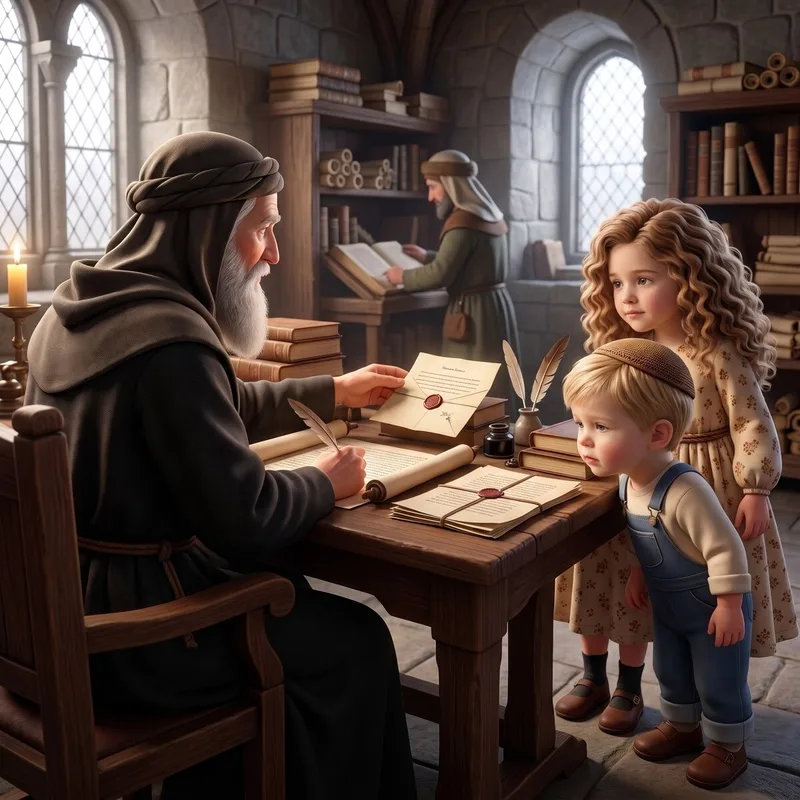
- Not opening another person's letters, which protects privacy.
- Not reminding a baal teshuvah of his past. This is understood to have been taught for Yidden who had been forced to leave Yiddishkeit and then returned. The Mishnah in Bava Metzia already teaches that we do not say to a baal teshuvah, remember your earlier deeds. Rabbeinu Gershom's cherem is understood as applying that mitzvah firmly to those who came back.
For young children, the two easiest to talk about are the letters and the baal teshuvah. The first is about private things that belong to someone else. The second is about what we say to a person who has done teshuvah.
What is the lesson for children?
The lesson is that being a Torah leader means caring about how other people feel. Rabbeinu Gershom did not only learn and teach. He also set up protections so that people would not be hurt.
For a child this turns into two small habits. First, some things belong to someone else, such as a private note, a diary or a closed envelope, and we do not open them. Second, when someone has fixed a mistake, we do not bring it up again.
These connect directly to middos your child may already be learning. Our article on never embarrassing a friend covers the second one in more detail, and guarding my tongue is a good partner for it.
How do I explain Rabbeinu Gershom to a 4-year-old, a 7-year-old and an 11-year-old?
Age 4: Keep it to one picture. Rabbeinu Gershom was a very great rebbi, a light for Yidden. He made a rule that we do not open someone else's letter. Ask, what do we do if a letter has Totty's name on it?
Age 7: Add the second rule. Explain that a person who did something wrong and then did teshuvah is a person we respect, and we never say, remember what you did. Ask for an example from school or the playground of how a friend could be embarrassed, and what to say instead.
Age 11: Talk about why a takanah has a cherem. Leaders made these rules for the sake of the whole community, and the rules protected people who were not in a position to protect themselves. You can also talk about what it means to be a me'or: a person whose behavior gives others light.
What questions can we ask at the Shabbos table?
These are talking-only questions, so they suit the Shabbos table or a Yom Tov afternoon.
- Why is Rabbeinu Gershom called the light of the exile?
- Why does a private letter belong only to the person it was written to?
- How would you feel if someone kept reminding you of a mistake you already fixed?
- What can we say to a friend who has just said sorry?
- Who is a me'or in our family or our class, someone who makes things brighter?
On a weekday, a simple activity fits the story well. Help your child write a letter to a grandparent, seal it, and talk about how only the person it is addressed to opens it. Writing is not for Shabbos or Yom Tov, so keep this for a weekday or erev Shabbos.
What is a Torah Tale book about Rabbeinu Gershom like?
Torah Tale's personalized book about Rabbeinu Gershom Me'or HaGolah is in the Stories of Tzaddikim collection. Your child's name and likeness, from one uploaded photo, appear on every page in high-resolution 3D animated-film style, and up to eight siblings, ages 0 to 18, can appear in the same book. The book is written with careful rabbinical guidance and strict tznius, and reviewed by our team before it goes to print.
Every book ends with a discussion page of 10 questions about the story, mixing comprehension with middos. That page is what turns a story read to a child into something talked about at the table. If you add parents and grandparents, they appear with the children on a closing family page in every format.

Softcover 8″×8″

Hardcover 8″×8″

Board book 6″×6″

Coloring book 8.5″×11″
The formats are a board book (6"x6" with rounded safety corners, ages 0-4), a softcover photo book (8"x8", ages 4-8), and a hardcover photo book (8"x8", ages 5-18). Softcover and hardcover books open with a dedication page. An optional matching coloring book (8.5"x11", black-and-white line art) can be added to a book, as a weekday activity only. The story can be ordered in English, Hebrew or Yiddish, and a book can be ordered in more than one language.
You can order a single book, or subscribe to a collection on the Monthly plan (4 books a month in one delivery, billed monthly) or the Yearly plan (the whole collection, paid once, $30 off, still 4 books a month until it is done). A subscription includes only that collection's own books.
Ready to make it? Creating a book takes about five minutes: a free account, then a few short questions about each child's name, boy or girl, age and one photo, any siblings, the story, your community (asked once), the language and the format. You can create the book and make Rabbeinu Gershom's story one your child can talk about, with their own name on every page.
Frequently asked questions
Who was Rabbeinu Gershom Me'or HaGolah?
Rabbeinu Gershom ben Yehudah was a Torah leader in Mainz, in Ashkenaz, about a thousand years ago, and is often counted among the first of the Rishonim. He taught many talmidim and is remembered for his takanos. He is called Me'or HaGolah, the light of the exile.
What does Me'or HaGolah mean?
Me'or HaGolah means the light of the exile. The title was given to Rabbeinu Gershom because his Torah and his takanos brought light and guidance to Yidden living far from Eretz Yisrael.
What is the lesson of Rabbeinu Gershom for children?
The lesson is that Torah leadership includes protecting other people's dignity. His takanos teach us not to read someone's private letter and not to remind a person who returned to Yiddishkeit of his past. Children can practice this by respecting private things and by never embarrassing a friend.
How do I explain Rabbeinu Gershom to a 5-year-old?
You can say that Rabbeinu Gershom was a very great rebbi who taught Torah to many Yidden and made rules to keep everyone safe and respected. Give one example a child understands, like not opening someone else's letter. Then ask, how would you feel if someone read your private note?
Is a Torah Tale book about Rabbeinu Gershom suitable for Shabbos reading?
Yes. Reading a storybook is entirely appropriate on Shabbos, and the discussion page at the end gives you 10 questions about the story to talk through at the table. The optional coloring book is different: coloring is not done on Shabbos or Yom Tov, so keep it for a weekday.