Parshas Korach for Kids: Aharon's Staff, the Challenge & Respect
Korach challenged Moshe and Aharon, Hashem showed who was chosen, and Aharon's staff blossomed overnight. A parent's guide to retelling it, the middos it teaches, and questions for the Shabbos table.
Published by Torah Tale.
Create this book for your child
Parshas Korach is the story of a man who challenged Moshe and Aharon, the test Hashem set to show who was chosen, and the staff of Aharon that blossomed with almonds overnight. Children connect to it because everyone knows the feeling of wanting someone else's turn, and the parsha shows where that feeling leads and how Hashem answers it.
What happens in Parshas Korach?
Korach, a descendant of Levi, gathers a group against Moshe and Aharon. The Torah names Dasan and Aviram and On ben Peles from Shevet Reuven among them, along with two hundred and fifty respected men. Their claim is that the whole community is holy, so why do Moshe and Aharon set themselves above everyone?
When Moshe hears this, he falls on his face. Then he tells them to take censers, put fire and ketores in them, and come before Hashem the next morning, and Hashem will show who is chosen. Moshe also sends for Dasan and Aviram, but they answer that they will not come up.
The next day Korach gathers the whole community at the Ohel Moed, and the kavod of Hashem appears. Moshe and Aharon fall on their faces and plead for the people. Hashem tells the people to move away from the tents of Korach, Dasan and Aviram. Then the earth opens and takes them and their households from the camp, and a fire from Hashem consumes the two hundred and fifty men offering ketores. The Torah tells us later, in Parshas Pinchas, that the sons of Korach did not die.
Elazar the kohen is then told to take the censers and hammer them into plates to cover the mizbeach. They stay as a reminder that only the descendants of Aharon may offer ketores.
What happened with the plague and Aharon?
The next day the people complain again, and a plague begins among them. Moshe tells Aharon to take a censer, put fire from the mizbeach and ketores in it, and hurry to the people to atone for them. Aharon, the very man who had just been challenged, runs into the middle of the community. The pasuk says he stood between the dead and the living, and the plague stopped.
This is a part of the parsha worth telling slowly to children. The one who was criticized is the one who rushes to protect the people.
What was the staff that blossomed?
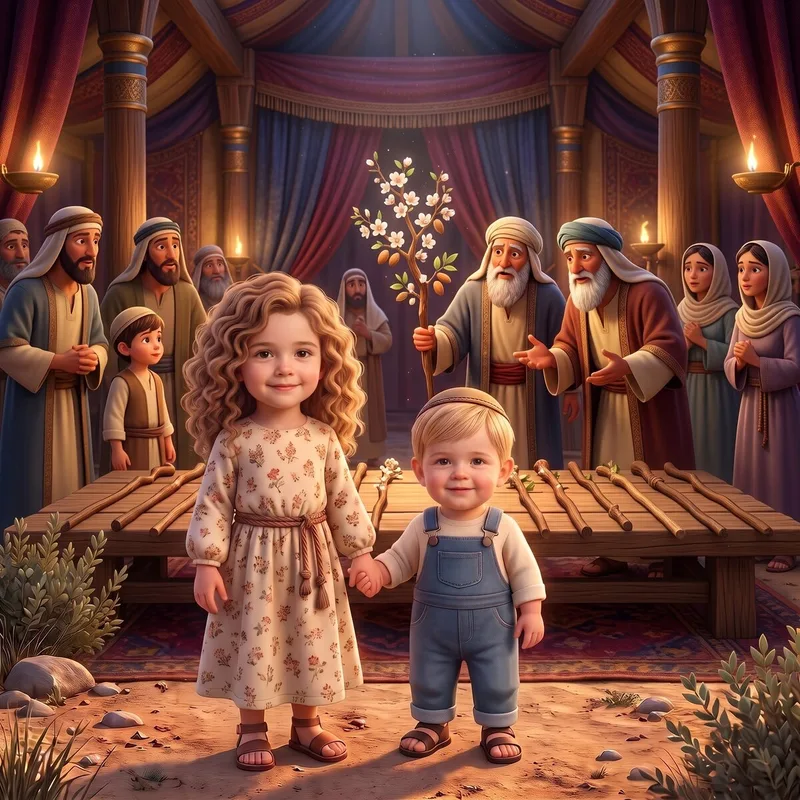
Hashem then gives a clear sign. Moshe takes a staff from the nasi of each tribe, twelve in all, each with the owner's name on it. The staff for Levi carries Aharon's name. Moshe places them in the Ohel Moed before the Edus.
The next day Moshe goes in, and Aharon's staff has budded, bloomed and borne ripe almonds. Moshe shows all of the staffs to Bnei Yisrael, and Aharon's is kept before the Edus as a sign. The rest of the parsha lays out the duties of the kohanim and leviim and the gifts they receive.
Why did Korach argue with Moshe?
His words sounded fair: everyone is holy. But the Torah tells the story as one of a man who wanted more honor. Chazal tell us, in a Midrash that Rashi brings on the first pasuk of the parsha, that Korach was hurt when Elitzafan ben Uziel was made nasi of the family of Kehas.
The Midrash also relates that Korach dressed his followers in garments of techeles and asked Moshe whether a garment made entirely of techeles still needs a thread of techeles in its tzitzis. This is a midrashic detail, not something stated in the pesukim.
Pirkei Avos 5:17 teaches that a machlokes l'shem shamayim will last, and that the machlokes of Korach and his congregation is the example of one that is not. A good question to ask older children is how you can tell whether a disagreement is really about the truth.
What is the lesson of Korach for children?
There are three middos children can take from it.
- Being happy with your role. Aharon was chosen to be the Kohen, and no one else needed his job.
- Respecting those who lead. Moshe's first response to the challenge was to fall on his face before Hashem.
- Caring even for those who criticized you. Moshe and Aharon pleaded for the people, and Aharon ran to stop the plague.
For a related story about speaking with respect, see Guarding My Tongue. For how to settle a quarrel kindly, see Making Peace with Friends.
How do I explain Korach to a 4-year-old, a 7-year-old and a 10-year-old?
Age 4: Tell it in three sentences. Hashem picked Aharon to be the Kohen. Some people wanted his job, and Hashem showed everyone who was chosen by making Aharon's staff grow almonds overnight. Everyone has a job from Hashem, and we are happy with ours.
Age 7: Add the feeling. Ask whether they have ever wanted someone else's turn, and talk about how it feels in the stomach. Explain that Korach let that feeling grow and told other people about it, and that Moshe and Aharon still cared about the people.
Age 10: Take on the words. Korach said everyone is holy, and that is true in its way, but he used it to take more honor. Ask how we can tell whether our own argument is for the truth or for ourselves, and use Pirkei Avos 5:17 as the guide.
If your child is worried about the harder part of the story, it is fine to stay with the staff and with Aharon running to help the people.
What is a personalized Parshas Korach book like?
In a Torah Tale book, your child is the hero. Their name and, from one uploaded photo, their likeness appear on every page, illustrated in 3D animated-film style. Up to eight siblings, ages 0 to 18, can appear in the same book. Every book is written with careful rabbinical guidance and strict tznius, and our team reviews it before it goes to print.

Softcover 8″×8″

Hardcover 8″×8″

Board book 6″×6″

Coloring book 8.5″×11″
There are three formats: a 6x6 board book with rounded safety corners for ages 0-4, an 8x8 softcover photo book for ages 4-8, and an 8x8 hardcover photo book for ages 5-18. Softcover and hardcover books open with a dedication page. You can order in English, Hebrew or Yiddish. If you add parents and grandparents, they appear with the children on a closing family page in every format.
Every book ends with a discussion page of 10 questions that mix comprehension with middos: what happened, and what it asks of the child. The optional matching coloring book (8.5x11, black-and-white line art) is a weekday activity, for an afternoon or erev Shabbos, and never for Shabbos or Yom Tov itself.
You can find Parshas Korach in the story picker under Torah. The creator suggests the first parsha that can still arrive before its Shabbos, usually a few weeks ahead, so this is a parsha you may want to choose yourself. For more on picking a parsha, see How to Choose the Weekly Parsha for Your Child's Book.
What questions can we ask at the Shabbos table about Korach?
Reading a book at the Shabbos table is entirely appropriate, and these questions need only talking. Pick two or three for the age at your table:
- Who was Korach, and who joined him?
- What did Moshe do first when they challenged him?
- What was the test with the censers and the ketores?
- What did Aharon do when the plague started?
- What happened to the twelve staffs, and why was Aharon's kept?
- Is there a job in our home that is not yours but you sometimes wish it was? How can we be happy when it is someone else's turn?
If you have read the story in the parsha before, Parshas Shelach comes just before Korach, and Parshas Beha'aloscha tells of Moshe's humility.
When you are ready, you can create the book for your child. It takes a free account and a few short questions: each child's name, boy or girl, age and one photo, any siblings, the story, your community (asked once), the language and the format.
Frequently asked questions
What is the story of Parshas Korach for kids?
Korach and a group of respected men challenged Moshe and Aharon's leadership. Hashem showed who was chosen, and the challengers were removed from the camp. Later, twelve staffs were placed in the Ohel Moed, and only Aharon's staff blossomed and bore almonds, which showed everyone that Aharon was chosen.
What is the lesson of Korach for children?
The lesson is to be happy with the role Hashem gave you and to respect those He chose to lead. Pirkei Avos 5:17 teaches that a disagreement l'shem shamayim lasts, and gives the machlokes of Korach and his congregation as the example of one that is not. Children can learn that wanting what belongs to someone else, and gathering others to join in, leads somewhere sad.
How do I explain Korach to a 4-year-old?
Keep it short and focus on the ending: Hashem chose Aharon to be the Kohen, and showed everyone by making his staff grow almonds overnight. Add one simple line, that everyone has a job from Hashem and we are happy with ours. You can leave out the harder details and simply say that Korach did not listen to Moshe.
Why did Korach argue with Moshe and Aharon?
The Torah records his claim that the whole community is holy, so Moshe and Aharon should not set themselves above it. Chazal tell us, in a Midrash that Rashi brings at the start of the parsha, that Korach was hurt when Elitzafan ben Uziel was appointed nasi of the family of Kehas. Children can understand this as jealousy dressed up as a good-sounding reason.
Is it appropriate to read Parshas Korach to young children?
Yes, as long as you tell it at the child's level. Younger children do well with the test, Aharon running to help the people, and the staff that blossomed, while older children can handle the whole story. Reading a parsha book at the Shabbos table is entirely appropriate, and the discussion page at the end of every Torah Tale book gives you 10 questions to talk through.