Making Peace with Friends (עושים שלום) for Kids: Teaching Shalom at Home
A Middos story about a child who takes the first step toward peace after a quarrel with a friend, with the Torah sources, what to say at ages 4, 8 and 11, and questions for the table.
Published by Torah Tale.
Create this book for your child
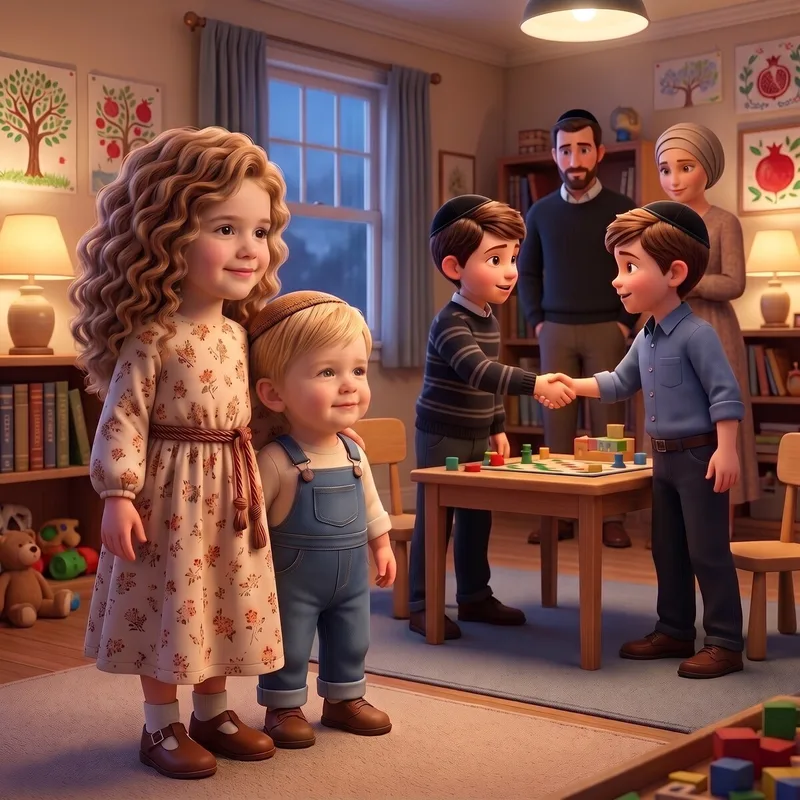
Making Peace with Friends (עושים שלום) is a Torah Tale Middos story about a child who, after a disagreement with a friend, chooses to take the first step toward shalom. It lands with children because quarrels over games, turns and words are part of their daily life, and the story shows them that making peace is something a child can actually do, without waiting for a grown-up to step in.
What is the Making Peace with Friends story about?
This story is part of the Middos collection, where the good character a child grows is set in everyday life today. Here the setting is the friendship itself: a disagreement, hurt feelings, and the choice to make things right.
The moments a story like this draws on will be familiar to any parent: a game that ends in raised voices, a toy two children both wanted, a careless comment that stung. In the personalized book, your own child is the one who decides that the friendship matters more than winning the argument.
That is the whole point of the story. Children already know how to fight. What they need to see is how a friendship gets repaired.
What does the Torah say about making peace between friends?
The Torah's language is the language of effort. Tehillim 34:15 says "בַּקֵּשׁ שָׁלוֹם וְרָדְפֵהוּ" - seek peace and pursue it. Pursuing means going toward peace, not waiting for it to arrive.
In Pirkei Avos (1:12) Hillel teaches us to be among the students of Aharon, loving peace and pursuing peace. The Avos d'Rabbi Nosson relates how Aharon would go to each person in a quarrel in turn and tell him that the other one was sorry, until the two of them made peace with each other.
The Mishnah in Peah (1:1) also lists bringing peace between a person and his friend among the mitzvos we say in davening every morning. Children hear these words in Shacharis long before they understand them, so it helps to connect the words to a real friend and a real argument.
What is the lesson of making peace with friends?
The story teaches a few simple ideas that a child can hold onto:
- Someone has to go first. Peace usually begins when one child decides not to wait for the other.
- Being right and being at peace are different things. A child can say what hurt and still say sorry for their own part.
- A good sorry has a next step. "I'm sorry I grabbed it. Do you want to play again?" is stronger than a mumbled sorry and a walk away.
- Accepting a sorry is part of making peace. The friendship is repaired from both sides.
How do I explain making peace to a 4-year-old, an 8-year-old and an 11-year-old?
- Age 4: Keep it to one picture. "When you and your friend get upset, you can fix it with kind words." Practice the words together, like "I'm sorry. Do you want to play?", and praise the first time your child uses them on their own.
- Age 8: Talk about the difference between winning an argument and keeping a friend. Ask, "What did you want? What did your friend want? What could one of you do to make it better?" Children this age can also understand that you can be sorry for your part even when the other child did something wrong too.
- Age 11: Bring in the Torah sources. Ask what it means that we are told to pursue peace, and what it would take to go to a friend after a real falling out. Talk about how words said in anger, or about a friend to others, make peace harder, and how to keep a quarrel from becoming a group matter.
What can I say when my child is in the middle of a fight?
In one sentence: "We don't have to decide who won, we have to decide how to fix it."
Once everyone has calmed down, you can walk your child through four steps:
- Take a moment to calm down first.
- Say what happened and how it felt.
- Say sorry for your own part.
- Offer to start again, whether that means playing together or just saying hello tomorrow.
Do not force a sorry in the middle of anger. A child who is still furious learns to say the words without meaning them. Wait, then guide. If a situation is serious or keeps repeating, speak with your child's teacher or your rav.
What questions can we ask at the Shabbos table about making peace?
Reading a storybook at the Shabbos table is wonderful, and these questions are for talking, not writing or drawing:
- Has there been a time this week when you and a friend or sibling had a fight? How did it end?
- Why is it hard to be the first one to say sorry?
- What did Aharon do to bring two people together?
- What could you say to a friend who is still upset with you?
- How does it feel when someone makes peace with you first?
If this opens a wider conversation, our articles on guarding my tongue, loving every Yid and saying sorry with Rabban Gamliel connect naturally.
What is a personalized Making Peace with Friends book like?
In Torah Tale's version, your child is the hero. Their name and, from one uploaded photo, their likeness appear on every page, illustrated in high-resolution 3D animated-film style. Up to eight siblings, ages 0 to 18, can appear in the same book, which suits a story about getting along.
Every book ends with a dedicated discussion page of 10 questions, mixing comprehension with middos, so the story is something you talk about and not only something you read. Each book is written with careful rabbinical guidance and strict tznius, and reviewed by our team before it goes to print.

Softcover 8″×8″

Hardcover 8″×8″

Board book 6″×6″

Coloring book 8.5″×11″
There are three formats. The 6x6 board book with rounded safety corners is for ages 0-4, the 8x8 softcover is for ages 4-8, and the 8x8 hardcover is for ages 5-18. The softcover and hardcover open with a dedication page. If you add parents, grandparents and other relatives with their photos, they appear with the children on a closing family page in every format. The book can be ordered in English, Hebrew or Yiddish.
An optional matching coloring book (8.5"x11", black-and-white line art) can be added to a one-time order. Coloring is melacha, so it is a weekday activity, perfect for a weekday afternoon or erev Shabbos, while the storybook itself is a good fit for Shabbos reading.
Creating the book takes a free account and a few short questions: each child's name, boy or girl, age and one photo, any siblings, the story, your community (asked once), the language and the format. It takes about five minutes.
Ready to give your child a story where they are the one who makes peace? You can create the book at torahtale.com/create.
Frequently asked questions
What is the lesson of Making Peace with Friends?
The lesson is that peace between friends is something a child can actively do, not just wait for. Someone has to take the first step, and being at peace with a friend matters more than winning the argument. The story builds the middah of pursuing shalom in everyday situations a child actually lives.
How do I explain making peace to a 4-year-old?
Keep it short and concrete: when we fight with a friend, we can fix it with kind words, like 'I'm sorry, do you want to play again?' Let your child practice the words with you first, and praise the moment they use them. At this age, the action matters more than the explanation.
Does the Torah really tell us to make peace between friends?
Yes. Tehillim 34:15 tells us to seek peace and pursue it, and Pirkei Avos 1:12 records Hillel's teaching to be among the students of Aharon, who loved and pursued peace. The Mishnah in Peah (1:1) also lists bringing peace between a person and his friend among the mitzvos we say in davening each morning.
What should I do if my child refuses to say sorry?
Wait until your child has calmed down, since a forced sorry in the middle of anger rarely teaches anything. Then ask what happened and how each child felt, and help your child find one thing they can honestly be sorry for. If it is still hard, ask your rav or your child's teacher for guidance that fits your child.
Which Torah Tale format is best for a Making Peace with Friends book?
It depends on your child's age. Torah Tale offers a 6x6 board book with rounded safety corners for ages 0-4, an 8x8 softcover for ages 4-8, and an 8x8 hardcover for ages 5-18. Up to eight siblings can appear in the same book, and an optional matching coloring book is a weekday activity.
Can we read the book on Shabbos?
Yes. Reading a storybook is entirely appropriate on Shabbos, and the discussion page at the end gives you 10 questions to talk about at the table. The optional coloring book is different, since coloring is melacha, so keep it for weekdays or erev Shabbos.