Parshas Beha'aloscha for Kids: The Menorah, Pesach Sheni & Moshe's Humility
How to tell Parshas Beha'aloscha to children: the menorah, Pesach Sheni, the silver trumpets, Moshe's humility and Miriam, with ideas for a 4-year-old, a 7-year-old and a 10-year-old.
Published by Torah Tale.
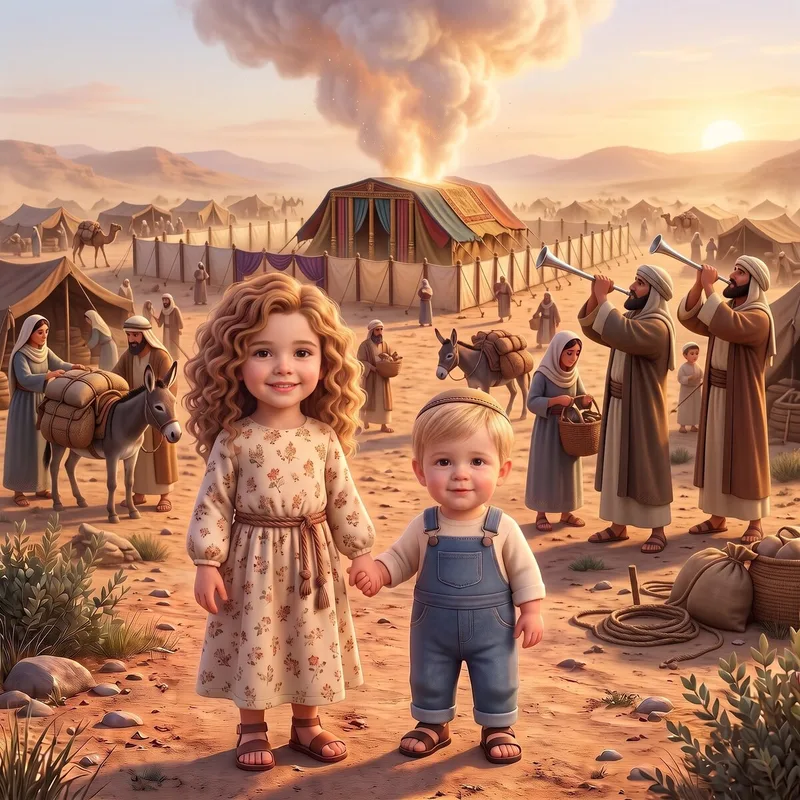
Create this book for your child
Parshas Beha'aloscha is the third parsha in Sefer Bamidbar, after Naso, and it moves quickly: Aharon lights the menorah, men who missed the korban Pesach get a second chance, the Yidden set out from Har Sinai, and then the complaints begin. Children connect with it because it is full of things they know from their own day: wanting what they do not have, feeling left out, saying the wrong thing, and hoping for another chance.
What happens in Parshas Beha'aloscha?
Here are the main events, in the order the Torah tells them:
- Aharon lights the seven lamps of the menorah.
- The Leviim are purified and set apart for their avodah.
- Men who are tamei ask for a way to bring the korban Pesach, and Pesach Sheni is given.
- The cloud rests over the Mishkan, and the people travel and camp as the cloud directs.
- Hashem commands two silver trumpets.
- The Yidden set out from Har Sinai.
- The people complain, and Moshe asks for help carrying the burden of leading them.
- Seventy elders are gathered, and Eldad and Medad prophesy in the camp.
- Miriam and Aharon speak about Moshe, and Miriam waits outside the camp until she is healed.
The parsha reaches its close when the people move on from Chatzeros to the Midbar Paran. Everything in between teaches children something about how a Yid acts in good times and in hard ones.
Why does Aharon light the menorah first?
The Torah says Aharon lit the lamps facing the front of the menorah, exactly as Hashem had told Moshe. The pasuk also tells us the menorah was made of hammered gold.
Rashi brings a Midrash (Tanchuma) explaining why this comes right after the gifts of the nesiim in Parshas Naso: Aharon felt sad that he and his shevet had no part in that dedication, and Hashem comforted him that his own avodah, lighting the menorah, was precious. Rashi also explains the word beha'aloscha, quoting Chazal: the kohen must hold the flame to the wick until it rises on its own. A good place for children to start is that a mitzvah is something we finish properly.
What is Pesach Sheni, and why do children love it?
It is the part of the parsha where a child can feel a real second chance. The Torah tells us that some men were tamei to a dead person and could not bring the korban Pesach on 14 Nisan. They came to Moshe and Aharon and asked why they should be left out of bringing Hashem's korban with everyone else.
Moshe told them to wait while he heard what Hashem commanded. Hashem gave them Pesach Sheni, one month later on 14 Iyar, for them and for anyone tamei or far away on the first date. The point for a child is that these men did not shrug and say it was too late. They wanted the mitzvah, and they asked. There is a minhag to eat a little matzah on Pesach Sheni.
What do the complaints, Eldad and Medad, and Miriam teach?
After the people left Har Sinai, some began to complain. Others craved meat and said they missed the foods of Mitzrayim, even though the mann fell for them every day. Chazal tell us the mann could taste like whatever a person was thinking of. A simple lesson for children is to look at what Hashem is giving us right now before asking for more.
Moshe then told Hashem that the people were too heavy for him to carry alone. Hashem told him to gather seventy elders to share the burden. Two men, Eldad and Medad, stayed in the camp and prophesied there, and Yehoshua asked Moshe to stop them. Moshe answered, "Are you jealous for my sake?" and said he wished all of Hashem's people could be prophets. The Torah itself tells us Moshe was very humble, more than any person on earth.
Later, Miriam and Aharon spoke about Moshe in a way that was not right. Miriam was afflicted with tzaraas and sat outside the camp for seven days. Moshe davened for her with a very short tefillah, and the Torah says the people did not travel until she was brought back. Rashi, quoting Chazal (Sotah 9b), says this was a reward for the time she waited at the Nile to see what would happen to baby Moshe. For more on careful speech, see Guarding My Tongue for Kids.
How do I explain Parshas Beha'aloscha to a 4-year-old, a 7-year-old and a 10-year-old?
Choose the part that fits, and do not try to tell it all in one sitting.
- Age 4: Aharon lit the menorah, and the Yidden followed the cloud wherever it went. Hashem gave them the mann every day, and Moshe davened to Hashem when things were hard. A one-sentence script: "Hashem takes care of us, so we say thank you."
- Age 7: Tell Pesach Sheni and Eldad and Medad. Ask: "What would you do if you missed a mitzvah, and what did Moshe say when he was not jealous?"
- Age 10: Add Miriam and Aharon. Talk about how careful we must be with what we say about others, and how humility looks in Moshe's reply to Yehoshua and in his short tefillah for Miriam.
What can we talk about at the Shabbos table?
Reading is a lovely thing to do on Shabbos, and so are these questions, which need only talking:
- Why did the men who were tamei come to Moshe and Aharon, and what did they want?
- Why do you think Aharon needed to hear that his avodah mattered?
- What did Moshe do when the burden felt too heavy?
- What did Moshe say to Yehoshua about Eldad and Medad?
- Why do you think the people waited for Miriam?
- What is one thing Hashem gave you today that you can thank Him for?
For a weekday activity, you can play the silver trumpets. The Torah says they were made of hammered silver, and they called the people to gather and to travel. Make a pretend signal, and let the children gather when they hear it. This is for a weekday afternoon or erev Shabbos, not for Shabbos itself.
What is a personalized Parshas Beha'aloscha book like?
The Torah Tale book for Parshas Beha'aloscha comes from the Torah collection. Your child's name and, from one uploaded photo, their likeness appear on every page, illustrated in 3D animated-film style. Up to eight siblings, ages 0 to 18, can be in the same book. Every book is written with careful rabbinical guidance and strict tznius, and our team reviews it before printing.
Every book ends with a discussion page of 10 questions about the story, mixing comprehension with middos. That is what turns the book from something read to a child into something talked about at the table. If you add parents, grandparents and other relatives with their photos, they appear with the children on a closing family page in every format.

Softcover 8″×8″

Hardcover 8″×8″

Board book 6″×6″

Coloring book 8.5″×11″
There are three formats: a 6x6 board book with rounded safety corners for ages 0-4, an 8x8 softcover for ages 4-8, and an 8x8 hardcover for ages 5-18. The softcover and hardcover open with a dedication page. An optional matching coloring book (8.5x11, black-and-white line art) can be added to a book. It is a weekday activity for an afternoon or erev Shabbos, never for Shabbos or Yom Tov. Languages are English, Hebrew and Yiddish.
To order, you create a free account and answer a few short questions: each child's name, boy or girl, age and one photo, any siblings, the story, your community (asked once), the language and the printed format. It takes about five minutes. The creator suggests the first parsha that can still arrive before its Shabbos and shows a live countdown to that parsha's order deadline. If you want Beha'aloscha for the Shabbos it is read, check the countdown to the order deadline for delivery before that Shabbos. For help choosing, see How to Choose the Weekly Parsha for Your Child's Book, and if you want to read the previous parsha first, here is Parshas Naso for Kids.
When you are ready, you can create the book and let your child see themselves in the camp of Yisrael, following the cloud.
Frequently asked questions
What is Parshas Beha'aloscha about for kids?
Parshas Beha'aloscha tells how Aharon lit the menorah, how men who missed the korban Pesach received Pesach Sheni, and how the Yidden set out from Har Sinai following the cloud. It also tells of the people's complaints, the seventy elders who helped Moshe, and Miriam's waiting outside the camp. For children it is a parsha about gratitude, humility and second chances.
What is the lesson of Parshas Beha'aloscha?
There is more than one lesson, and you can choose the one that fits your child. The complaints about the mann teach us to notice what Hashem gives us, Moshe's reply to Yehoshua about Eldad and Medad shows humility without jealousy, and Miriam's story teaches how careful we must be with our words. Pesach Sheni teaches that a person who truly wants to do a mitzvah should speak up and ask.
What is Pesach Sheni in Parshas Beha'aloscha?
Pesach Sheni is a second date for the korban Pesach, on 14 Iyar. The Torah tells us that men who were tamei and could not bring the korban Pesach came to Moshe and Aharon and asked why they should be left out. Hashem then gave the mitzvah of Pesach Sheni to them and to anyone who was tamei or far away on the first date. There is a minhag to eat a little matzah on Pesach Sheni.
How do I explain Miriam speaking about Moshe to a young child?
Keep it simple: Miriam and Aharon said something about Moshe that was not right, and Hashem showed how much He cares about how we speak about others. Then add the part children remember most, that the whole people waited for Miriam to come back before they traveled. You can say that careful speech matters, and that the Yidden showed how much they cared for her.
Is there a personalized book for Parshas Beha'aloscha?
Yes. Torah Tale makes a personalized book for Parshas Beha'aloscha, from the Torah collection, with the child's name and, from one uploaded photo, their likeness illustrated in 3D animated-film style on every page. Up to eight siblings, ages 0 to 18, can appear in the same book. Every book ends with a discussion page of 10 questions about the story.
Which format of the Beha'aloscha book fits my child's age?
Torah Tale offers a 6x6 board book with rounded safety corners for ages 0-4, an 8x8 softcover for ages 4-8, and an 8x8 hardcover for ages 5-18. An optional matching coloring book is a weekday add-on, not for Shabbos or Yom Tov. The child's age is one of the short questions when you create the book.