Parshas Shelach for Kids: The Meraglim, Kalev & Why Emunah Beats Fear
Parshas Shelach is the story of twelve men sent to scout Eretz Yisrael, ten who came back afraid, and two who remembered that Hashem was with them. Here is how to tell it to a 3-4 year old, a 6-7 year old and a 9-12 year old.
Published by Torah Tale.
Create this book for your child
Parshas Shelach is the story of twelve men whom Moshe sent to scout Eretz Yisrael. Ten of them came back frightened, and two, Kalev and Yehoshua, remembered that Hashem was with them. It lands with children because they know exactly what it feels like when something looks too big, and the parsha shows them what emunah sounds like at that moment.
What happens in Parshas Shelach?
Shelach is the fourth parsha in Sefer Bamidbar. Hashem tells Moshe to send men to scout Eretz Kena'an, one man from each shevet, each of them a leader among his people. Before they leave, Moshe gives Hoshea bin Nun the name Yehoshua. Rashi, following Chazal, says Moshe davened for him that Hashem should save him from the plan of the meraglim.
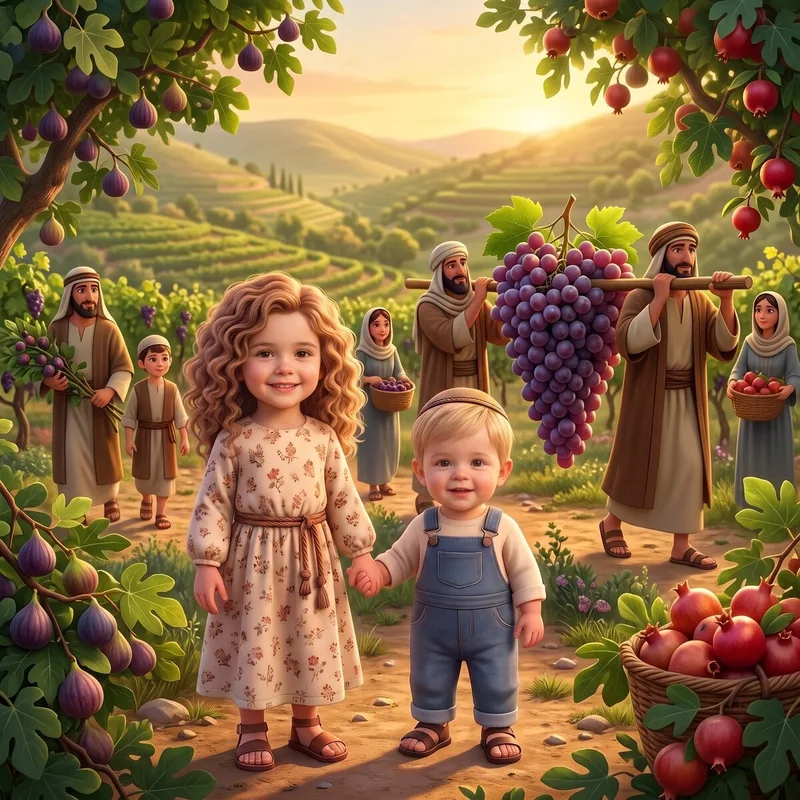
The men travel through the land for forty days. They bring back a huge cluster of grapes that two men carry on a pole, along with pomegranates and figs. They say the land really does flow with milk and honey, as Hashem had promised.
Then ten of them add, "But the people living there are strong, and the cities are large and fortified." Kalev quiets the people and says, "Let us go up and take it, for we can surely do it." The ten answer, "We cannot go up against that nation, for they are stronger than we are."
Why did Moshe send spies in the first place?
The words "shelach lecha" mean "send for yourself." Rashi explains that Hashem was not commanding Moshe to do this, but leaving it to his own judgment. Later, in Sefer Devarim, Moshe recalls that the people had come to him asking for scouts, and the idea pleased him.
The Torah says that these were important men, heads of Bnei Yisrael. That is part of what makes the story so sobering for children and adults alike: even leaders can let fear speak for them.
What went wrong, and what is the lesson for children?
Two things went wrong, and both are worth naming for a child. The first is emunah. Hashem had promised the land, and the ten focused on how strong the people were instead of on that promise. The second is how they spoke. The Torah calls what they spread a dibah, a bad report about the land, and Chazal and the meforshim learn from this story how seriously we must take lashon hara.
The ten also said, "We were like grasshoppers in our own eyes, and so we were in their eyes." A lesson we can draw from this is that how a person sees himself colors everything he sees. A child who says "I can't" before even trying has already half decided the outcome.
That night the people cried. Chazal tell us that night was the ninth of Av, and that it became a night of weeping for later generations. This is one reason the story is learned so seriously. For young children there is no need to dwell on that. It is enough to say that crying and giving up were the wrong answer, and that trusting Hashem was the right one.
What did Kalev and Yehoshua do differently?
Kalev spoke up when the crowd was loud. Rashi, following Chazal, says that on the journey Kalev went by himself to Chevron to daven at the graves of the Avos, so that he would not be led along by the others. Yehoshua and Kalev later tore their garments and told the people, "The land is very, very good. If Hashem desires us, He will bring us into it. Only do not rebel, and do not fear the people of the land."
The people spoke of stoning them. Then Hashem told Moshe that the people would not enter the land. Moshe pleaded for them, and Hashem said, "I have forgiven, as you have asked." Even so, the decree stood: forty years in the midbar, one year for each day of the scouting. The Torah says Kalev had "a different spirit" and would enter the land. The pasuk also says the children, about whom the people had said they would be taken captive, would enter.
The Torah then tells of those who went up to fight after being told not to. Moshe warned them, and they went anyway, without the Aron and without Moshe. They were defeated. For a child, the point is plain: trust also means listening when we are told to wait.
What are the mitzvos at the end of Shelach?
After the decree, the Torah turns to mitzvos for when Bnei Yisrael will enter the land: nesachim with the korbanos, and separating challah from the dough. It also tells of a man who desecrated Shabbos. The parsha closes with the mitzvah of tzitzis.
The Torah says that when we see the tzitzis, we will remember all of Hashem's mitzvos and do them, and we will not follow our hearts and our eyes. The verb used for scouting the land, latur, appears again here, as "do not wander" after your heart and eyes. A child who puts on tzitzis every morning has a small, daily way of connecting to the lesson of the meraglim.
How do I explain Parshas Shelach at different ages?
- Ages 3-4: Tell it in a few sentences. Twelve men went to look at Eretz Yisrael. They brought back big grapes. Ten were scared, but Kalev and Yehoshua said, "Hashem will help us." Ask your child to hold up the grapes and say that sentence together.
- Ages 6-7: Add the idea of how we talk. Ask, "What did the ten say that made everyone cry? What could they have said instead?" Children this age can understand that words can make others feel brave or scared.
- Ages 9-12: Bring in the questions. Why did Hashem not accept the report even though it was partly true? What is the difference between describing difficulty and giving up? Why does the Torah list the meraglim's names? Older children can also compare the decision to send the scouts with the people's later decision to go up without permission.
For a younger sibling, the parshiyos before this one in Sefer Bamidbar can give a fuller picture of the midbar. See Parshas Beha'aloscha for Kids, which comes just before. For the lashon hara side of this parsha, Guarding My Tongue for Kids has simple ways to practice speaking carefully at home.
What can we talk about at the Shabbos table?
Shabbos is a good time to talk about Shelach, and it needs nothing but conversation. Try these questions:
- What was good about the land that the meraglim saw?
- Why did the people cry? What would you have said to them?
- Kalev spoke up when no one else did. When is it hard to speak up?
- What can we say to a friend who is afraid to try something new?
- What do we think of when we look at our tzitzis?
For something to eat, put out grapes, a pomegranate or figs, and let the children say that these were the fruits the meraglim carried. During the week, you could also look at your child's tzitzis together and ask what he or she remembers when seeing them.
What is a personalized Parshas Shelach book like?
A Torah Tale book of this parsha stars your child. Their name and, from one uploaded photo, their likeness appear on every page, illustrated in 3D animated-film style. Up to eight siblings, ages 0 to 18, can appear in the same book, and if you add parents and grandparents with their photos, they appear with the children on a closing family page in every format.

Softcover 8″×8″

Hardcover 8″×8″

Board book 6″×6″

Coloring book 8.5″×11″
The formats are matched to age: a 6"x6" board book with rounded safety corners for ages 0-4, an 8"x8" softcover photo book for ages 4-8, and an 8"x8" hardcover photo book for ages 5-18. The softcover and hardcover open with a dedication page. An optional matching coloring book is a weekday activity, for erev Shabbos or a weekday afternoon, never for Shabbos itself. The books themselves are made for reading, including at the Shabbos table.
Every book ends with a discussion page of ten questions that mix comprehension with middos: what happened, and what it asks of the child. Each book is written with careful rabbinical guidance and strict tznius, and reviewed by our team before it goes to print. Parents do not preview the book before printing. If you are choosing between parshiyos, How to Choose the Weekly Parsha for Your Child's Book explains how.
Creating a book takes about five minutes, with a free account and a few short questions: each child's name, boy or girl, age and one photo, any siblings, the story, your community (asked once), the language and the format. When you are ready, you can create the book.
Frequently asked questions
What is the story of Parshas Shelach for kids?
Moshe sent twelve men, one from each shevet, to scout Eretz Yisrael for forty days. They brought back wonderful fruit, but ten of them said the land could not be conquered, and the people cried. Kalev and Yehoshua said that Hashem would help, but the people did not listen, and Hashem decreed that the generation would not enter the land and that their children would.
What is the lesson of Parshas Shelach?
The central lesson is emunah: trusting that if Hashem promised something, we can rely on it even when the task looks big. Chazal and the meforshim also learn from the meraglim how damaging an evil report, lashon hara, can be. A third lesson is Kalev's courage to speak up when everyone else is afraid.
How do I explain the meraglim to a 4-year-old?
Keep it short and concrete. Say that twelve men went to look at Eretz Yisrael, which Hashem had promised to give to Bnei Yisrael. Ten were scared and forgot that Hashem is always with us, while Kalev and Yehoshua remembered. A young child can hold on to one sentence: when we feel afraid, we remember that Hashem is with us.
Why did Hashem tell Bnei Yisrael to wear tzitzis at the end of Shelach?
The Torah says that tzitzis are there so that we will see them, remember all the mitzvos of Hashem and do them, and not follow after our hearts and eyes. The meraglim had gone to scout the land, and the Torah uses the same word, latur, for scouting there and for the heart and eyes wandering here. Parents can use this to show a child that tzitzis are a daily reminder.
Is there a Parshas Shelach book personalized for my child?
Yes. Torah Tale has a Parshas Shelach book from the Torah collection, with your child's name and likeness from one uploaded photo, illustrated in 3D animated-film style. Every book ends with a discussion page of ten questions that mix comprehension with middos, so the family can talk about the story together.