Parshas Chukas-Balak for Kids: The Rock, the Copper Snake & Bilam's Donkey
A parent's guide to Parshas Chukas-Balak: what happens, the lesson about Hashem's protection and the words we speak, how to explain it to a 3-4, 6-7 and 9-12 year old, and questions for the Shabbos table.
Published by Torah Tale.
Create this book for your child - Parshas Chukas · Create this book for your child - Parshas Balak
Parshas Chukas-Balak joins the sixth and seventh parshiyos of Sefer Bamidbar, which are read together in some years. Chukas brings the parah adumah, the passing of Miriam, the water from the rock, Aharon's petirah and the copper snake. Balak brings Bilam, his donkey and the brachos that came out of his mouth in place of curses. Children remember the donkey, but one thread runs through both parshiyos: Hashem watches over Yidden, and the words we speak matter.
What happens in Parshas Chukas?
Chukas opens with the parah adumah. The Torah calls it a chukah, and Rashi explains that it is a decree from Hashem, kept even when we do not fully understand it. Its ashes, mixed with spring water, were used to purify someone who had become tamei through contact with a meis.
Then Miriam passes away at Kadesh, and the people have no water. Rashi, bringing Chazal, explains that the water had been theirs in Miriam's merit (you can read more in Miriam's Well for Kids). Hashem tells Moshe to take the staff, gather the people and speak to the rock. Moshe struck the rock twice, and water came out in abundance.
Hashem then told Moshe and Aharon that, because they had not sanctified Him in the eyes of Bnei Yisrael, they would not bring this assembly into the land. The meforshim discuss in what way, so with young children we simply say that Hashem had told Moshe to speak to the rock.
Aharon is niftar on Hor HaHar, and the pasuk tells us that the whole house of Yisrael cried for him thirty days. Rashi explains that this is because Aharon pursued peace between people.
Later the people speak against Hashem and Moshe and complain about the mann. Snakes bite them, and the people say 'chatanu', we were wrong, and ask Moshe to daven for them. Hashem tells Moshe to make a saraf and set it on a pole, and anyone who was bitten and looked at it would live. The Mishnah in Rosh Hashanah teaches that the snake itself did not heal anyone: when Yisrael looked upward and turned their hearts to their Father in heaven, they were healed.
The parsha continues with the journey, the song at the be'er, and Yisrael's victories over Sichon and Og. Hashem tells Moshe not to fear Og. For this parsha on its own, see Parshas Chukas for Kids.
What happens in Parshas Balak?
Balak, king of Moav, is afraid of Yisrael. He had heard that whoever Bilam blessed was blessed and whoever he cursed was cursed, so he sends messengers to ask Bilam to curse the people. Hashem tells Bilam not to go and not to curse them, because they are blessed.
When Balak sends more distinguished messengers, Hashem allows Bilam to go, but only to say what Hashem tells him. On the road, a malach with a drawn sword stands in the way. Bilam does not see it, but his donkey does. She turns into a field, then presses against a wall, then lies down, and each time Bilam hits her.
Then Hashem opens the donkey's mouth. She asks Bilam what she did to him that he hit her these three times. Hashem opens Bilam's eyes, he sees the malach and bows, and the malach tells him that the donkey's turning aside had kept him from harm.
Balak brings Bilam to high places overlooking Yisrael and builds seven altars each time. Three times Bilam opens his mouth, and three times only brachos come out. The Torah later tells us, in Devarim, that Hashem turned the curse into a blessing because He loves Yisrael. Near its end, the parsha turns to a sad episode in Shittim, where Pinchas acts to stop a plague. Most parents leave those details for older children. For this parsha on its own, see Parshas Balak for Kids.
What is the lesson of Chukas-Balak for kids?
The main lesson of Balak is that Hashem protects Yidden. A king, a navi and a whole plan could not change what Hashem had decided, and a child can feel safe knowing that.
A second lesson is about words. Bilam came to curse, and what came out was 'Mah tovu ohalecha Yaakov, mishkenosecha Yisrael', how goodly are your tents, Yaakov, your dwelling places, Yisrael. Rashi explains that Bilam saw that the openings of their tents did not face one another, so no one could look into his neighbor's tent. We say these words when we enter shul, and they give children a simple picture of respecting each other's privacy and of saying good things about others. For everyday practice, see Guarding My Tongue for Kids.
Chukas adds two more. The parah adumah teaches that we do a mitzvah because Hashem commanded it, even when we do not understand every reason. And the copper snake teaches that when we are in trouble, we look up and turn to Hashem.
How do I explain Chukas-Balak to a 3-4, 6-7 or 9-12 year old?
- Ages 3-4: Keep it to one picture. 'Bilam wanted to say bad things about the Yidden. Hashem made only good things come out of his mouth.' Add the donkey who saw the malach, and let them say it back to you.
- Ages 6-7: Tell the donkey story in order: turned aside, pressed against the wall, lay down, then spoke. Then tell what Bilam said instead of a curse. Add the rock: Hashem said to speak to it, and Moshe Rabbeinu hit it.
- Ages 9-12: Talk about the Mishnah on the copper snake, about Rashi on the tents, and about why Aharon was mourned so deeply. Chazal also teach that Hashem is exacting with tzaddikim, so even the greatest are held to the highest standard. This is a good age to ask what 'Hashem said to speak' asks of us when we are frustrated.
What can we ask at the Shabbos table about Chukas-Balak?
Talking, singing and questions fit the Shabbos table. Here are five to try:
- What did the donkey see that Bilam did not?
- Bilam came to curse and said 'Mah tovu' instead. What is a good thing we can say about someone in our family today?
- Hashem told Moshe to speak to the rock. When is it hard to do exactly what we are told?
- When the Yidden were bitten, they said 'chatanu'. Why is it brave to say we were wrong?
- Why do we say 'Mah tovu' when we walk into shul?
Together you can also sing 'Mah tovu' on the way to shul. For a weekday or erev Shabbos activity, the optional coloring book can be colored during the week, never on Shabbos or Yom Tov, since coloring is melacha.
What is a personalized Torah Tale book of Chukas-Balak like?
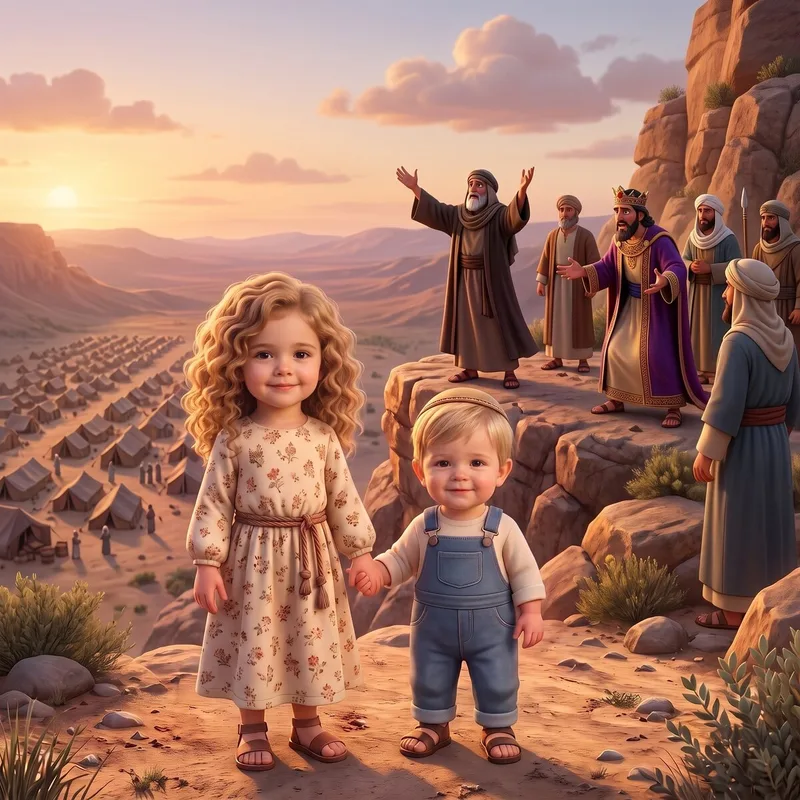
A Torah Tale book makes your child the hero of the parsha. Their name and, from one uploaded photo, their likeness appear on every page, illustrated in 3D animated-film style. Up to eight children, ages 0 to 18, can appear in the same book, and the book can be ordered in English, Hebrew or Yiddish. In a double-parsha week, one book covers both parshiyos.

Softcover 8″×8″

Hardcover 8″×8″

Board book 6″×6″

Coloring book 8.5″×11″
There are three formats: a 6"x6" board book with rounded safety corners (ages 0-4), an 8"x8" softcover photo book (ages 4-8) and an 8"x8" hardcover photo book (ages 5-18). An optional matching 8.5"x11" coloring book in black-and-white line art can be added to a book as a one-time add-on. Softcover and hardcover books open with a dedication page. If you add parents, grandparents and other relatives, they appear with the children on a closing family page in every format.
Every book ends with a discussion page of ten questions about the story, mixing comprehension with middos. That is what turns the book from something read to your child into something talked about at the table. Every book is written with careful rabbinical guidance and strict tznius, and reviewed by our team before it goes to print.
The book creator suggests the first parsha that can still arrive before its Shabbos, usually two to three weeks out, with a live countdown to that parsha's order deadline. For more on choosing, see How to Choose the Weekly Parsha for Your Child's Book.
Ready to put your child in the story? You can create the book in about five minutes with a free account and a few short questions.
Frequently asked questions
What is Parshas Chukas-Balak about?
Chukas teaches the parah adumah, tells of Miriam's passing, the water from the rock, Aharon's petirah, the copper snake and the wars with Sichon and Og. Balak tells how the king of Moav hired Bilam to curse Yisrael, and how Hashem turned his words into brachos. Near its end the parsha turns to a sad episode in Shittim, which many parents leave for older children.
What is the lesson of Parshas Balak for kids?
Hashem protects Yidden, and no one can harm them with words when Hashem has blessed them. Children can also learn that our own words matter, and that we should say good things about others, the way 'Mah tovu ohalecha Yaakov' praises Yisrael.
How do I explain Bilam's donkey to a young child?
Say that Bilam wanted to go and curse the Yidden, but Hashem sent a malach to stand in his way. The donkey saw the malach and Bilam did not, and Hashem let the donkey speak. Then Bilam saw the malach himself, and in the end only brachos came out of his mouth.
Why did Moshe hit the rock in Parshas Chukas?
Hashem told Moshe to take the staff, gather the people and speak to the rock, but Moshe struck it twice. Hashem then told Moshe and Aharon that they had not sanctified Him in the eyes of Bnei Yisrael, so they would not bring this assembly into the land. The meforshim discuss in what way, so with young children it is enough to say that Hashem had told Moshe to speak to the rock.
Is there a personalized Torah Tale book for Chukas-Balak?
Yes, Torah Tale makes personalized books for the weekly parsha, and a double-parsha week produces one book covering both parshiyos. Your child's name and likeness, from one uploaded photo, appear in 3D animated-film style, and every book ends with a discussion page of ten questions. You can start at torahtale.com/create with a free account and a few short questions.