Miriam's Well for Kids: Taanis 9a, Three Gifts & Hakaras Hatov
Chazal teach in Taanis 9a that Yisrael had a well in the midbar in the merit of Miriam. Here is the story, its source, and how to talk about it with children.
Published by Torah Tale.
Create this book for your child
Miriam's Well is the teaching of Chazal that Bnei Yisrael had a well of water with them in the midbar, and that it was there in the merit of Miriam HaNeviah. Children connect with it because it begins with something they know well, a cup of water, and asks a simple question: where does this come from, and who should I thank?
What is the story of Miriam's Well?
Bnei Yisrael traveled through the midbar, a dry and empty place, with children, animals and everything they owned. Chazal tell us that they had a well that provided water for them, and that this gift came in the merit of Miriam.
Then the Torah tells us that Miriam passed away in Kadesh and was buried there. The very next pasuk says that there was no water for the congregation (Bamidbar 20:1-2). The people gathered against Moshe and Aharon and spoke sharply about their thirst.
Hashem told Moshe to take the staff and speak to the rock in front of the people (Bamidbar 20:8), and water came out for the people and their animals (Bamidbar 20:11). The Gemara adds that the well returned in the merit of Moshe and Aharon.
What do Chazal actually say about the well?
It helps to keep the pesukim and the Midrash apart. The pesukim tell us three things: Miriam passed away, there was no water, and Hashem then provided water. That the well had been with them in her merit is what Chazal teach.
The Gemara in Taanis 9a says that three good leaders stood for Yisrael: Moshe, Aharon and Miriam. Three gifts came through them: the well in the merit of Miriam, the clouds of glory in the merit of Aharon, and the mann in the merit of Moshe. When Miriam passed away, the well stopped, and it came back in the merit of Moshe and Aharon.
On Bamidbar 20:2, Rashi learns from the placement of this pasuk that throughout the forty years they had the well in Miriam's merit. That is all we need to say as fact. Beyond that, we tell it to children the way the sources do, without adding scenes.
What does Miriam's Well teach children?
The first lesson is hakaras hatov. Children turn on a tap and water comes out, and it takes a story to make them stop and notice. In the midbar, water was a gift, and Chazal teach that it came through a person.
The second lesson is that quiet goodness matters. Miriam's name is connected to a gift that kept a whole nation alive. We do not need to know every detail of what she did to see that the people around us may be bringing blessing we never think about.
A third question comes from the pesukim themselves: what do we do when something we depended on is suddenly gone? The Torah shows us the people's thirst and Hashem's answer. It is a gentle opening to talk about asking, davening and trusting.
For more on thanking people, see Saying Thank You for Kids: Teaching Hakaras Hatov at Home.
How do I explain Miriam's Well to a 4-year-old and to a 9-year-old?
For a 3 or 4-year-old, keep it very short and concrete. You can say: "Yidden were in the midbar, where there is no river. Hashem gave them water, and Chazal tell us it was because of Miriam, who was so good. When we drink water, we say thank you." Let them hold a cup of water while you say it.
For a 6 or 7-year-old, add the three gifts: the well, the clouds and the mann. Ask them to match each gift to its leader. Children this age enjoy the pattern, and it keeps Miriam, Aharon and Moshe together as a team.
For a 9 to 12-year-old, bring in the source and the order of the pesukim. Look at Bamidbar 20:1-2 together and ask what the placement of the second pasuk right after Miriam's passing tells us. Then show them how Rashi and Taanis 9a answer. This teaches an older child how Chazal learn from the text, and that a Midrash is anchored in a pasuk.
If your child likes stories where a Midrash rests on a few words of the Torah, they may also enjoy Nachshon Jumps into the Sea, which comes from Sotah 37a.
What questions can we ask at the Shabbos table?
Reading is a lovely Shabbos activity, and this story gives you talking points that need nothing but the table and a cup of water. Here are some to try:
- What do we use water for before we even sit down to eat on Shabbos?
- Why do you think the Torah tells us about the water right after it tells us Miriam passed away?
- Which three gifts did Bnei Yisrael have in the midbar, and who is each one connected to?
- Who in our home gives us something good that we usually do not notice?
- How can we say thank you to that person this week?
On a weekday, try a small habit: when a child pours a glass of water at a meal, they say one thing they are thankful for before they drink. It takes seconds, and it links the story to something that happens every day.
What is a personalized Miriam's Well book like?
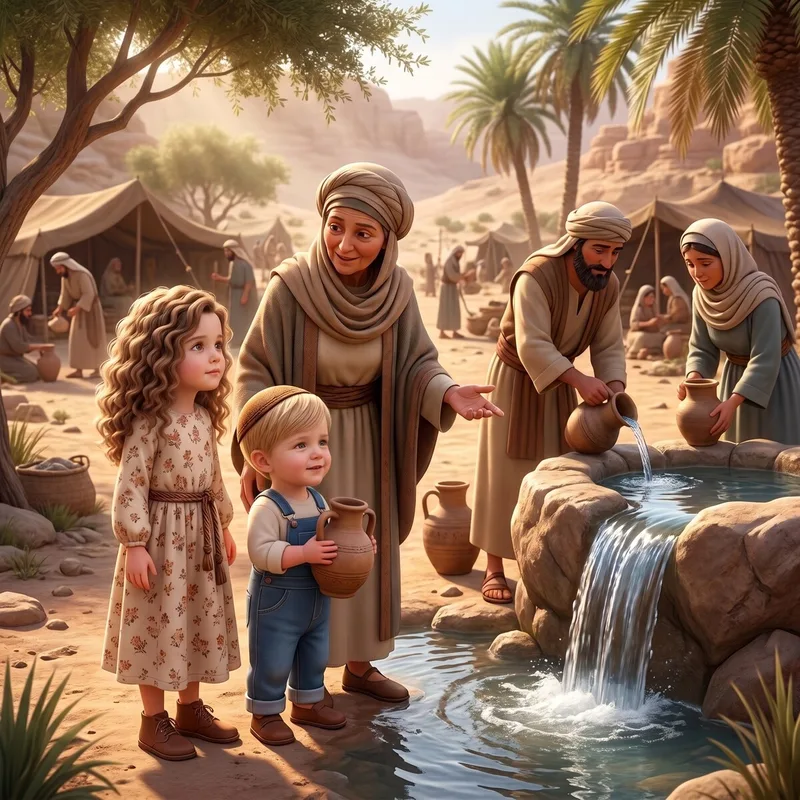
Miriam's Well is in Torah Tale's Midrash & Aggadah collection, where each story is told from its named source in the Gemara or Midrash. Your child is the hero, with their name and, from one uploaded photo, their likeness on every page in 3D animated-film style. A book can include up to eight siblings, ages 0 to 18.
Every book is written with careful rabbinical guidance and strict tznius, and is reviewed by our team before it goes to print. Each one ends with a discussion page of 10 questions about the story, mixing comprehension with middos, so the book becomes something to talk about at the table and not only something to read to a child. If you add parents, grandparents and other relatives with their photos, they appear with the children on a closing family page in every format.

Softcover 8″×8″

Hardcover 8″×8″

Board book 6″×6″

Coloring book 8.5″×11″
There are three formats: a 6"x6" board book with rounded safety corners (ages 0-4), an 8"x8" softcover photo book (ages 4-8), and an 8"x8" hardcover photo book (ages 5-18). Softcover and hardcover open with a dedication page. An optional matching coloring book is available as a one-time add-on, and it is a weekday activity, never for Shabbos or Yom Tov. The books themselves are right for reading at the Shabbos table.
How do I order the book?
Creating a book takes about five minutes. You need a free account and a few short questions: each child's name, boy or girl, age and one photo, any siblings, the story, your community (asked once), the language and the printed format. Languages are English, Hebrew and Yiddish. Details on shipping and plans are on the pricing page.
When you are ready, you can create the book and choose Miriam's Well from the Midrash & Aggadah collection.
Frequently asked questions
What is Miriam's Well?
Chazal teach that throughout Bnei Yisrael's time in the midbar they had a well that supplied them with water, and that it was there in the merit of Miriam. The source is Taanis 9a, and Rashi brings the same idea on Bamidbar 20:2. The pesukim themselves tell us that when Miriam passed away, there was no water for the people.
Where does Miriam's Well appear in the Torah?
The Torah does not use the name 'Miriam's well'. Parshas Chukas tells us that Miriam passed away in Kadesh and then there was no water for the congregation (Bamidbar 20:1-2). Chazal and Rashi learn from the order of these pesukim that the water had been there in her merit.
What is the lesson of Miriam's Well for children?
The main lesson is hakaras hatov, appreciating what we receive and the people through whom it comes. Water is something children use all day without thinking, so this story gives a simple way to notice it and say thank you. It also shows that one person's quiet goodness can benefit a whole nation.
How do I explain Miriam's Well to a 4-year-old?
Keep it to a few sentences: Yidden were in the midbar, where it is dry, and Hashem gave them water. Chazal tell us this was because Miriam was so good. Then ask your child to name something they are thankful for when they drink a cup of water.
Is there a Torah Tale book about Miriam's Well?
Yes, it is in the Midrash & Aggadah collection, where the stories are told from their named sources in the Gemara or Midrash. Your child's name and likeness, from one uploaded photo, appear on every page in 3D animated-film style. The book ends with a discussion page of 10 questions.