Parshas Chukas for Kids: The Parah Adumah, the Rock & the Copper Snake
Parshas Chukas is the parsha of a mitzvah we keep because Hashem said so, a rock that gave water, and a copper snake that taught Yidden to look up. Here is the story, the lesson, and how to explain it to children of different ages.
Published by Torah Tale.
Create this book for your child
Parshas Chukas is the sixth parsha in Sefer Bamidbar, and children tend to remember three things from it: a red cow whose mitzvah we cannot fully explain, a rock that gave water, and a copper snake on a pole. Underneath all three is one idea. We trust Hashem and turn to Him, even when we do not understand and even when we are thirsty, tired or upset.
What happens in Parshas Chukas?
The parsha opens with the parah adumah, the red heifer, whose ashes purify a person who became tamei through a meis. Then the Torah jumps ahead to Miriam's passing at Kadesh, and right after it we read that there was no water for the people.
The people quarreled with Moshe, and Hashem told Moshe to speak to the rock. After the rock, Moshe sent messengers to the king of Edom to ask for passage, and Edom refused. Aharon then passed away on Hor HaHar, and Moshe took Aharon's bigdei kehunah and put them on Elazar, his son. The Torah tells us that the whole house of Yisrael wept for Aharon for thirty days.
The king of Arad then attacked, and Yisrael davened and won. As the people traveled around Edom, they grew impatient and spoke against Hashem and Moshe. The nechashim came, the people admitted their wrong, and the copper snake healed them. Later the people sang at the be'er, and Yisrael fought Sichon and Og, with Hashem telling Moshe not to fear Og.
What is the parah adumah, and why is it called a chok?
The pasuk describes a red heifer that is temimah, without a blemish, and that never had a yoke on it. It was taken outside the camp and slaughtered in front of Elazar the kohen, and then it was burned. The kohen threw cedar wood, hyssop and scarlet wool into the fire. A person who was tahor gathered the ashes and kept them outside the camp, and they were mixed with spring water and sprinkled on someone who had become tamei through a meis, on the third and the seventh day.
The Torah itself tells us that the kohen and the one who burns the cow become tamei until the evening, while the ashes make someone else tahor. This is why the parah adumah is the famous example of a chok, a mitzvah we keep because Hashem commanded it. On the words zos chukas haTorah, Rashi explains that the Satan and the nations of the world taunt Yisrael about this mitzvah, and so the Torah calls it a chok: it is a decree from Hashem, and we do not need to doubt it.
What happened at the rock in Parshas Chukas?
After Miriam passed away there was no water. Chazal tell us (Taanis 9a) that the well had been in Miriam's merit, and you can read more in our article on Miriam's Well. The people gathered against Moshe and Aharon, who fell on their faces before the Ohel Moed.
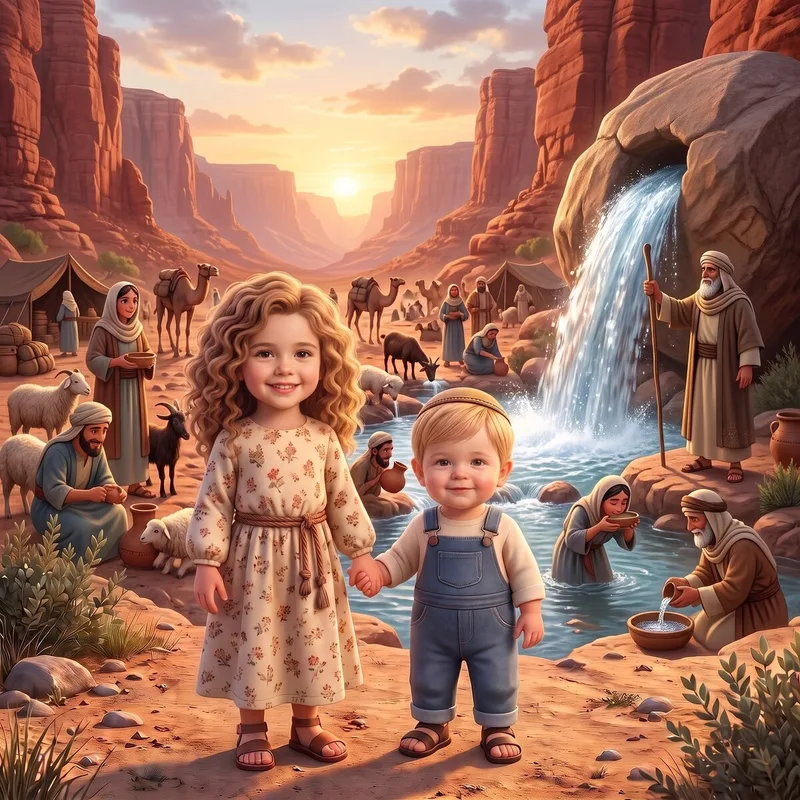
Hashem told Moshe to take the staff, gather the people, and speak to the rock before their eyes. Moshe took the staff as Hashem commanded, but he struck the rock twice, and water came out in abundance. The people and their animals drank.
Hashem then told Moshe and Aharon that because they had not believed in Him to sanctify Him in the eyes of Bnei Yisrael, they would not bring this congregation into Eretz Yisrael. The Torah does not name the sin in a single word, and the meforshim explain it in different ways. Rashi explains that had Moshe spoken to the rock and it had given water, Yidden would have said: if a rock that cannot speak or hear fulfills Hashem's word, how much more should we.
It helps to tell children this with respect. Moshe Rabbeinu was the greatest of the nevi'im, and Chazal teach that Hashem is exacting with tzaddikim, as much as a hair's breadth (Yevamos 121b). Even a small step away from Hashem's exact words matters when the whole nation is watching.
What do the snakes and the copper snake teach children?
As Yisrael went around Edom, the people grew impatient. They spoke against Hashem and Moshe about the way and the mann, and then the nechashim came. Rashi brings from Chazal a connection between these snakes and lashon hara, which makes this a good moment to read Guarding My Tongue with an older child.
The people then came to Moshe and said they had sinned by speaking against Hashem and against him, and they asked him to daven. The pasuk says vayispalel Moshe be'ad ha'am, and Moshe davened for the people, even though they had spoken against him. Hashem told him to make a saraf and set it on a pole, and anyone who was bitten and looked at it would live. Moshe made a nachash nechoshes.
The Mishnah in Rosh Hashanah (3:8) asks whether the snake really kills or gives life. It answers that when Yisrael looked upward and turned their hearts to their Father in heaven, they were healed. That is the whole lesson in one line: the cure came from turning to Hashem.
How do I explain Parshas Chukas to a 4-year-old, a 7-year-old and a 10-year-old?
Ages 3 to 4: Keep it to one picture. You can say: 'The Yidden were thirsty. Hashem told Moshe to speak to the rock, and Moshe hit it, and water still came out. Hashem wants us to listen to Him exactly.' Leave the snakes for later if your child is sensitive.
Ages 6 to 7: Tell the nechashim story as a story about saying sorry. The people complained, and then they said 'we were wrong' and asked Moshe to daven for them. Moshe davened, and Hashem showed them how to be healed. Ask: 'What did Moshe do when they spoke against him?'
Ages 9 to 12: Children this age can handle the idea of a chok and the question of what 'sanctifying Hashem's name' means. Ask them what the people would have learned if the rock had answered to speech, using Rashi's kal vachomer. You can also ask why the Torah is so exacting about leaders.
What are good Shabbos table questions for Parshas Chukas?
Reading and talking are exactly right for Shabbos, and these questions need nothing but conversation:
- Why were the people thirsty after Miriam passed away?
- What did Hashem tell Moshe to do at the rock, and what did Moshe do?
- Which mitzvos do we keep simply because Hashem said so?
- What did the people say after the nechashim came?
- How did Moshe answer people who had spoken against him?
- When we have said something unkind, how do we make it right?
What is a personalized Parshas Chukas book like?
A Torah Tale book of Parshas Chukas, from the Torah collection, puts your child's name on every page and, from one uploaded photo, their likeness, illustrated in 3D animated-film style. Up to eight children, ages 0 to 18, can appear in the same book. Every book is written with careful rabbinical guidance and strict tznius, and our team reviews it before it goes to print.

Softcover 8″×8″

Hardcover 8″×8″

Board book 6″×6″

Coloring book 8.5″×11″
Every book ends with a discussion page of 10 questions that mix comprehension with middos, which is what turns a book you read to your child into a story you talk about at the table. There are three formats: a board book (6x6 with rounded safety corners, ages 0-4), a softcover photo book (8x8, ages 4-8) and a hardcover photo book (8x8, ages 5-18). Softcover and hardcover open with a dedication page. If you add parents and grandparents, they appear with the children on a closing family page in every format. An optional matching coloring book is a weekday activity, for erev Shabbos or a weekday afternoon, never for Shabbos itself.
Creating a book takes about five minutes. You open a free account and answer a few short questions: each child's name, boy or girl, age and one photo, any siblings, the story, your community (asked once), the language and the format. The book can be in English, Hebrew or Yiddish. The creator suggests the first parsha that can still arrive before its Shabbos, usually two to three weeks out, so it fits best when Chukas is a few weeks ahead. At any other time of year you can choose the story yourself in the story picker. If your family has just finished Parshas Korach, Chukas is the natural next one.
When you are ready, you can create the book and make your child the hero of Parshas Chukas.
Frequently asked questions
What is Parshas Chukas about for kids?
Parshas Chukas begins with the mitzvah of the parah adumah, a chok that purifies someone who became tamei. It then tells of Miriam's passing, the lack of water, Moshe and the rock, Aharon's passing, the nechashim and the copper snake, and the wars with Sichon and Og. For children, the thread running through it is trusting Hashem and turning to Him instead of complaining.
What is a chok, and how do I explain it to a child?
A chok is a mitzvah that we keep because Hashem commanded it, even when we do not fully understand the reason. You can tell a child that when Abba or Mommy asks us to do something, we do it because we trust them, and that we trust Hashem even more. Rashi on the parah adumah says that the Satan and the nations of the world taunt Yisrael about this mitzvah, and that is why the Torah calls it a chok.
Why did Moshe hit the rock instead of speaking to it?
Hashem told Moshe to take the staff and speak to the rock, and Moshe struck it twice. Water still came out. Hashem then told Moshe and Aharon that they had not believed in Him to sanctify Him in the eyes of Bnei Yisrael. The meforshim explain the exact sin in different ways, and Rashi explains that speaking to the rock would have shown everyone how much we should listen to Hashem's word.
What is the lesson of the nechashim and the nachash nechoshes?
The people spoke against Hashem and Moshe, and then they admitted they had done wrong and asked Moshe to daven for them. Moshe davened, and Hashem told him to make a copper snake and set it on a pole. The Mishnah in Rosh Hashanah teaches that it was their looking up and turning their hearts to Hashem that healed them. Children can learn to say 'I was wrong' and to turn to Hashem.
What age is a personalized Parshas Chukas book for?
Torah Tale offers a board book (6x6 with rounded safety corners, ages 0-4), a softcover photo book (8x8, ages 4-8) and a hardcover photo book (8x8, ages 5-18). Your child's age is one of the short questions when you create the book. Every book ends with a discussion page of 10 questions about the story.