Parshas Behar-Bechukosai for Kids: Shemittah, Yovel & the Brachos of Torah
Behar-Bechukosai closes Sefer Vayikra with the land's Shabbos, Yovel and the brachos for toiling in Torah. Here is the story, the middos, and how to explain it to children of different ages.
Published by Torah Tale.
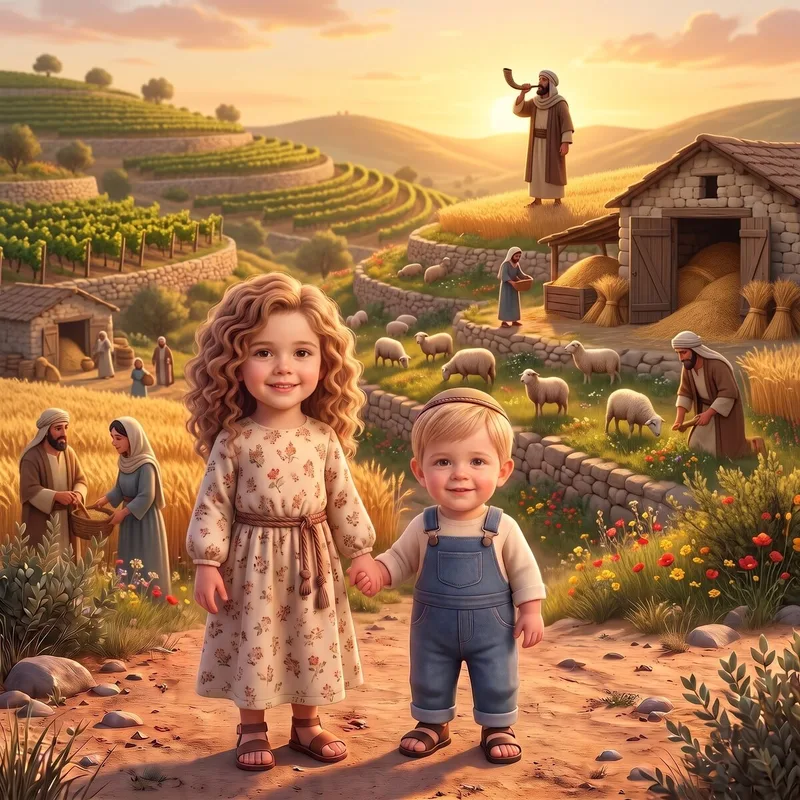
Create this book for your child - Parshas Behar · Create this book for your child - Parshas Bechukosai
Parshas Behar-Bechukosai closes Sefer Vayikra, and in many years the two parshiyos are read together as one. Behar teaches that the land belongs to Hashem: the seventh year is a Shabbos for the land, and the fiftieth year, Yovel, returns fields to their families and sets servants free. Bechukosai promises brachos to Bnei Yisrael for toiling in Torah and keeping the mitzvos. Children connect to it because it speaks to things they already feel: what is mine, whether I can share it, and whether I can trust that I will be taken care of.
What happens in Parshas Behar?
Behar opens at Har Sinai. Rashi asks what shemittah has to do with Har Sinai, and explains that just as shemittah was given at Sinai with all its details, so all the mitzvos were given with their details at Sinai.
The Torah tells us that when Bnei Yisrael come into the land, they sow and harvest for six years. The seventh year is a Shabbos for Hashem: the field is not sown and the vineyard is not pruned.
Then the Torah asks the question every child would ask: what will we eat in the seventh year? Hashem answers that He will command His bracha in the sixth year, and the land will produce enough for three years.
Next, Bnei Yisrael count seven times seven years. On Yom Kippur of the fiftieth year the shofar is sounded throughout the land, and freedom is proclaimed. Each person returns to his family's field. The land cannot be sold forever, because, as the Torah says, ki li ha'aretz, the land is Hashem's, and Bnei Yisrael are like strangers and settlers with Him.
Behar also teaches that we may not wrong one another, that a Yid who becomes poor must be helped to stand on his feet, and that a loan to him carries no interest. It speaks of how to treat an eved Ivri, and recalls that Bnei Yisrael are Hashem's servants whom He took out of Mitzrayim. For more on the first half of the double parsha, see Parshas Behar for Kids and The Shmita Year for Kids.
What happens in Parshas Bechukosai?
Bechukosai begins Im bechukosai teilechu, "if you walk in My chukim." Rashi explains that this means toiling in Torah. The brachos that follow are spelled out one by one: rain in its season, a land that gives its produce, and trees that give their fruit. They will eat bread until they are satisfied and live securely in the land.
The Torah promises peace in the land, so that they lie down with no one making them afraid. It says five of them will chase a hundred. It also says that Hashem will be present among them, that He will be their Elokim and they will be His people, and that He broke the poles of their yoke and led them upright.
The Torah then also describes what happens if Bnei Yisrael turn away from the mitzvos. This section ends with a promise: Hashem will remember His bris with Yaakov, Yitzchak and Avraham, and will not reject Bnei Yisrael or destroy them. For young children, most parents stay with the brachos and the closing promise, and ask a rav or teacher how much more to say for an older child.
The parsha closes with the mitzvos of erachin, consecrated things and maaser behemah. Its last pasuk says these are the mitzvos Hashem commanded Moshe for Bnei Yisrael on Har Sinai, the same place where Behar began. When Bechukosai is finished in shul, the kahal says Chazak chazak v'nischazek, because it completes Sefer Vayikra. More in Parshas Bechukosai for Kids.
What is the lesson of Behar-Bechukosai for children?
Four middos run through the parsha, and a child can hold on to any of them:
- Everything is Hashem's, so we share. If the land is Hashem's, then what we have is a gift to use well, including for a friend who has less.
- Bitachon. The Torah itself asks what we will eat in the seventh year, and then answers that Hashem will send the bracha.
- Helping someone stand up. A Yid who falls on hard times is helped, not taken advantage of.
- Effort in Torah. Bechukosai opens with toiling in Torah, and Rashi explains it that way.
How do I explain Behar-Bechukosai to a 4-year-old, a 7-year-old and a 10-year-old?
Around 3 or 4: Keep it to one picture. Hashem owns the land and everything in it, and the land gets a Shabbos too. When we do what Hashem asks, He gives us good things, like rain, fruit and peace.
Around 5 to 7: Tell the question and the answer. "What will we eat in the seventh year?" Hashem promised a big bracha in the sixth year. Then talk about a borrowed toy: it belongs to someone else, so it goes back.
Around 8 to 12: Bring in Yovel and Rashi's question about shemittah and Har Sinai. Ask why the Torah returns fields to families and frees servants in the fiftieth year, and what it means that Bnei Yisrael are Hashem's servants. Then connect it to Bechukosai: the brachos are tied to toiling in Torah and keeping mitzvos.
One sentence to use at home: Hashem gives us everything we have, so we rest when He tells us, share, trust Him, and work hard in Torah, and He promises us brachos and peace.
What is a personalized Torah Tale book of Behar-Bechukosai like?
In a Torah Tale book of this parsha your child is the hero. Their name and, from one uploaded photo, their likeness appear on every page, illustrated in high-resolution 3D animated-film style. Up to eight siblings, ages 0 to 18, can appear in the same book. If you add parents and grandparents, they appear with the children on a closing family page in every format.
Every book is written with careful rabbinical guidance and strict tznius, and is reviewed by our team before it goes to print. Every book ends with a discussion page carrying 10 questions about the story, mixing comprehension with middos, so what happened and what it asks of the child can be talked about together. The book comes in English, Hebrew and Yiddish, and you can order more than one language. A double-parsha week produces one book covering both parshiyos.

Softcover 8″×8″

Hardcover 8″×8″

Board book 6″×6″

Coloring book 8.5″×11″
There are three formats, and you choose by the child's age:
- 6x6 board book with rounded safety corners, ages 0-4
- 8x8 softcover photo book, ages 4-8 (opens with a dedication page)
- 8x8 hardcover photo book, ages 5-18 (opens with a dedication page)
You can add an optional matching coloring book, 8.5x11 in black-and-white line art. It is a weekday activity, for an afternoon during the week or erev Shabbos, and never for Shabbos itself. The storybook, by contrast, is perfect to read at the Shabbos table.
Behar-Bechukosai is read in the spring, shortly before Shavuos. You can find it in the Torah category of the story picker. The book creator suggests the first parsha that can still arrive before its Shabbos, with a live countdown to that parsha's order deadline.
Which questions can we ask at the Shabbos table?
These are for talking and listening only, so they work well around the table:
- What does it mean that the land has a Shabbos?
- What will we eat in the seventh year, and how does Hashem answer?
- Why do you think the Torah says the land belongs to Hashem and not to us?
- What can you share this week with someone who has less, or who needs help?
- What does Rashi mean that "walking in My chukim" is toiling in Torah? What is something you work hard to learn?
- When is it hard to trust that things will be okay, and what helps?
On a weekday, here is an activity for younger children: set out seven small piles of seven blocks, and count together toward fifty. Then talk about what it would feel like to return something to its owner.
Other parshiyos in the same sefer, like Parshas Emor, also give a lot to talk about.
Ready to make your child the hero of the parsha?
Creating a book needs a free account and a few short questions: each child's name, boy or girl, age and one photo, any siblings, the story, your community (asked once), the language and the format. The whole flow takes about five minutes. When you are ready, you can create the book.
Frequently asked questions
What is Parshas Behar-Bechukosai about?
Behar teaches the mitzvos of shemittah and Yovel, that the land belongs to Hashem, and how to treat a fellow Yid who has become poor. Bechukosai promises brachos to Bnei Yisrael for walking in Hashem's chukim and keeping His mitzvos, gives a warning about turning away, and ends with the mitzvos of erachin and consecrated things.
What is the lesson of Parshas Behar-Bechukosai for kids?
A child can take away that everything we have comes from Hashem, so we can trust Him, share, and help a friend who is struggling. Bechukosai adds that effort in Torah and mitzvos matters, and that Hashem promises brachos and peace.
How do I explain shemittah and Yovel to a young child?
For a 3- or 4-year-old, say that Hashem owns the land, so once in seven years the land has its own Shabbos and rests. For an older child, add that in the fiftieth year, Yovel, fields return to their families and servants go free, and that Hashem promised enough food in the sixth year to last through the rest.
Are Behar and Bechukosai always read together?
In many years they are read together as a double parsha, and in other years they are read separately. When they are read together, a double-parsha week produces one Torah Tale book covering both.
Which Torah Tale format suits a child for Behar-Bechukosai?
Torah Tale offers a 6x6 board book with rounded safety corners for ages 0-4, an 8x8 softcover for ages 4-8, and an 8x8 hardcover for ages 5-18. Every format ends with a discussion page of 10 questions about the story, so the book can be talked about at the table as well as read.