Parshas Emor for Kids: The Moadim, the Twelve Loaves & Kiddush Hashem
Parshas Emor is the parsha of Hashem's special times: Shabbos and the Yamim Tovim in order, the light that burns always, and a reminder to treat Hashem's name with respect. Here is the story, the lesson, how to explain it to a 4-year-old and a 9-year-old, and Shabbos-table questions.
Published by Torah Tale.
Create this book for your child
Parshas Emor is the eighth parsha in Sefer Vayikra, and it is the parsha of Hashem's special times. It tells the kohanim how to guard their kedushah, lists Shabbos and the Yamim Tovim in order, describes the light that burned always and the twelve loaves set out every Shabbos, and speaks of treating Hashem's name with respect. Children connect to it because so much of it is already part of their year: the sukkah, the matzah, the shofar.
What happens in Parshas Emor?
The parsha opens with Hashem telling Moshe: emor el hakohanim bnei Aharon v'amarta aleihem, speak to the kohanim, the sons of Aharon, and say to them. The kohanim have extra rules to protect their kedushah, including rules about becoming tamei to the dead, with exceptions for close relatives.
Rashi, quoting Chazal, explains that the double language of emor v'amarta teaches that adults must warn the young. In this case, adult kohanim must keep the young kohanim from becoming tamei. From this we learn a wider idea that parents and teachers are responsible for the children in their care.
The parsha then speaks of korbanos. The Torah says an animal brought to Hashem must be without a blemish, and the kohanim eat the holy foods only in a state of purity. For a child, the simple idea is that we give Hashem our best.
Which Yamim Tovim are in Parshas Emor?
The Torah calls them mo'adei Hashem, the appointed times of Hashem, holy gatherings that Bnei Yisrael proclaim. The parsha goes through them in order:
- Shabbos: six days of work, and the seventh day a Shabbos of complete rest.
- Pesach: the korban Pesach on the fourteenth of the first month, and seven days of matzos beginning on the fifteenth.
- The omer: bringing the first of the new grain to the kohen, and counting seven full weeks, fifty days. On the fiftieth day, which we call Shavuos, two loaves are brought.
- Rosh Hashanah: the first day of the seventh month, a day of remembrance with the teruah.
- Yom Kippur: the tenth day of that month, when we afflict ourselves and do no work.
- Sukkos: from the fifteenth, living in sukkos for seven days, taking the four minim, and rejoicing before Hashem.
The Torah gives the reason for the sukkah itself: ki vasukkos hoshavti es Bnei Yisrael b'hotzi'i osam mei'eretz Mitzrayim. Hashem had Bnei Yisrael dwell in sukkos when He took them out of Mitzrayim. If you want to go deeper into that Yom Tov, read The Sukkos Story for Kids.
Right in the middle of this list, after Shavuos and before Rosh Hashanah, the Torah repeats the mitzvah of leaving the corner of the field and the gleanings for the poor. Rashi brings a teaching of Chazal that this placement shows that one who leaves these gifts for the poor is considered as if he built the Beis HaMikdash and brought korbanos in it. The mitzvah of peah appears first in Parshas Kedoshim, the parsha just before Emor.
What are the ner tamid and the twelve loaves?
Toward the end of the parsha the Torah returns to the Mishkan. Bnei Yisrael bring pure, pressed olive oil to kindle a lamp continually, and the pasuk says Aharon would arrange the lamps from evening until morning before Hashem.
Then come the lechem hapanim: twelve challos, set out in two rows of six on the pure table. The Torah says they are arranged anew every Shabbos. Children usually like this part because they can picture it: twelve loaves, two rows, six in each.
Near its end, the parsha also tells of a man who spoke disrespectfully about Hashem's name. He was held until Hashem's instruction was made clear, and then Bnei Yisrael did as Hashem commanded Moshe. This is a serious episode, and it is a parent's decision how much to tell. For young children it is enough to say that Hashem's name is precious and we speak of it with great respect.
What is the lesson of Parshas Emor?
The parsha states its central idea in a pasuk: v'lo sechalelu es shem kodshi v'nikdashti b'soch Bnei Yisrael. Do not profane My holy name, and I will be sanctified among Bnei Yisrael. This is kiddush Hashem. In a child's terms, it means saying a bracha slowly and with kavanah, speaking respectfully, and behaving in a way that makes a Yid proud of being a Yid.
The second lesson is for the grown-ups: emor v'amarta. Children learn from what adults say and also from what adults do, so a parsha that begins with speaking to the kohanim and then to their children is a good moment to ask what we are teaching at home.
The third is that time can be holy. Shabbos and the Yamim Tovim are not ordinary days that we happen to enjoy. Hashem set them apart, and the Torah lists them so we can keep them.
How do I explain Parshas Emor to a 4-year-old and a 9-year-old?
Ages 3 to 4: use pictures. Hashem told us about special days, and the first one is Shabbos. In the Mishkan there was a light that stayed lit with pure olive oil, and every Shabbos twelve challos were set out. Ask, which special day do you love most?
Ages 6 to 8: go through the Yamim Tovim in order and let your child connect each to something they do: the sukkah, the matzah, the shofar. Explain that we count forty-nine days from Pesach, and Shavuos is the fiftieth day, and that the Torah tells us why we sit in a sukkah. Ask what a child can do so that people see Hashem's name honored.
Ages 9 to 12: read emor v'amarta together and ask why the Torah says it twice. Bring Rashi's explanation that adults must warn the young. Talk about kiddush Hashem and why the Torah says we must be careful with Hashem's name, and ask what that looks like for a ten-year-old in school or on the street.
What questions can we ask at the Shabbos table?
Shabbos is a natural time for this parsha, since Shabbos is the very first moed on its list. These are for talking only:
- Why do you think the Torah lists Shabbos first, before the Yamim Tovim?
- Which Yom Tov in the parsha do you look forward to most, and why?
- Why did the oil for the lamp have to be pure and the best?
- What does it mean to make Hashem's name holy, and what is one way we can do that this week?
- Why did the Torah say emor v'amarta, and what do grown-ups teach you just by how they act?
For a weekday activity, make a simple chart of the moadim in the order the parsha lists them, with your child adding what each one means. Or set twelve rolls in two rows of six on a weekday or erev Shabbos to picture the lechem hapanim, then enjoy them. Drawing, coloring and writing are melacha, so keep those for weekdays or erev Shabbos, never for Shabbos itself.
What is a personalized Torah Tale book of Parshas Emor like?
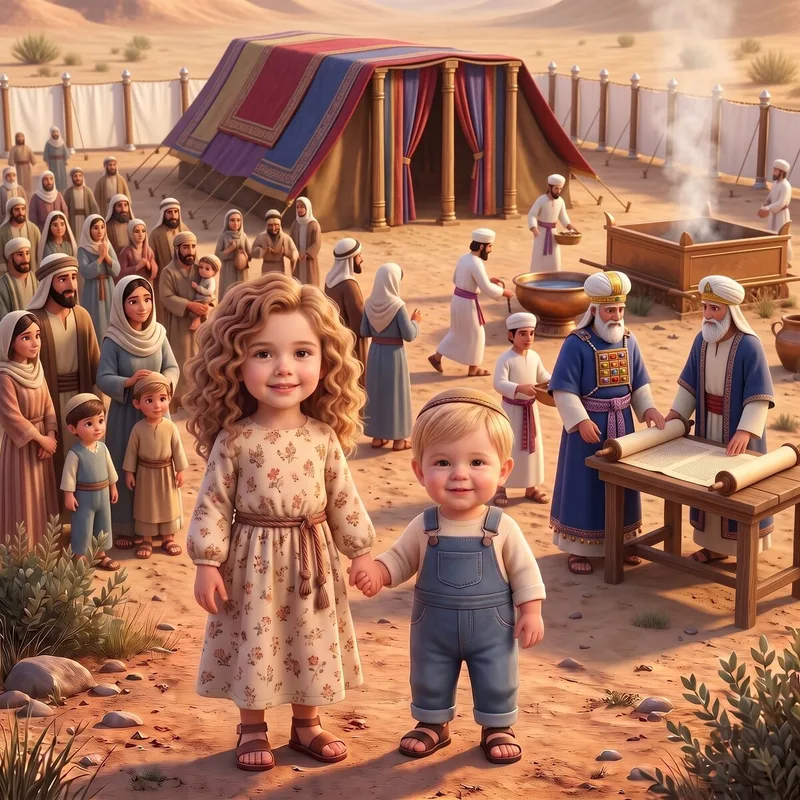
Torah Tale makes personalized Torah storybooks in which your child is the hero. Their name and, from one uploaded photo, their likeness appear on every page in 3D animated-film style. Up to eight children, ages 0 to 18, can appear in the same book. A parsha book comes from the Torah collection, and a book can be ordered in English, Hebrew or Yiddish.

Softcover 8″×8″

Hardcover 8″×8″

Board book 6″×6″

Coloring book 8.5″×11″
There are three formats: a 6x6 board book with rounded safety corners for ages 0-4, an 8x8 softcover photo book for ages 4-8, and an 8x8 hardcover photo book for ages 5-18. The optional matching coloring book is 8.5x11 in black-and-white line art, and it is a one-time add-on for weekdays. Softcover and hardcover open with a dedication page, and if you add parents and grandparents they appear with the children on a closing family page in every format.
Every book ends with a discussion page of 10 questions about the story, mixing comprehension with middos, so the book can be talked about at the table and not only read to a child. Every book is written with careful rabbinical guidance and strict tznius, and reviewed by our team before it goes to print.
Emor is read in the spring, in the weeks of sefiras haomer. To plan ahead for that Shabbos, check the countdown to the order deadline for delivery before Shabbos, and see how to choose the weekly parsha for your child's book. Creating a book takes about five minutes: a free account, then a few short questions about each child's name, boy or girl, age and photo, any siblings, the story, your community (asked once), the language and the format.
When you are ready, you can create the book and put your child into the parsha of Hashem's special times.
Frequently asked questions
What is Parshas Emor about?
Parshas Emor begins with Hashem telling Moshe to speak to the kohanim about guarding their holiness and about korbanos that must be whole. It then lists Shabbos and the Yamim Tovim, describes the ner tamid and the lechem hapanim, and near its end tells of a man who spoke disrespectfully about Hashem's name.
What is the lesson of Parshas Emor for children?
One lesson is kiddush Hashem, acting in a way that honors Hashem's name, which the parsha states in the pasuk v'nikdashti b'soch Bnei Yisrael. Another is that adults are responsible for teaching and guiding children, which we learn from the double language of emor v'amarta. A third is that Shabbos and the Yamim Tovim are holy times set apart by Hashem.
How do I explain Parshas Emor to a 4-year-old?
Keep it to three simple pictures: Hashem tells us about special days, starting with Shabbos, a light in the Mishkan was kept burning with pure olive oil, and twelve challos were set out every Shabbos. Then ask which special day your child loves most. You can leave out the harder parts of the parsha for now.
Which Yamim Tovim are mentioned in Parshas Emor?
The parsha mentions Shabbos, Pesach with the seven days of matzos, the counting of the omer for fifty days, Rosh Hashanah, Yom Kippur and Sukkos. It calls them the mo'adei Hashem, the holy gatherings that Bnei Yisrael proclaim.
Can I read a Torah Tale book at the Shabbos table?
Yes, reading the storybook is entirely appropriate on Shabbos and Yom Tov, and every book ends with a discussion page of 10 questions for the table. The optional coloring book is different: coloring is melacha, so it is only a weekday activity, such as an afternoon during the week or erev Shabbos.