The Shmita Year for Kids: The Land's Shabbos, Bitachon & Sharing
What the Torah tells us about the seventh year, the land's own Shabbos, and the question every child asks: what will we eat? Plus how to explain it at ages 3-4, 6-7 and 10-12.
Published by Torah Tale.
Create this book for your child
The Shmita year is the seventh year in a cycle of seven in Eretz Yisrael, when the land rests from planting and harvesting and what grows is there for everyone to eat. Children grasp it quickly, because it is a Shabbos for the land, and because the Torah itself asks the question any child would ask: what will we eat?
What is the Shmita story for kids?
The Torah introduces Shmita in Parshas Behar, where Hashem speaks to Moshe at Har Sinai. When Bnei Yisrael come into the land that Hashem is giving them, the land itself is to rest, a "Shabbos laHashem" (Vayikra 25:2).
The pesukim lay out a rhythm. For six years you sow your field, prune your vineyard and gather what grows. In the seventh year the land has a Shabbos: you do not sow your field and you do not prune your vineyard (25:3-4). What grows on its own is not harvested the way it is in other years (25:5).
Then the Torah says who may eat. The produce of the land's Shabbos is food for you, your servants, your hired workers, the settlers living with you, and your animals (25:6-7). In Parshas Mishpatim the Torah adds that the poor of your people eat from it too (Shemos 23:11). In the seventh year, a field is no longer one person's private storehouse.
Rashi notices where this mitzvah appears. Behar opens with the words "b'Har Sinai", and Rashi asks what Shmita has to do with Har Sinai in particular. He explains that just as Shmita was given with all its general rules and its details at Sinai, so too all the mitzvos were given with their details at Sinai.
What will we eat in the seventh year?
The Torah does not skip the worry. It says it out loud: "And if you say, what will we eat in the seventh year, behold we will not sow and not gather our produce" (Vayikra 25:20). Children like this part of the story, because the pasuk takes the question seriously.
The answer comes right away. Hashem says He will command His blessing for you in the sixth year, and the sixth year's crop will carry you through three years (25:21). The farmer's job is to keep the mitzvah, and Hashem takes care of the food.
What is the lesson of the Shmita year?
The first lesson is bitachon. Stopping work and trusting that there will still be food is a very concrete way to believe that Hashem provides. For a child, the everyday version is simple: we do our part, and we trust that Hashem is looking after us.
The second is sharing. In the seventh year the owner eats from the field together with his workers, the poor and the animals. The third is that the land is not really ours. The Torah says it plainly in the same parsha: "for the land is Mine, for you are strangers and settlers with Me" (25:23).
The Midrash (Vayikra Rabbah) speaks of those who keep Shmita as "gibborei koach", mighty ones, because they watch their field open to everyone and hold themselves back. The Torah also speaks of releasing loans at the end of seven years (Devarim 15:1-2), another way the seventh year loosens our grip on what we own. Many families link this to the Shabbos story, since Shmita is a Shabbos of years.
How do I explain Shmita to my child by age?
Ages 3-4: the field has a Shabbos
Keep it to one picture. "Hashem gave the land a Shabbos, just like we have Shabbos. Once every seven years the fields rest, and the fruit is for everybody." That is enough at this age, and it connects to something they already know.
Ages 6-7: sharing and trusting
Add the question. "The farmers asked, what will we eat? Hashem promised a big blessing in the sixth year." Then ask what it feels like to share something that is yours. Children this age enjoy noticing that the animals and the poor eat from the same field.
Ages 10-12: who owns the land?
Older children can handle the harder idea. Bring the pasuk "the land is Mine" and ask what changes when you remember that what you have is on loan from Hashem. They can also notice that the Torah raises the worry before it gives the promise. You can connect it to Parshas Mishpatim, where Shmita appears alongside everyday mitzvos between people.
When is the next Shmita year, and does it apply to us?
Years are counted in cycles of seven. The last Shmita year was 5782, from Rosh Hashanah 2021. The next is 5789, beginning at Rosh Hashanah in the fall of 2028, and the current year, 5787, is the fifth year of the cycle.
The mitzvos of Shmita as they relate to the land and its produce are tied to Eretz Yisrael. How they are kept today, and what applies to a family in chutz la'aretz, such as buying produce or lending money, is a question for your rav. As a story for children, though, the lessons of bitachon and sharing are for every home.
What can we talk about at the Shabbos table?
Talking, questions and stories belong at the table. Here are five that work with a mixed-age group:
- Why do you think the Torah calls the seventh year a Shabbos?
- What would worry you if the fields rested for a whole year?
- What did Hashem promise to do in the sixth year?
- Who is allowed to eat what grows in the seventh year, and why does that matter?
- When did we have to wait and trust, and how did it turn out?
Let the youngest answer first and the older children add the pesukim. A story book is also welcome at the Shabbos table or on a quiet Shabbos afternoon, because reading is a perfect Shabbos activity.
What is a personalized Shmita storybook like?
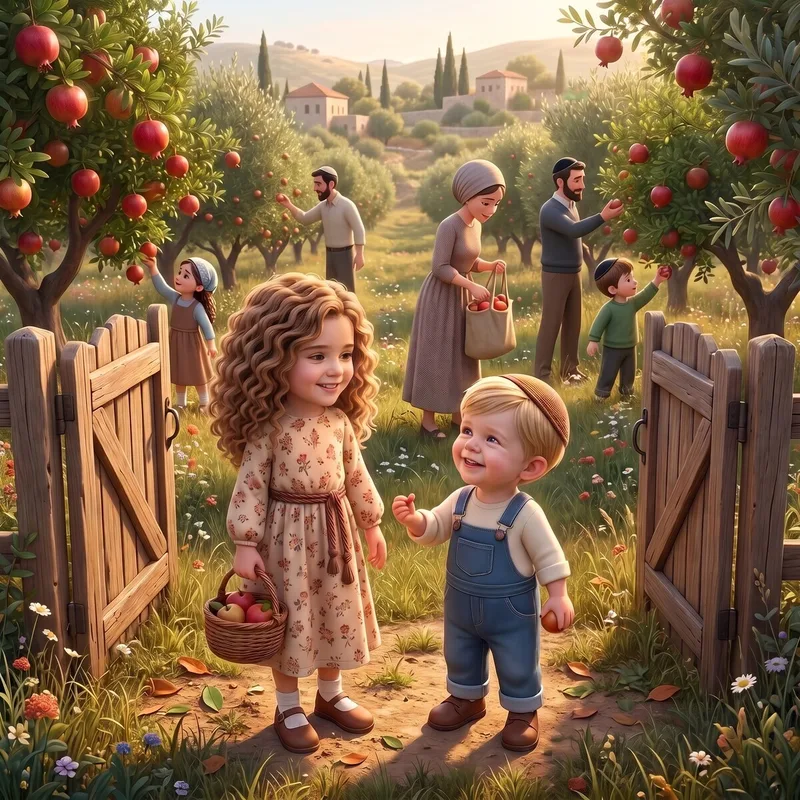
Torah Tale's Shmita book is part of the Jewish Life collection, the simchos and minhagim of a Yiddishe life. Your child is the hero: their name and, from one uploaded photo, their likeness appear on every page, illustrated in 3D animated-film style. Up to eight siblings, ages 0 to 18, can appear in the same book.
The book is written with careful rabbinical guidance and strict tznius, and reviewed by our team before it goes to print. Every book ends with a discussion page of 10 questions mixing comprehension with middos, so what happened and what it asks of the child can both be talked about at the table. If you add parents and grandparents, they appear with the children on a closing family page in every format.

Softcover 8″×8″

Hardcover 8″×8″

Board book 6″×6″

Coloring book 8.5″×11″
There are three formats. The board book is 6x6 with rounded safety corners, for ages 0-4. The softcover is an 8x8 photo book for ages 4-8, and the hardcover is an 8x8 photo book for ages 5-18. Softcover and hardcover open with a dedication page. The books come in English, Hebrew and Yiddish.
An optional matching coloring book, in black-and-white line art, can be added to a one-time order. Coloring is melacha, so it is for a weekday: an erev Shabbos afternoon or a weekday after school, never on Shabbos or Yom Tov. If you want the whole collection, a collection subscription is Monthly (four books a month in one delivery) or Yearly (the whole collection, paid once, $30 off), always only that collection's own books.
Ready to make one? Creating a book takes about five minutes with a free account and a few short questions: each child's name, boy or girl, age and one photo, any siblings, the story, your community (asked once), the language and the format. You can create the book and pick the Shmita story from the Jewish Life collection.
Frequently asked questions
What is the Shmita year in simple words for kids?
Shmita is the seventh year in a cycle of seven years in Eretz Yisrael. In that year the land has a Shabbos, so the fields are not worked the way they are in the other six years. What grows is there for everyone to eat.
What is the lesson of the Shmita year?
The main lesson is bitachon, trusting that Hashem will provide even when we stop working. It also teaches sharing, because the produce of the seventh year is for everyone, and it reminds us that the land belongs to Hashem. The Torah says this directly: 'The land is Mine' (Vayikra 25:23).
How do I explain Shmita to a 4-year-old?
You can say that Hashem gave the land a Shabbos, just like we have Shabbos every week. Once every seven years the fields rest, and the fruit that grows is for everybody. Keep it to one idea and one picture, such as a field resting.
When is the next Shmita year?
The last Shmita year was 5782, which ran from Rosh Hashanah 2021 to the following Elul. The next is 5789, beginning at Rosh Hashanah in the fall of 2028. The practical laws of Shmita are a matter for your rav.
Is there a personalized Torah storybook about the Shmita year?
Yes. Torah Tale has a Shmita story in its Jewish Life collection, with your child's name and likeness on every page, and it ends with a discussion page of 10 questions mixing comprehension with middos. It can be ordered in English, Hebrew or Yiddish.