Parshas Bechukosai for Kids: Brachos, Toiling in Torah & Peace
Parshas Bechukosai closes Sefer Vayikra with brachos of rain, food and peace, a gentle look at the tochacha, and a promise that Hashem remembers us. Here is the story, the lesson, and words for a 4-year-old, a 7-year-old and an 11-year-old.
Published by Torah Tale.
Create this book for your child
Parshas Bechukosai is the last parsha of Sefer Vayikra, and its big idea is easy for a child to hold: when Yidden walk in Hashem's ways and toil in Torah, Hashem promises rain, food, peace and safety, and even when things go wrong, He promises not to abandon His people. Children connect to the pictures of full fields, quiet homes and a Hashem who stays close. Below you will find the parsha retold for kids, the lesson, and words you can use for different ages.
What happens in Parshas Bechukosai?
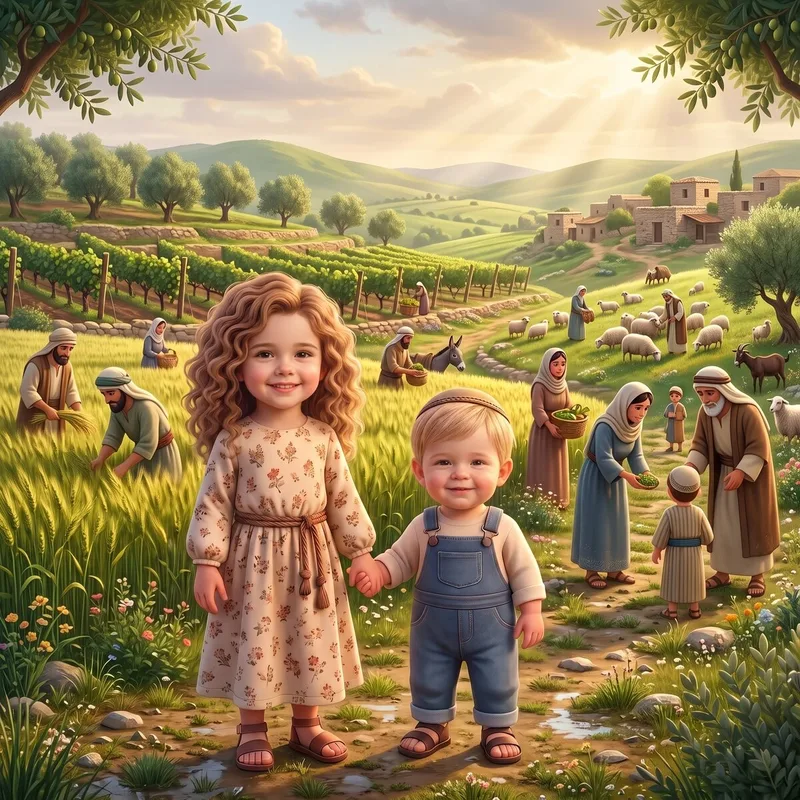
The parsha opens with the words Im bechukosai teileichu, 'if you walk in My chukim,' and then the Torah lists the brachos. Hashem promises rain in its season, so the land gives its produce and the trees give their fruit. The harvest will be so full that the threshing will last until the grape harvest, and the grape harvest until the time of sowing.
The Torah promises that they will eat bread until satisfied and live securely in the land. Hashem also promises peace in the land, no fear of wild beasts, and that the sword will not pass through it. Five of Bnei Yisrael will chase a hundred, and a hundred will chase ten thousand.
Hashem says He will turn to them, make them fruitful and keep His covenant with them. He will place His Mishkan among them and be their Elokim, and they will be His people. The Torah reminds them that Hashem took them out of Mitzrayim and broke the bars of their yoke, leading them komemiyus, which Rashi explains as standing upright and tall.
Then comes v'im lo tishmeu li, 'and if you will not listen to Me.' This is the tochacha. The Torah describes in stages how things become hard if the mitzvos are ignored, and says that the land will then make up its Shabbasos. You can read more about the land's rest in Parshas Behar for Kids and The Shmita Year for Kids.
But the parsha does not stay there. The Torah tells us that even in the land of their enemies, Hashem will not despise them or reject them to destroy them, and that He will remember His covenant with Yaakov, with Yitzchak and with Avraham, and He will remember the Land.
The last chapter gives the laws of arachin, pledging to Hashem, and of things set aside for Hashem. It also teaches ma'aser behemah, where the animals pass one by one under the rod and every tenth one is holy. The parsha, and Sefer Vayikra, ends with the words that these are the mitzvos Hashem commanded Moshe for Bnei Yisrael at Har Sinai. When it is finished we say Chazak, chazak v'nischazek.
What does Im Bechukosai Teileichu mean?
The word teileichu means 'you will walk.' The pasuk goes on to say 'keep My mitzvos and do them,' so Rashi asks what the walking adds. His answer is that it means that Yidden should be amelim baTorah, toiling in Torah.
For a child, that is a very usable idea. Walking is done one step at a time, and learning Torah is the same. We learn a pasuk, a perek, a new bracha, and we keep going even when it is not easy.
What is the lesson of Parshas Bechukosai for children?
- Effort matters. The parsha begins with toiling in Torah, so we can praise a child for trying hard, not only for knowing the answer.
- Peace is precious. After the food and drink, the Torah adds peace. Rashi explains that without peace nothing else is worth much, which is a good thing to tell siblings who are arguing over a toy.
- Hashem stays close. He promises to dwell among Bnei Yisrael, and He promises not to reject them even after the tochacha.
- Give honestly. With ma'aser behemah, the pasuk says not to check between good and bad and not to swap it. We learn that what we give to Hashem should be given sincerely, not only the leftovers.
A note on the tochacha: the parsha is speaking to Klal Yisrael as a whole. It is wise not to tell a child that a particular hardship in their own life is a punishment. If you are unsure how to answer a question like that, ask your rav or your child's teacher.
How do I explain Bechukosai to a 4-year-old, a 7-year-old and an 11-year-old?
For a 4-year-old, stay with the brachos. You can say: 'Hashem told Yidden that if they do the mitzvos and learn Torah, He will send rain so the fields grow, and they will have food and a safe home. And Hashem is always close to us.' Ask what they would like to grow in a field, and let the answer lead the conversation.
For a 7-year-old, add toiling in Torah and the idea that peace is added after the food. Tell the ma'aser behemah picture: the animals walk out one by one, every tenth is holy, and we do not pick the nicest one for ourselves. You can mention that the Torah also warns what happens if we ignore the mitzvos, and that Hashem still promises to remember the Avos.
For an 11-year-old, open the pesukim together. Look at Rashi on Im bechukosai and on v'nasati shalom baaretz. Notice how the tochacha moves in stages, and how the Torah turns toward the end, from warning to a promise of remembering. Connect the land's Shabbasos to Behar, and ask why the Torah chose to end Sefer Vayikra with this parsha and a chapter of pledges.
What questions can we ask about Bechukosai at the Shabbos table?
These are talking questions only, so they work well at the table on Shabbos:
- What brachos does the Torah promise in Bechukosai? Can you name three?
- Why do you think Rashi says teileichu means toiling in Torah?
- Why does the Torah add peace after the food and drink?
- What would a really peaceful week look like in our home?
- In ma'aser behemah, why does the Torah say not to pick the best or swap it?
- How do we know from the end of the tochacha that Hashem never gives up on Yidden?
If your children are small, ask them to act out the animals walking one by one, or to sing a song about rain. Everyone's answers count.
What is a personalized Parshas Bechukosai book like?
A Torah Tale book is built around your child. Their name and, from one uploaded photo, their likeness appear on every page, illustrated in 3D animated-film style. Up to eight siblings, ages 0 to 18, can appear in the same book. Bechukosai is a parsha book from the Torah collection, written with careful rabbinical guidance and strict tznius, and reviewed by our team before it goes to print. Customers do not preview or approve the book before printing.

Softcover 8″×8″

Hardcover 8″×8″

Board book 6″×6″

Coloring book 8.5″×11″
There are three formats, matched to age: a 6 by 6 inch board book with rounded safety corners for ages 0-4, an 8 by 8 inch softcover photo book for ages 4-8, and an 8 by 8 inch hardcover photo book for ages 5-18. Softcover and hardcover books open with a dedication page. If you add parents, grandparents and other relatives with their photos, they appear with the children on a closing family page in every format.
Every book ends with a discussion page of 10 questions mixing comprehension with middos, so the book becomes something you talk about, not only something you read. Reading it at the Shabbos table or on a Shabbos afternoon is just right. An optional matching coloring book is a weekday activity, for erev Shabbos or a weekday afternoon, never for Shabbos or Yom Tov.
The book creator suggests a parsha a few weeks ahead, but the story is one of the short questions, so you can choose Bechukosai. In a year when Behar and Bechukosai are read together, a double-parsha week produces one book covering both. For help picking, see How to Choose the Weekly Parsha for Your Child's Book, and check the countdown to the order deadline so the book can arrive in time.
Ready to begin? You can create the book with a free account and a few short questions: each child's name, boy or girl, age and photo, any siblings, the story, your community (asked once), the language and the format. It takes about five minutes.
Frequently asked questions
What is Parshas Bechukosai about for kids?
Parshas Bechukosai tells Bnei Yisrael that if they walk in Hashem's chukim and toil in Torah, they will have rain on time, full harvests, safe homes and peace. It then describes, step by step, what happens if they turn away from the mitzvos, and promises that Hashem will still remember His covenant. It closes with the laws of pledges to Hashem and ma'aser behemah.
What does Im Bechukosai Teileichu mean?
The words mean 'if you walk in My chukim.' Rashi explains that the walking here refers to toiling in Torah, since the mitzvos are mentioned separately right afterward. For a child, it can be put simply: Hashem asks us to keep learning and trying, step by step.
How do I explain the tochacha in Bechukosai to a young child?
With young children, spend most of your time on the brachos and keep the tochacha short and calm. You can say that when Yidden do not follow the mitzvos, things become hard, but Hashem never gives up on them and always remembers the Avos. If a child has questions about something frightening, a rav or teacher can guide you.
What is the lesson of Parshas Bechukosai?
One lesson is that effort in Torah and mitzvos matters, and that the mitzvos are connected to the good things in our lives. Another is that Hashem stays close to Yidden, and a third is that peace is worth more than almost anything else. Children also learn from ma'aser behemah to give honestly, without picking out the best for themselves.
Can I get a personalized Parshas Bechukosai book for my child?
Yes. Torah Tale makes personalized storybooks for the weekly parsha, with your child's name and likeness, from one uploaded photo, illustrated in 3D animated-film style on every page. Creating a book takes a free account and a few short questions, and every book ends with a discussion page of 10 questions about the story.