Parshas Behar for Kids: Shemittah, Yovel & Trusting Hashem
Parshas Behar teaches that the land belongs to Hashem, that it rests in the Shemittah year, and that a Yid who is struggling deserves our help. Here is the story retold for children, with ways to explain it and questions for the Shabbos table.
Published by Torah Tale.
Create this book for your child
Parshas Behar is the ninth parsha in Sefer Vayikra, and it is about a year when the land rests, a shofar that announces freedom, and a Torah that asks us to look after one another. Children connect to it because the big idea is simple: everything belongs to Hashem, so we can rest, trust and share.
What is Parshas Behar about?
The parsha opens with Hashem speaking to Moshe Rabbeinu at Har Sinai, which is where its name comes from. Rashi asks at the very beginning what Shemittah has to do with Har Sinai in particular. He answers that just as Shemittah was given with its general rules and its details at Sinai, so all the mitzvos were.
The parsha then moves through three connected subjects: the Shemittah year, the Yovel year, and how Yidden must treat each other. It closes with a reminder not to make idols, to keep Hashem's Shabbos and to revere the Mikdash.
What are Shemittah and Yovel, told for children?
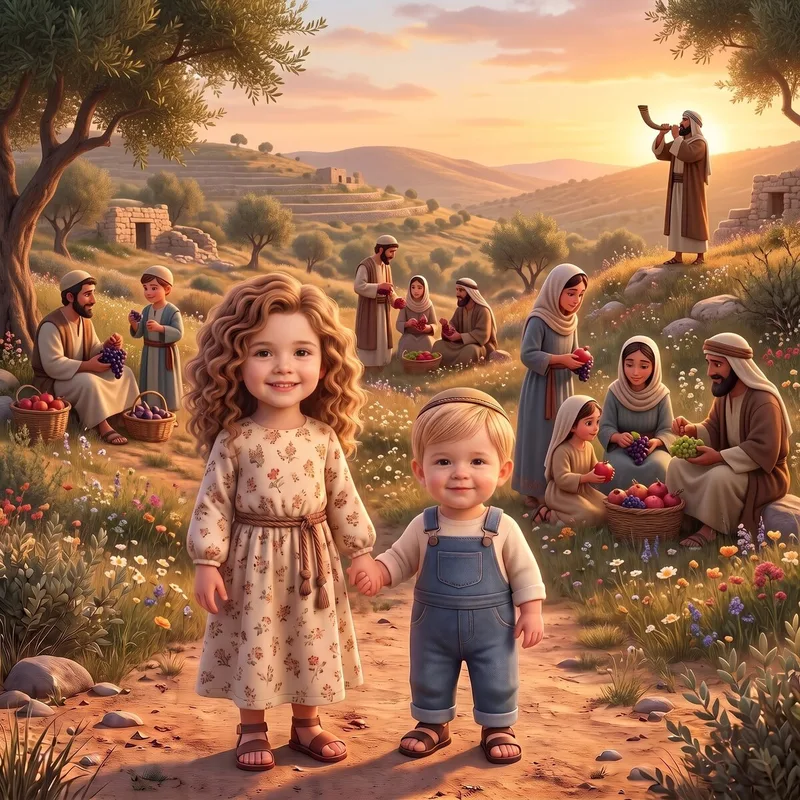
The Torah says that when Bnei Yisrael come into the land, they work their fields for six years. They sow, prune and gather the crop. But the seventh year is a Shabbos la'Hashem, a Shabbos for the land itself. In that year the farmers do not sow or prune.
What grows by itself in the seventh year is not harvested in the usual way. The pesukim say it is there to eat, for the owner, for his workers, for his animals and for the wild animals of the land. Nobody is left out.
Then the Torah tells us to count seven cycles of seven years. On Yom Kippur of the fiftieth year, the shofar is blown through the whole land. This is Yovel, and the pasuk says u'kratem dror ba'aretz, proclaim freedom in the land. Fields go back to their families, and a Yid who had to sell himself to work goes free. As in Shemittah, the land also rests in that year.
What does Hashem promise about the sixth year?
The Torah asks the question a child might ask: what will we eat in the seventh year if we do not sow or gather? Then the pesukim give Hashem's answer. He will command His bracha upon the sixth year, and it will give a crop for three years.
This is the heart of the parsha for young children. A farmer who rests his field is doing something that looks risky, and the Torah tells him that Hashem takes care of him. That is bitachon, trusting Hashem, and it is a feeling a four-year-old can understand when they see Totty or Mommy trusting calmly.
The Torah also says that the land cannot be sold forever, because it is Hashem's, and that we are like guests living with Him on it. This is why we do not hold on to what we have too tightly.
What does Behar teach about being fair and kind?
Alongside the mitzvos of the land, Behar gives the mitzvos between people. The Torah says not to wrong one another in buying and selling. A few pesukim later it repeats that we may not wrong each other, and Rashi explains that this second pasuk is about hurtful words. If you want to teach this to a child, our article on guarding my tongue has everyday examples.
The parsha then speaks about a brother who has become poor. The Torah says v'hechezakta bo, you shall strengthen him, so he does not fall. We also do not take interest from him. The idea is that someone in trouble should be helped up, not squeezed.
Finally, if a Yid became so poor that he sold himself to work, the Torah tells the master not to make him work like a slave. The pasuk gives the reason that Bnei Yisrael are Hashem's servants, whom He took out of Mitzrayim. For older children this is a powerful idea: no Yid belongs to another person, and everyone has dignity.
The parsha just before it, Parshas Emor, covers the moadim and kiddush Hashem. Together, the two parshiyos show how the Torah's holy times and its everyday fairness belong in the same life.
How do I explain Parshas Behar to a 4-year-old, a 7-year-old and a 10-year-old?
Around age 4: Keep one picture in mind. Every seventh year the fields in Eretz Yisrael get a Shabbos, just like us, and Hashem looks after the farmers. You might say, Hashem takes care of us, even when we rest.
Around age 7: Add the counting. Six years of work, a seventh of rest, and after seven of those, Yovel, with the shofar on Yom Kippur. Ask what it would feel like to be a farmer who stops working and trusts, and why Hashem promised a bigger crop in the sixth year.
Around age 10: Talk about who really owns things. If the land is Hashem's and we are guests on it, how does that change how we treat a friend who is struggling, or what we do with what we have? You can also look together at the pesukim about not wronging each other and not taking advantage of someone's need.
What is a personalized Parshas Behar book like?
A Torah Tale book of Parshas Behar tells the parsha with your child as the hero. Their name and, from one uploaded photo, their likeness appear on every page, in 3D animated-film style. The books are written with careful rabbinical guidance and strict tznius, and our team reviews each one before it goes to print.
Every book ends with a discussion page of ten questions about the story, mixing comprehension with middos: what happened, and what it asks of your child. If you add parents and grandparents, they appear with the children on a closing family page in every format.

Softcover 8″×8″

Hardcover 8″×8″

Board book 6″×6″

Coloring book 8.5″×11″
There are three formats. The 6x6 board book with rounded safety corners is for ages 0-4, the 8x8 softcover is for ages 4-8, and the 8x8 hardcover is for ages 5-18. Softcover and hardcover open with a dedication page. An optional matching coloring book is a weekday activity: for a weekday afternoon or erev Shabbos, never for Shabbos itself. The storybook, on the other hand, is a good one to read at the Shabbos table.
Parsha books come from the Torah collection. The creator suggests the first parsha that can still arrive before its Shabbos, and shows a live countdown to the order deadline. If you want Behar, choose it in the story picker, and check that countdown. Our guide on choosing the weekly parsha for your child's book explains how this works. In a double-parsha week, one book covers both parshiyos.
What can we ask at the Shabbos table about Behar?
Questions, talking and singing are all you need at the table. Here are some to try, according to age:
- What is a Shabbos for the land, and who does the land belong to?
- Why might a farmer worry in the seventh year, and what did Hashem promise?
- What happens at Yovel, and when is the shofar blown?
- When have you trusted that Hashem would take care of something?
- How can we help a friend who is having a hard time, without making them feel small?
- What is a hurtful word that is easy to say, and what could we say instead?
Let the children answer first, and share an example of your own, so they see bitachon and chesed in your life as well.
Parshas Behar gives children a gentle but big idea: what we have is from Hashem, so we can rest, trust and help. When you are ready, you can create the book with a free account and a few short questions, and the whole flow takes about five minutes.
Frequently asked questions
What is Parshas Behar about, in simple words?
Parshas Behar teaches the mitzvos of Shemittah and Yovel, when the land rests and Hashem is shown to be its true Owner. It also teaches us to be fair in business, to help a Yid who has become poor, and not to take interest from him. The parsha ends with a reminder to keep Shabbos and to revere the Mikdash.
What is the lesson of Parshas Behar for children?
One lesson is bitachon, trusting that Hashem provides, since the Torah promises a bracha in the sixth year for those who keep Shemittah. Another is that what we have is a gift from Hashem, which is why we share and help. A third is to treat every Yid with dignity, in business and in the words we say.
How do I explain Shemittah to a 4-year-old?
You can say that every seventh year, in Eretz Yisrael, the fields get a Shabbos, and the farmers rest with them. Hashem is the real Boss of the land, and He takes care of everyone. Keep it short and let your child ask the questions.
What is Yovel?
Yovel is the fiftieth year, counted after seven cycles of seven years. The Torah says a shofar is blown on Yom Kippur and freedom is proclaimed throughout the land. In that year fields return to their families, and a Yid who sold himself to work goes free, as the pesukim describe.
Is there a Torah Tale book for Parshas Behar?
Yes. Parsha books come from the Torah collection, and you choose Behar in the story picker. Your child's name and likeness appear on every page in 3D animated-film style, and the book ends with a discussion page of ten questions mixing comprehension with middos. The creator suggests the first parsha that can still arrive before its Shabbos, so check the countdown to the order deadline.
Which Torah Tale format suits a Behar book?
It depends on your child's age. The 6x6 board book with rounded safety corners is for ages 0-4, the 8x8 softcover is for ages 4-8, and the 8x8 hardcover is for ages 5-18. An optional matching coloring book is also available, and it is a weekday activity.