Our Family Day Out (יום כיף משפחתי) for Kids
Our Family Day Out is a Family collection story about a child's day with the people who love them. Here is what it is about, which middos a day out brings up, and how to talk about it with children at different ages.
Published by Torah Tale.
Create this book for your child
Our Family Day Out (יום כיף משפחתי) is a Torah Tale story from the Family collection about a child spending a day together with the family. It lands with children because it is about their own world: the people who love them, what they do together, and what a parent or grandparent quietly teaches along the way. Below we explain what the story is about, which middos a day out naturally brings up, and how to talk about it at different ages.
What is the story Our Family Day Out about?
The Family collection is built around a child and the grown-ups who love them. Its stories are about what they do together and what a parent or grandparent teaches. Our Family Day Out is the story in that collection about a day spent together as a family.
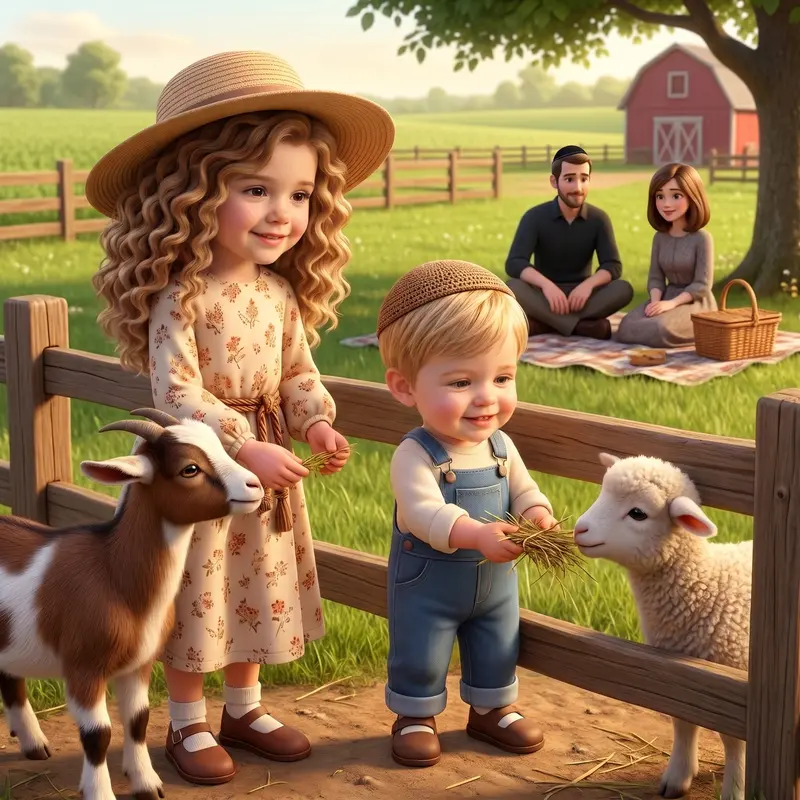
It is not a parsha or a Yom Tov story, so there are no pesukim or Midrash to retell here. It is a story about your child's own life, with your child as the hero: their name and, from one uploaded photo, their likeness on every page, illustrated in 3D animated-film style.
If you add parents and grandparents with their photos, they appear together with the children on a closing family page in every format. The story itself stars the children.
Why does a family day out belong in a Torah book?
The Torah speaks about teaching children in more than one place. In Krias Shema we say that we speak of Hashem's words with our children b'shivt'cha b'veisecha u'vlechtecha vaderech (ובלכתך בדרך), when we sit in our house and when we walk on the way. We learn from this that chinuch is not only for the table and the classroom.
A day out is a day on the way. Children watch how Mommy and Totty speak to the person at the counter, how Zaidy and Bubby are treated, and whether a bracha is said before the snack. Those moments teach more than a lecture does. If you would like to teach the words themselves, see our guide to teaching Krias Shema at home.
Which middos does a family day out bring up?
We do not want to claim more than the story says, so here is plainly what a day out tends to bring up in any home. These are good topics for the conversation after the book is read.
- Hakaras hatov: thanking whoever planned, drove or packed the food, and thanking Hashem for the day.
- Savlanus: waiting for a turn, waiting in the car, waiting for everyone to be ready.
- Sharing: one snack, one seat by the window, one turn at something.
- Kibbud av va'em: the Torah says kabeid es avicha v'es imecha (Shemos 20:12), and a day with the grown-ups is a real chance to listen, help and say thank you.
- Brachos: a day out is full of food, so it is full of chances to say the right bracha. See teaching brachos before eating.
How do I explain it to a 3-year-old, a 7-year-old and a 10-year-old?
The same story works at every age if you change the question, not the story.
- Around 3 or 4: use one sentence. Mommy and Totty took us out for a whole day together, and we say thank you to Hashem. Then ask your child to show you on the page who is there and what they liked best.
- Around 6 to 8: ask what happened, then ask what the child did to be a good part of the day. Who helped? Who waited? Who said thank you?
- Around 9 to 12: talk about teaching by example. Ask what a child learns from simply watching a parent or grandparent all day, and what they would like to be seen doing. This is also the age to bring in the pasuk of u'vlechtecha vaderech.
What can we ask at the Shabbos table?
Reading a storybook is entirely appropriate on Shabbos, and the book's last page is built for this. Whatever you read, keep the Shabbos table to talking, singing and questions. Here are five that work for the whole family:
- What was your favorite part of a day we spent together?
- Who did we thank this week, and how did we thank them?
- When did someone have to wait, and how did it feel?
- What did Mommy, Totty, Zaidy or Bubby do that you would like to do when you are older?
- What is one thing you would like to teach your own children one day?
For more ideas on conversation with a grown-up in the picture, see Shabbos with My Family.
What is the personalized Our Family Day Out book like?
Every Torah Tale book is written with careful rabbinical guidance and strict tznius, and reviewed by our team before it goes to print. Up to eight children, siblings, can appear in the same book, ages 0 to 18, which makes a family story an easy fit for a house with several children.
Every book ends with a dedicated discussion page of 10 questions about the story, mixing comprehension with middos. This is what turns the book from something read to a child into something talked about at the table. The softcover and hardcover open with a dedication page, and every format closes with the family page.

Softcover 8″×8″

Hardcover 8″×8″

Board book 6″×6″

Coloring book 8.5″×11″
There are three formats. The 6x6 board book with rounded safety corners is for ages 0-4, the 8x8 softcover is for ages 4-8, and the 8x8 hardcover is for ages 5-18. You can order in English, Hebrew or Yiddish, or in more than one language. An optional matching coloring book, 8.5x11 inches in black-and-white line art, can be added to a one-time order.
How can we make our own family day out more meaningful?
You do not need a big plan. A few small habits turn an ordinary outing into chinuch.
- Pick a weekday. Choose a weekday outing, or Chol HaMoed if it fits. Our article on Chol HaMoed for kids explains the in-between days.
- Say brachos together. Let each child say the bracha before a snack, and ask your rav whether Tefillas HaDerech applies to your trip.
- Give every child a job. Carrying the water bottle, holding the door and handing out the snacks are all real ways to help.
- End with one thank you each. On the way home, every person says one thing they are thankful for.
- Color on a weekday. If you add the coloring book, it is a weekday activity: save it for a weekday afternoon, erev Shabbos, or Chol HaMoed.
When you are ready, create the book. You open a free account and answer a few short questions: each child's name, boy or girl, age and one photo, any siblings, the story, your community (asked once), the language and the printed format. The whole thing takes about five minutes.
Frequently asked questions
What is Our Family Day Out (יום כיף משפחתי) about?
It is a story from the Torah Tale Family collection about a child spending a day together with the family. The Family collection is about a child and the grown-ups who love them, what they do together and what a parent or grandparent teaches. Your child is the hero, with their name and likeness on every page.
How do I explain a family day out to a 4-year-old?
Keep it to one simple sentence, such as: Mommy and Totty took us out for a whole day together, and we say thank you to Hashem for a good day. Then let your child tell you what they liked best. At this age, saying the bracha before a snack and a thank you at the end of the day is plenty.
What is the lesson of a family day out?
The story is about being together and about what the grown-ups in a child's life teach by example. A day out naturally brings up hakaras hatov, patience, sharing and kibbud av va'em. The discussion page at the end of the book mixes comprehension questions with middos, so the family can talk about what happened and what it asks of the child.
Which format is best for Our Family Day Out?
Choose by your child's age. The 6x6 board book with rounded safety corners is for ages 0-4, the 8x8 softcover is for ages 4-8, and the 8x8 hardcover is for ages 5-18. Every format ends with the discussion page and the family page.
Can I read the book on Shabbos?
Yes, reading a storybook is entirely appropriate on Shabbos and Yom Tov, and the discussion page makes it a good fit for the table. The optional matching coloring book is a weekday activity, for a weekday afternoon, erev Shabbos or Chol HaMoed.
Can the grandparents be in the book?
Yes, if you add them. A family can add parents, grandparents and other relatives with their photos. The story itself stars the children, and the grown-ups you add appear with them on a closing family page in every format.