Shabbos with My Family for Kids: Shabbos at Home & What the Grown-Ups Teach
Shabbos with My Family is a personalized storybook about a child's Shabbos at home with the people who love them. Here is how to talk about it, what to ask at the table and how the book works.
Published by Torah Tale.
Create this book for your child
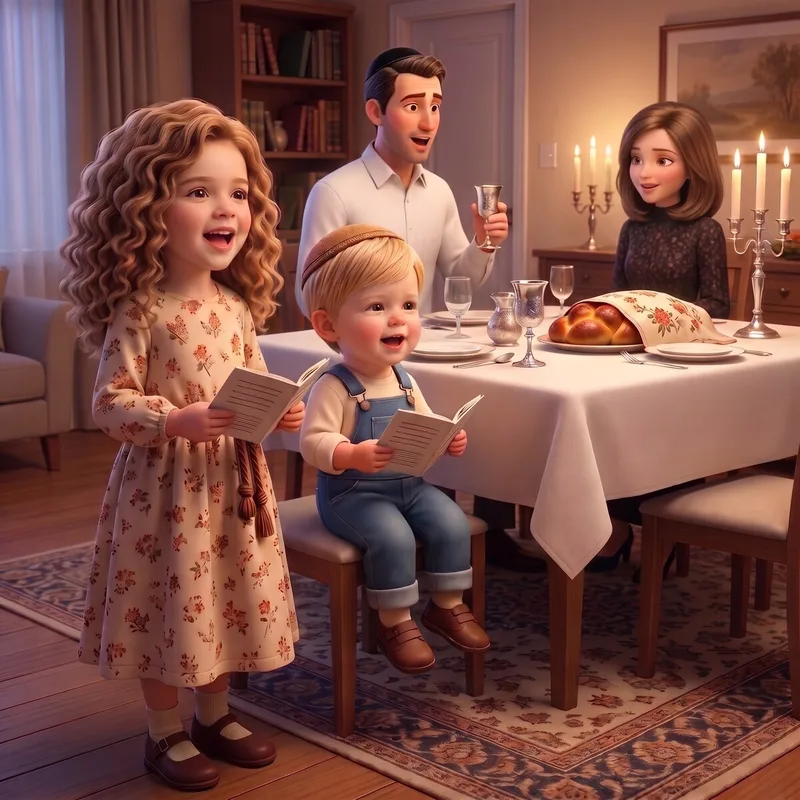
Shabbos with My Family is a personalized Torah Tale storybook about a child's Shabbos at home with the people who love them. It lands with children because Shabbos is the part of the week they know best, with the same table, the same songs and the same faces every time. The book puts your child's name and likeness into that familiar picture and ends with questions to talk about.
What is the Shabbos with My Family storybook about?
The book belongs to the Family collection, whose stories are about a child and the grown-ups who love them, set at home today. They are about what a child and family do together and what a parent or grandparent teaches. This one is about Shabbos in that home.
Your child is the hero, drawn in 3D animated-film style from the photo you upload. If you add parents and grandparents when you create the book, they appear with the children on a closing family page. The story itself stars the children.
Why does Shabbos at home matter so much to children?
A child does not learn Shabbos from a lecture. A child learns it from what happens in the house: the table set a little differently, the candles, the challah, the songs and the grown-ups who are not rushing anywhere.
The Torah gives Shabbos twice in the Aseres HaDibros. Zachor, remember, is in Shemos, and Shamor, guard, is in Devarim. Chazal teach that both were said together. A child can hold onto both ideas in simple words: we remember Shabbos and we guard Shabbos.
Many familiar parts of Shabbos also have a source children enjoy hearing. We have two loaves at our meals, and the Torah tells us that on the sixth day in the Midbar Yidden gathered a double portion of mann. Chazal teach that we remember Shabbos over wine at Kiddush. Naming these small things aloud as you read helps a child see that what they do every week has a reason.
How do I explain Shabbos to a 3-year-old, a 6-year-old and an 11-year-old?
The same story works at every age if you change how much you say. Here is a simple way to think about it.
- Around 3: Point and name. "Here are the candles. Here is the challah. Here is Totty making Kiddush." Say one sentence: "Shabbos is Hashem's special day and we spend it together."
- Around 6: Add the why. Shabbos is a day when we rest because Hashem rested, and a day we keep as a family. Ask what the child's favorite part is and let them tell you.
- Around 11: Talk about what the grown-ups put into Shabbos. Preparing takes effort, and sitting together without a rush is a choice. Ask what the child would want to carry into their own home one day.
Do not feel you have to cover everything in one sitting. A page or two on Friday afternoon and the rest at the table is plenty.
What Shabbos table questions can we ask after reading?
Reading is welcome on Shabbos, and so is talking, singing and telling stories. Every Torah Tale book ends with a discussion page of 10 questions that mix comprehension with middos, so you will have questions ready. If you want a few of your own, these work at most tables:
- What is your favorite part of our Shabbos, and why?
- What is one thing someone at this table did for you this week that you want to thank them for?
- What can you do this Shabbos to help make it nicer for someone else?
- Is there a song or a story from a grandparent that you would like to hear again?
- What would you want to keep the same when you have your own Shabbos table?
Let the youngest answer first. Children who go last often just repeat what others said.
What is the personalized book like?
Torah Tale prints the book with your child's name and likeness on every page. Up to eight children, from ages 0 to 18, can appear in the same book, which suits a table full of siblings. The language can be English, Hebrew or Yiddish, and a book can be ordered in more than one.

Softcover 8″×8″

Hardcover 8″×8″

Board book 6″×6″

Coloring book 8.5″×11″
There are three formats. The board book is 6"x6" with rounded safety corners, for ages 0-4. The softcover photo book is 8"x8" for ages 4-8, and the hardcover photo book is 8"x8" for ages 5-18. Softcover and hardcover books open with a dedication page, which is a nice place for a few words from you. Every book is written with careful rabbinical guidance and strict tznius, and reviewed by our team before it goes to print.
If grandparents live nearby or far away, adding them gives them a place on the closing family page. A related read is Bobby & Zaidy and Me, which looks at what grandparents teach.
What can we do during the week to get ready for Shabbos?
Children enjoy Shabbos more when they have a part in it. Some simple jobs that suit young children are counting the places at the table, laying out the challah cover and choosing a Shabbos song to sing. Keep anything to do with candles, matches or hot food with the grown-ups.
If your child likes to color, the optional matching coloring book is 8.5"x11" in black-and-white line art. It is a weekday activity, and it fits well on a weekday afternoon or on erev Shabbos, well before Shabbos begins. Many children like to color during the week and then look forward to the storybook at the table.
The storybook itself is what the Shabbos table is for, since reading is entirely appropriate on Shabbos.
For more on the day itself, see The Shabbos Story for Kids. If you would like to look at the two parents on their own, there are Mommy and Me and Totty and Me.
Ready to make it your child's story?
Start with a free account, answer a few short questions and upload one photo. The whole flow takes about five minutes. When you are ready, you can create the book and give your child a Shabbos story that looks like their own home.
Frequently asked questions
What is the Shabbos with My Family book about?
It is a personalized storybook from the Family collection about a child's Shabbos at home with the grown-ups who love them. The Family collection is built around what a child does together with parents and grandparents and what they teach. Your child is the hero, with their name and likeness on every page.
Can we read this book on Shabbos?
Yes. Reading a storybook is entirely appropriate on Shabbos, and a book to read at the Shabbos table or on a long Shabbos afternoon is a very good fit. The optional coloring book is a weekday activity, best on a weekday afternoon or on erev Shabbos well before Shabbos begins.
How do I explain Shabbos to a 3-year-old?
Keep it to what the child can see and do: we light candles, we eat challah, we sing, and Hashem gave us Shabbos as a special day. Say it in one short sentence and repeat it every week. A toddler learns Shabbos through the same few things happening in the same order.
Which format suits which age?
The board book is 6"x6" with rounded safety corners and is for ages 0-4. The softcover photo book is 8"x8" for ages 4-8, and the hardcover photo book is 8"x8" for ages 5-18. Your child's age is one of the short questions when you create the book.
Can grandparents and parents be in the book?
Yes, you can add parents, grandparents and other relatives with their photos. The story itself stars the children, and the grown-ups appear with them on a closing family page in every format.
How do I create the book?
You need a free account and a few short questions: each child's name, boy or girl, age and one photo, any siblings, the story, your family's community (asked once), the language and the printed format. The whole flow takes about five minutes and starts at torahtale.com/create. Books can be ordered in English, Hebrew or Yiddish.