Chol HaMoed for Kids: What the In-Between Days Are & How to Explain Them
Chol HaMoed are the in-between days of Pesach and Sukkos. Here is how to explain them to a 3-4 year old, a 6-7 year old and a 9-12 year old, plus questions for the table.
Published by Torah Tale.
Create this book for your child
Chol HaMoed is the stretch of in-between days in the middle of Pesach and Sukkos. They are not Yom Tov days with the full restrictions of melacha, but they are still part of the festival, which is why children often ask why the days feel different. A good explanation gives a child a feeling for both sides: these days are special, and they are also meant for simcha.
What is Chol HaMoed, and why does it have that name?
Chol means ordinary or weekday, and moed means a festival. Chol HaMoed is the ordinary part of the festival, the days between the first Yom Tov days and the last ones. The name already holds the whole idea: these days are weekday-like in some ways and part of the moed in others.
Outside Eretz Yisrael there are four days of Chol HaMoed on Pesach and five on Sukkos. In Eretz Yisrael each festival has one more day. Shavuos has no Chol HaMoed at all.
What do we keep on Chol HaMoed?
The festival is still going. On Pesach we still do not eat chametz. On Sukkos we still eat in the sukkah and take the arba minim, except on Shabbos Chol HaMoed. We add Yaaleh V'yavo to davening and to bentching, and the mitzvah of simcha continues.
The Rambam in Hilchos Yom Tov writes that rejoicing on the festival includes the whole household, children among them. For a parent this is a useful reminder: part of what you are teaching on these days is happiness in the mitzvos.
Many kinds of work are restricted on Chol HaMoed, and there are detailed halachos about what is permitted, such as laundry, haircuts and travel. For anything specific, ask your rav.
How do I explain Chol HaMoed to a young child?
Children do best with one clear picture. Here is how it can sound at three different stages.
Ages 3 to 4
Keep it to a sentence or two: "Yom Tov is a few special days. In the middle we have more days that are still part of Yom Tov, so we keep eating in the sukkah (or keep eating matzah), and we are still happy." Young children understand what they can see and do, so point to the sukkah, the lulav and esrog, or the matzah on the table.
Ages 6 to 7
Introduce the name. Chol is a regular day, moed is a festival, so Chol HaMoed is a regular day inside a festival. Ask them to find what is the same as Yom Tov (we still rejoice, we still say Yaaleh V'yavo) and what is different (we can do some things that we cannot on the first and last days).
Ages 9 to 12
Older children can handle the structure. Count the days with them for Pesach and Sukkos, and note that Shavuos has none. Ask them why they think Hashem gave us days that are both ordinary and holy. Let them answer in their own words before you add anything.
What is the lesson of Chol HaMoed for children?
One simple lesson is that simcha does not belong only to the big, dressed-up moments. It continues through ordinary hours as well: a walk, a meal, a game with a sibling. The festival does not turn off when the first Yom Tov days end.
A second lesson is gratitude for the time itself. On these days there is often a little more time at home for many families, and a parent can show that this time is a gift to use well, with family, with Torah and with chesed.
What is a personalized Chol HaMoed book like?
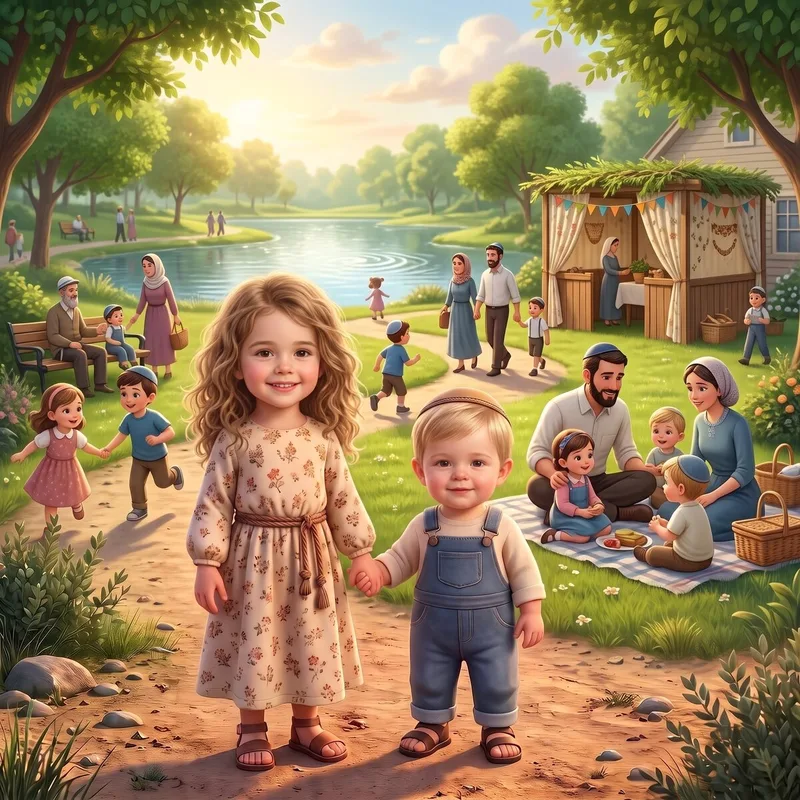
Torah Tale's Holidays collection includes a Chol HaMoed story, and in it your child is the hero. Their name and, from one uploaded photo, their likeness appear on every page, illustrated in 3D animated-film style. Up to eight children, ages 0 to 18, can appear in the same book, so siblings can share one story.
If you add parents, grandparents and other relatives with their photos, they appear with the children on a closing family page in every format. Softcover and hardcover books open with a dedication page. Every book is written with careful rabbinical guidance and strict tznius, and reviewed by our team before it goes to print.
You can choose the format by age: a 6x6 board book with rounded safety corners for ages 0-4, an 8x8 softcover for ages 4-8, or an 8x8 hardcover for ages 5-18. The book can be ordered in English, Hebrew or Yiddish.

Softcover 8″×8″

Hardcover 8″×8″

Board book 6″×6″

Coloring book 8.5″×11″
What can we talk about at the Shabbos table?
Every Torah Tale book ends with a discussion page of 10 questions that mix comprehension with middos: what happened, and what it asks of the child. If you are at the Shabbos table during Sukkos or Pesach, or just reading the book on a long Yom Tov afternoon, reading and talking are exactly right. Here are some questions of your own to start with:
- Which part of this festival is your favorite, and why?
- What is the same on Chol HaMoed as on Yom Tov?
- What is different on Chol HaMoed?
- How can we make someone else in the family happy this week?
- What are we thankful to Hashem for today?
For more on the festivals themselves, see The Sukkos Story for Kids and The Pesach Story for Kids, and for the day that follows Sukkos, Shemini Atzeres for Kids.
What can children do on a weekday of Chol HaMoed?
Chol HaMoed is a good time for simple, happy family routines. Some ideas that fit the days:
- Read a Torah story together, aloud, on any of the days, including Shabbos Chol HaMoed.
- Let the children help set up the table or the sukkah in ways that are safe for their age.
- Visit a grandparent or relative, or invite a guest to the meal.
- On a weekday of Chol HaMoed, when coloring is permitted, offer the optional matching coloring book, 8.5x11 in black-and-white line art. It is a one-time add-on to a book, never a subscription, and it is for weekdays only, never for Shabbos Chol HaMoed or Yom Tov.
For more on outings and what is permitted, ask your rav.
When you are ready, you can create the book in about five minutes: a free account, a few short questions about each child, the story, your community, the language and the format.
Frequently asked questions
What is Chol HaMoed in simple words for a child?
Chol HaMoed are the in-between days of Pesach and Sukkos. They come after the first Yom Tov days and before the last ones, and they are still part of the festival even though they feel more like regular days. We still keep the mitzvos of the festival and we still rejoice.
How many days of Chol HaMoed are there?
Outside Eretz Yisrael there are four days of Chol HaMoed on Pesach and five on Sukkos. In Eretz Yisrael each festival has one more day of Chol HaMoed. Shavuos has none, because it is a single Yom Tov day in Eretz Yisrael and two days outside it.
Can children color or draw on Chol HaMoed?
Coloring is permitted on a weekday of Chol HaMoed, so it can be a good activity for a quiet afternoon. It is not for Shabbos Chol HaMoed or for the Yom Tov days themselves, since coloring, drawing and writing are melacha on those days. Reading a storybook is fine on any of them, Shabbos and Yom Tov included.
Is there a Chol HaMoed book for kids with my child in it?
Yes. Torah Tale's Holidays collection includes a Chol HaMoed story, and the book stars your child with their name and likeness, illustrated in 3D animated-film style. Creating one takes a free account and a few short questions, and the book ends with a discussion page of 10 questions.
Which format suits which age?
The board book is 6x6 with rounded safety corners, for ages 0-4. The softcover is 8x8 for ages 4-8, and the hardcover is 8x8 for ages 5-18. An optional matching coloring book, 8.5x11 in black-and-white line art, can be added as a weekday activity.