Saying Shema (קריאת שמע) for Kids: Teaching Krias Shema at Home
Shema is among the first words a Jewish child ever learns, and it is said twice a day for the rest of a life. Here is what the words mean, where they come from in the Torah, why we cover our eyes, and how to explain all of it at home.
Published by Torah Tale.
Create this book for your child
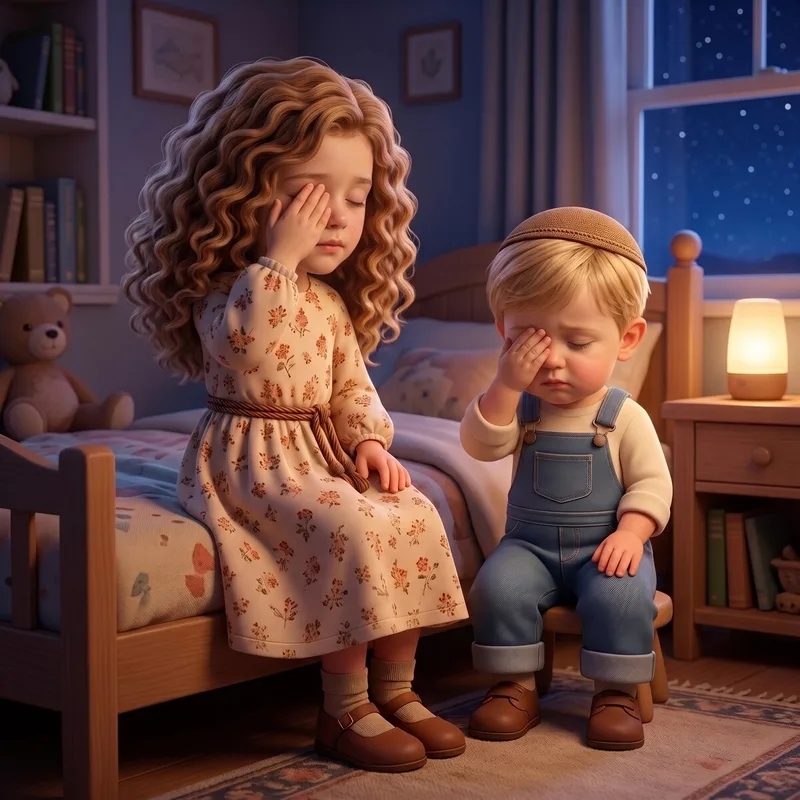
Krias Shema is the mitzvah of saying the words שמע ישראל ה' אלקינו ה' אחד twice a day, once in the morning and once in the evening. It is among the very first Torah a Jewish child ever learns, and it stays with a person for an entire lifetime. That is exactly why it lands so well as a story for children: the hero of the mitzvah is not somebody long ago in a far place, it is the child himself, standing next to his bed with his hand over his eyes.
What is Krias Shema, and what do children actually say?
The first pasuk is six words: שמע ישראל ה' אלקינו ה' אחד (Devarim 6:4). In English, 'Hear, Yisrael, Hashem is our G-d, Hashem is One.' Right after it we say quietly, ברוך שם כבוד מלכותו לעולם ועד.
The full Krias Shema is three parshiyos: Devarim 6:4-9, which begins with that pasuk; Devarim 11:13-21, V'haya im shamoa; and Bamidbar 15:37-41, parshas tzitzis, which ends with yetzias Mitzrayim. Older children say all three in davening, morning and night. Small children usually start with the first pasuk alone, at bedtime, with a parent.
The Gemara in Sukkah 42a says that once a small child can talk, his father teaches him Torah and Krias Shema. In other words, Shema is not something we wait to teach until a child understands it. We teach it first, and the understanding grows in afterwards.
Where does the mitzvah come from in the Torah?
The pesukim say it plainly. After the first pasuk comes ואהבת את ה' אלקיך בכל לבבך ובכל נפשך ובכל מאדך (Devarim 6:5), and then the instruction to teach these words to your children and to speak about them בשבתך בביתך ובלכתך בדרך ובשכבך ובקומך (Devarim 6:7). From ובשכבך ובקומך, when you lie down and when you rise, we learn that Shema is said twice a day.
The same pesukim are where tefillin and mezuzah come from, which is a detail children enjoy enormously. The words in a mezuzah on the doorpost of the house are the very words the child says at night. The parsha he says at bedtime is the parsha that is rolled up in the little case he kisses on the way to bed.
Why do we cover our eyes, and why is Baruch Shem said quietly?
The Gemara in Berachos 13b relates that Rebbi would pass his hand over his eyes while saying the first pasuk, and from this comes the minhag of covering the eyes. Explain it to a child the way it actually works: for five seconds, nothing is in front of your eyes except what you are saying.
Baruch Shem Kevod Malchuso l'olam va'ed is said in an undertone. Chazal (Pesachim 56a) relate that when Yaakov Avinu's sons said Shema Yisrael to him, declaring that Hashem is One in their hearts too, Yaakov answered ברוך שם כבוד מלכותו לעולם ועד. Because it is not a pasuk in the Torah, we say it quietly. On Yom Kippur it is said out loud. Children remember this from year to year, and it is worth telling them now so that the Yom Kippur moment makes sense when it comes.
What does Shema actually teach a child?
Two things, and both are worth naming out loud at the table.
The first is emunah in its simplest form. There is one Hashem, He made everything, He hears you. A child who says that sentence every night of his childhood is not learning a fact, he is building a way of seeing the world.
The second is that a Yid's day has a frame around it. Shema at night, and in the morning Modeh Ani and Shema again. The first thing and the last thing are both about Hashem, and everything else, cheder, supper, a scraped knee, the baby crying, sits inside that frame. A child feels this before he can explain it.
How to explain Shema at different ages
Ages 2 to 3: Do not explain. Do. Put your hand over your own eyes, say the six words slowly, and let him copy you. If he says two of the words, that is a full success.
Ages 4 to 6: One sentence: 'We cover our eyes so we are not looking at anything else, and we tell Hashem that He is the only One.' Add that every Yid in the world says these same words, which children find astonishing and comforting at once.
Ages 7 to 9: Now bring the pesukim. Show him Devarim 6:4-9 in a Chumash and find ובשכבך ובקומך together. Point to the mezuzah and tell him what is written inside it. This is the age to mention that there are three parshiyos, not only one.
Ages 10 to 12: Talk about kavanah and about the meaning of ואהבת, loving Hashem with your whole heart. Ask him honestly whether he says Shema quickly or slowly, and what would actually help him say it better. A ten-year-old can have that conversation and often wants to.
What a personalized Torah Tale book of Saying Shema is like
Saying Shema is a story in Torah Tale's Mitzvos collection, which takes the mitzvos a child keeps and sets them in everyday life today rather than long ago. Your child's name and likeness, built from one uploaded photo and illustrated in high-resolution 3D animated-film style, appear on every page. Up to eight siblings, ages 0 to 18, can be in the same book, so the bedtime in the story can look like the bedtime in your house.
Every book ends with a dedicated discussion page carrying ten questions about the story, mixing comprehension with middos: what happened, and what it asks of the child. That is the part that turns a book from something you read to a child into something the family talks about. If you add parents and grandparents with their photos, they appear with the children on a closing family page, in every format.

Softcover 8″×8″

Hardcover 8″×8″

Board book 6″×6″

Coloring book 8.5″×11″
For formats, match the age: the 6x6 board book with rounded safety corners is for ages 0-4, which is exactly the age a child is learning his first pasuk; the 8x8 softcover photo book is for ages 4-8; the 8x8 hardcover photo book is for ages 5-18. Softcover and hardcover open with a dedication page. A matching 8.5x11 coloring book in black-and-white line art can be added as a one-time add-on, and coloring is a weekday activity, for a weekday afternoon or erev Shabbos, never on Shabbos or Yom Tov.
Shabbos table questions about Shema
These are talking questions, nothing to write or draw. Try two or three, not all five.
- What are the six words of the first pasuk, and what do they mean?
- Why do we cover our eyes? What are we trying not to look at?
- Shema is said when we lie down and when we rise. Why do you think Hashem chose those two times?
- Where else in the house are these same words written? (The mezuzah.)
- What is one thing you could do to say Shema a little slower tonight?
A bedtime script you can use tonight
Keep it short and keep it the same every night. Sit on the edge of the bed. Say: 'We are going to tell Hashem that He is the only One.' Put your hand over your eyes, and say שמע ישראל ה' אלקינו ה' אחד slowly enough that a small child can hear each word. Then ברוך שם כבוד מלכותו לעולם ועד, quietly. Then say goodnight.
Sameness is the whole point. A child who hears the identical words in the identical place every night ends up owning them. If you want to build the rest of the day around it, netilas yadayim in the morning and a bedtime routine that always ends with Shema give a young child a day with two clear edges.
Ordering the book
Creating a book takes about five minutes and a free account, plus a few short questions: each child's name, boy or girl, age and one photo, any siblings, the story, your community (asked once), the language (English, Hebrew or Yiddish) and the printed format. Every book is written with careful rabbinical guidance and strict tznius and reviewed by our team before it goes to print.
You can order Saying Shema as a single book, or take the Mitzvos collection as a subscription, monthly or yearly, with four books a month arriving in one delivery. If a storybook arrives before Shabbos, it is exactly the right thing to read at the table or on a long Yom Tov afternoon.
Ready? Create the book and let your child see himself saying the pasuk he already knows by heart.
Frequently asked questions
What does Shema mean in simple words for a child?
The first pasuk, שמע ישראל ה' אלקינו ה' אחד, means 'Hear, Yisrael, Hashem is our G-d, Hashem is One.' For a young child it can be said as: every Yid stops and says out loud that there is one Hashem, and He is ours. The words are from Devarim 6:4, and Yidden have been saying them every day for thousands of years.
At what age do children start saying Shema?
The Gemara in Sukkah 42a teaches that once a small child can talk, his father teaches him Torah and Krias Shema. In practice many families say the first pasuk with a toddler at bedtime long before the child understands it, and the child grows into the words. Children take on the full Krias Shema at its proper times as they get older, and a rav can guide you for your own children.
Why do we cover our eyes when we say Shema?
The Gemara in Berachos 13b relates that Rebbi would pass his hand over his eyes while saying the first pasuk, and from this comes the widespread minhag of covering the eyes. The simple idea is that for those few seconds nothing else is in front of you, so the words get your whole attention. Children usually love this part and pick it up quickly.
Do girls say Shema too?
Krias Shema at its set times is a time-bound mitzvah, and the Mishnah in Berachos 3:3 teaches that women are exempt from it. The widespread practice is that girls say at least the first pasuk, and the bedtime Shema is said by boys and girls alike in most homes. Ask your rav about your family's practice.
How do I explain Shema to a 4-year-old?
Say it in one sentence: 'We cover our eyes so we are not looking at anything else, and we tell Hashem that He is the only one.' Then say the six words slowly together and leave it there. A four-year-old does not need the three parshiyos; he needs the habit, the quiet, and the feeling that this is his pasuk.
What is the Torah Tale book about Saying Shema?
Saying Shema is a story in Torah Tale's Mitzvos collection, which takes the mitzvos a child keeps and sets them in everyday life today. The child's name and likeness, built from one uploaded photo, appear on every page in 3D animated-film style, and up to eight siblings can be in the same book. Every book ends with a discussion page of ten questions about the story, mixing comprehension with middos.