Netilas Yadayim (נטילת ידיים) for Kids: Teaching Hand Washing Before Bread
Netilas yadayim is the mitzvah of washing our hands with a cup of water, with a bracha, before eating bread. Here is how to explain it to a 3-year-old, a 6-year-old and a 9-year-old, plus questions for the Shabbos table.
Published by Torah Tale.
Create this book for your child
Netilas yadayim is the mitzvah of washing our hands with a cup of water, with a bracha, before eating bread. Children connect with it because it is something they can actually do with their own hands, it has clear steps, and it comes around at every meal with bread, so a small child can keep a real mitzvah every single day.
What is netilas yadayim, and when do children do it?
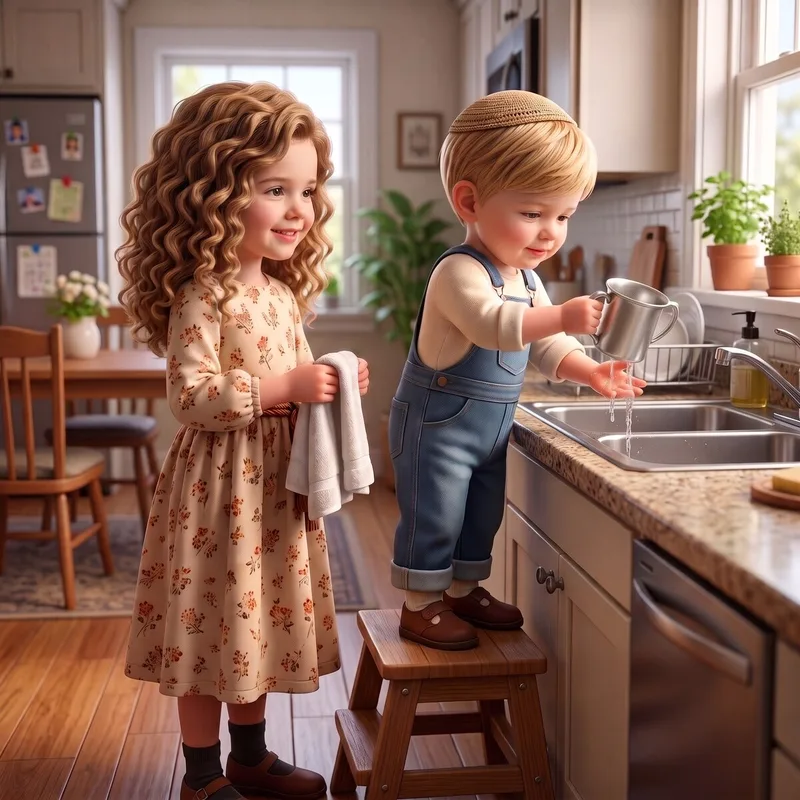
Before we eat bread, we take a cup, fill it with water and pour it over our hands. We say the bracha al netilas yadayim, dry our hands, and then say hamotzi over the bread. On Shabbos this means washing before the challah, and on a weekday it means washing before a meal with bread.
There is also a separate netilas yadayim in the morning, when a person wakes up. Many families teach it right after Modeh Ani, and you can read more about that first moment of the day in Modeh Ani for kids. The details of each washing are a good thing to go over with your rav.
Where does the mitzvah of netilas yadayim come from?
Chazal instituted the washing of hands before eating bread. The Torah itself describes the kohanim washing their hands and feet from the kiyor before serving in the Mishkan (Shemos 30:19-21), and many explain that our own washing before the meal is connected to that idea of preparing for something holy.
Chazal also teach that, now that there is no Beis HaMikdash, a person's table takes the place of the mizbeach (Berachos 55a). That is a lovely thing to tell an older child: the meal at your table is more than eating, and we prepare for it.
How does a child do netilas yadayim, step by step?
Here is the basic order that you can show a child. Customs differ on details such as how many times to pour and in what order, so follow your family minhag and ask your rav if you are unsure.
- Take the cup and fill it with water.
- Pour water over the right hand, then over the left, the way your family does it.
- Say the bracha al netilas yadayim.
- Dry the hands.
- Say hamotzi and eat the bread, without talking in between.
It helps to teach one step at a time. A child who has mastered the pouring this week can add the bracha next week.
What is the lesson of netilas yadayim for kids?
The lesson is to stop, get ready, and not rush into eating. The meal comes from Hashem, and the washing is a small moment of preparing for it. A child who washes before bread learns that ordinary moments in the day can be moments of mitzvah.
It also teaches a middah: doing the same thing properly every day, even when you are hungry and the challah is already on the table. Children learn this much more from watching a parent wash calmly than from being told about it.
How do I explain netilas yadayim to a 3-year-old, a 6-year-old and a 9-year-old?
Age 3 to 4: Keep it short. "Before we eat challah, we wash our hands with a cup, and then we say a bracha." Let them hold a small cup with your help, and use the same words each time.
Age 6 to 7: Add the order of the steps and the reason. They can learn that we wash before bread because Chazal told us to, and that we do not talk until after hamotzi. Let them lead the family in the steps once in a while.
Age 9 to 12: Tell them about the kohanim washing at the kiyor in the Mishkan and about the table that takes the place of the mizbeach. Ask them to notice how it feels to wash before every bread meal, including when they are away from home or at school. Questions about the details are a good moment to learn halacha together or to ask your rav.
What is a personalized Netilas Yadayim book from Torah Tale like?
Torah Tale prints personalized Torah storybooks in which the child is the hero. The Netilas Yadayim book is part of the Mitzvos collection, a collection of mitzvos a child keeps, set in everyday life today. Your child's name and, from one uploaded photo, their likeness appear on every page, illustrated in 3D animated-film style.
Every book is written with careful rabbinical guidance and strict tznius, and our team reviews it before it goes to print. Every book also ends with a discussion page of 10 questions about the story, mixing comprehension with middos, so what the child has read can become a conversation at the table.

Softcover 8″×8″

Hardcover 8″×8″

Board book 6″×6″

Coloring book 8.5″×11″
There are three formats, matched to age: a 6x6 board book with rounded safety corners for ages 0-4, an 8x8 softcover photo book for ages 4-8, and an 8x8 hardcover photo book for ages 5-18. Up to eight children can appear in one book, so brothers and sisters can wash together in the same story. If you add parents and grandparents, they appear with the children on a closing family page in every format.
Questions and activities for the Shabbos table and the weekdays
A storybook is perfect to read at the Shabbos table, since reading is entirely appropriate on Shabbos. Here are questions to ask there, with talking only:
- What do we do right before we make hamotzi?
- Why do you think we do not talk between washing and hamotzi?
- What does it mean that our table is like the mizbeach?
- Is there a step of netilas yadayim that is hard for you? What would make it easier?
- Who showed you how to wash for bread?
For a weekday activity, set up a spot where a young child can reach the cup and a towel, with a parent nearby, so that washing becomes part of the routine. On a weekday afternoon or erev Shabbos you can also add the matching coloring book (8.5x11, black-and-white line art), which is an optional one-time add-on to a book. Coloring is melacha, so keep it for the weekdays and not for Shabbos or Yom Tov.
For more on how the Shabbos meal feels from a child's point of view, see Shabbos with My Family, and for a gentle morning routine at home, Good Morning, My Family.
If you would like your child to see themselves keeping this mitzvah, you can create the book. It starts with a free account and a few short questions about your child, the story, your community, the language and the format, and takes about five minutes.
Frequently asked questions
What is netilas yadayim?
Netilas yadayim is the mitzvah of washing the hands with a cup of water before eating bread. We say a bracha and then dry our hands and make hamotzi. Chazal instituted it, and it is part of daily life in a Torah home.
How do I explain netilas yadayim to a 3-year-old?
Keep it to one sentence and one action: before we eat challah or bread, we wash our hands with a cup to get ready, and then we say a bracha. Let your child watch you do it and then do their part with your help. Repeating the same few words every meal works better than a long explanation.
What is the lesson of netilas yadayim for children?
It teaches a child to pause and prepare before eating, so that an ordinary meal is something we do with a bracha and with awareness of Hashem. It also shows that a mitzvah can be small and done many times a day. Children learn the most from seeing the same steps done calmly at every meal.
At what age should a child start washing netilas yadayim?
Many families begin teaching it when a child is old enough to follow the steps and learns to say the bracha. The exact age of chinuch and how much a young child should be expected to do are questions to ask your rav. Until then, children can wash alongside a parent and learn by watching.
Is there a personalized children's book about netilas yadayim?
Yes, Torah Tale has a personalized Netilas Yadayim book in its Mitzvos collection. Your child's name and, from one uploaded photo, their likeness appear in 3D animated-film style, and the book ends with a discussion page of 10 questions. Creating it starts with a free account and a few short questions at torahtale.com/create.
Is it all right to read a storybook about netilas yadayim on Shabbos?
Yes, reading a storybook is entirely appropriate on Shabbos and Yom Tov, and a book about this mitzvah fits well at the Shabbos table. Activities such as coloring or drawing belong to the weekdays, not Shabbos.