Good Night, My Family (לילה טוב, משפחה שלי) for Kids: Bedtime at Home
A goodnight story set at home, with the child and the grown-ups who love them. What it gives you to talk about at bedtime, how to explain it to a 3-year-old and a 7-year-old, and which format fits.
Published by Torah Tale.
Create this book for your child
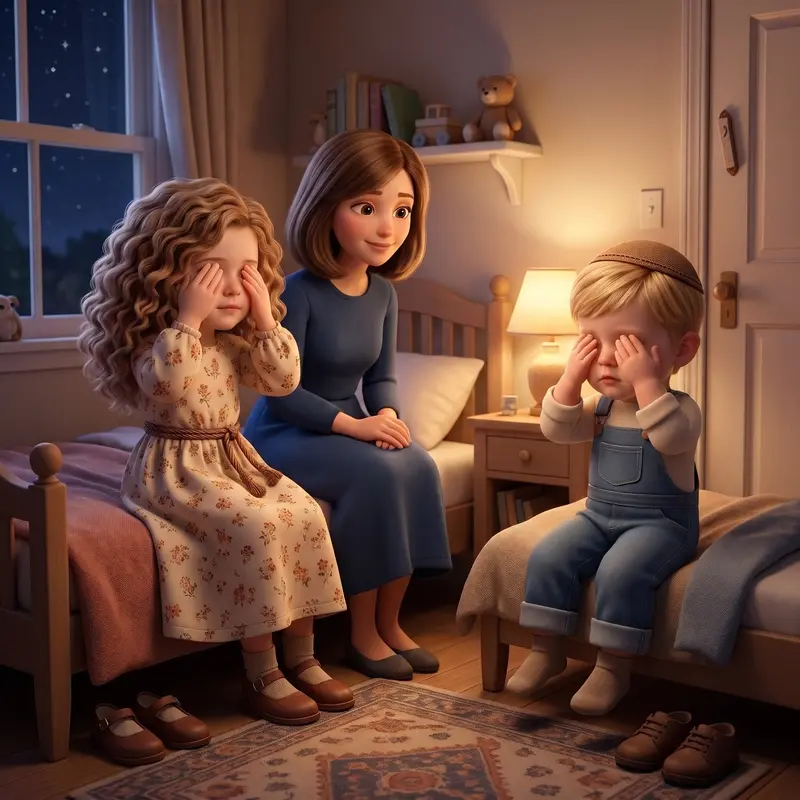
Good Night, My Family (לילה טוב, משפחה שלי) is a bedtime story from the Family collection of Torah Tale, set at home today, with the child at the center and the grown-ups who love them close by. It works because bedtime is a moment when children often want to feel that the people they love are near, and a story that ends the day with goodnights gives that feeling words.
What is the Good Night, My Family story about?
The Family collection is about a child and the grown-ups who love them: Mommy, Totty, Bubby and Zaidy. Each story is set at home, in our own time, and shows what they do together and what a parent or grandparent teaches. This is the evening story of that world.
Rather than retell the book line by line, this article focuses on what a goodnight setting gives you to talk about, and how to use it with your child tonight. If you want the daytime companion, there is Good Morning, My Family.
Why does a bedtime story belong in a Torah library?
Bedtime in a Jewish home already has Torah in it. Many families say Krias Shema al hamitah with their children, and the siddur has the other words of the night. Customs differ by age and community, so ask your rav or your child's rebbi what is right for your child.
Dovid HaMelech gives a child a very simple thought to fall asleep on, in Tehillim 121:4: hinei lo yanum v'lo yishan shomer Yisrael, the Guardian of Yisrael neither slumbers nor sleeps. Many siddurim also include HaMalach HaGoel, Yaakov's bracha to Ephraim and Menashe (Bereishis 48:16), in the bedtime Shema.
A goodnight story fits right next to these. It gives a child a picture of an evening where everyone is together, and then the words they already say feel like part of the same picture.
What is the lesson of a goodnight story about family?
A natural thing to draw from an evening with the people who love us is hakaras hatov: noticing that we are cared for and saying thank you for it. A child who says goodnight to Mommy and Totty, and to Bubby and Zaidy, is practicing a quiet kind of respect and love for the people closest to them. This is a lesson we draw from the setting, in the spirit of kibbud av va'em, not a quotation from the book.
The grown-ups in the Family collection are also teachers. At bedtime a parent often says the most important things in the fewest words. If this is the theme you want to build on, Thank You, Hashem, for My Family goes further into thanking.
How do I explain it to a 3-year-old, a 6-year-old and a 10-year-old?
Ages 2 to 4. One sentence is enough: At the end of the day, the people who love you say goodnight, and Hashem watches over us while we sleep. Turn the pages slowly, point to your child on each one, and let them say goodnight to each person in the family by name.
Ages 5 to 7. Ask them to tell you the story back, then ask: Who says goodnight to you? and What do you say to them? Children this age love routines, so let them help decide the order of your family's goodnights.
Ages 8 to 12. Older children can take the idea a step further. Ask what they have learned from the grown-ups in their own home, and what they would want to pass on one day. For the grandparent side of this, there is Bubby and Zaidy and Me.
What can we ask at bedtime or at the Shabbos table?
These work on a weeknight, and they also work on Friday night, since they are only talking and reading:
- What was the best part of today?
- Who in our family helped you today, and did you say thank you?
- What is one thing you learned from Mommy, Totty, Bubby or Zaidy?
- Who would you like to say goodnight to first, and why?
Keep it short. A bedtime conversation of two or three minutes, held every night, does more than one long talk that nobody keeps up. And if your child is already half asleep, the first question alone is plenty.
What is the personalized Torah Tale book like?
The child is the hero. Their name and, from one uploaded photo, their likeness appear on every page, illustrated in high-resolution 3D animated-film style. Up to eight children, ages 0 to 18, can share a single book, so siblings can be read the same goodnight story together.
If you add parents, grandparents and other relatives with their photos, they appear with the children on a closing family page, in every format. Every book also ends with a discussion page of 10 questions that mix comprehension with middos, so what began as a story at bedtime can carry over to the next morning or the next Shabbos table. Every book is written with careful rabbinical guidance and strict tznius, and reviewed by our team before it goes to print.

Softcover 8″×8″

Hardcover 8″×8″

Board book 6″×6″

Coloring book 8.5″×11″
Which format suits a bedtime book?
Choose by your child's age, since bedtime books are handled a lot and read over and over.
- Board book, 6x6 with rounded safety corners, ages 0-4: sturdy pages for the youngest children.
- Softcover photo book, 8x8, ages 4-8: the right size for a parent and child to read side by side.
- Hardcover photo book, 8x8, ages 5-18: one that stays on the shelf for years.
Softcover and hardcover open with a dedication page, a good place for a note from Bubby and Zaidy. There is also an optional matching coloring book, 8.5x11 in black-and-white line art. Coloring is melacha, so keep it for a weekday afternoon or erev Shabbos, never for Shabbos or Yom Tov. The storybook itself is wonderful to read on Shabbos.
How do I order it?
Creating a book takes about five minutes. You make a free account and answer a few short questions: each child's name, boy or girl, age and one photo, any siblings, the story, your community (asked once), the language and the printed format. Languages are English, Hebrew and Yiddish. Pick the Family category in the story picker to find Good Night, My Family, along with the other stories of the grown-ups at home.
When you are ready, create the book and give your child a goodnight story with themselves in it.
Frequently asked questions
What is Good Night, My Family about?
Good Night, My Family is a bedtime story from the Family collection, set at home today, about a child and the grown-ups who love them. The child's name and likeness appear on every page. It is a goodnight story, a companion to the morning story in the same collection.
How do I explain this story to a 3-year-old?
Keep it to one sentence: at the end of the day, the people who love you say goodnight, and Hashem watches over us while we sleep. Then let your child say goodnight to each person in the family by name. A board book for ages 0-4 is made for this age.
Is there a bedtime tefillah my child should say?
Many families say Krias Shema al hamitah with their children at bedtime, and customs differ by age and community. Ask your rav or your child's rebbi what is right for your child. A goodnight story is a natural way to lead into whatever your family already says.
Can we read this book on Shabbos?
Yes. Reading a storybook is entirely appropriate on Shabbos and Yom Tov, including a Friday night bedtime story. The optional matching coloring book is different, because coloring is melacha, so it is only for weekdays such as erev Shabbos or a weekday afternoon.
Which format is best for a bedtime book?
Go by the child's age. The board book (6x6, rounded safety corners) is for ages 0-4, the softcover (8x8) for ages 4-8 and the hardcover (8x8) for ages 5-18. Softcover and hardcover open with a dedication page, and every format ends with the discussion page and the family page.
Can my other children be in the same book?
Yes. Up to eight children, ages 0 to 18, can appear in the same book. During creation you enter each child's name, boy or girl, age and one photo.