Thank You, Hashem, for My Family: A Story for Kids
Thank You, Hashem, for My Family is a home-set Torah Tale story about thanking Hashem for Mommy, Totty, Bubby and Zaidy. Here is what it teaches, how to explain it to a 3-year-old and a 9-year-old, and what to ask at the Shabbos table.
Published by Torah Tale.
Create this book for your child
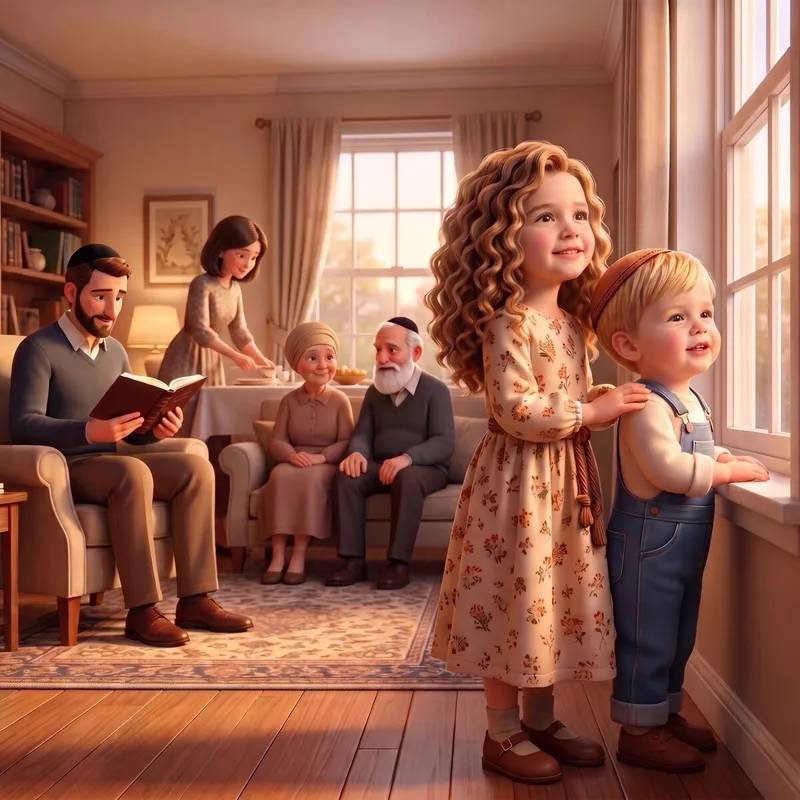
Thank You, Hashem, for My Family (תודה ה׳ על המשפחה שלי) is a Torah Tale story about a child thanking Hashem for the people at home: Mommy, Totty, Bubby and Zaidy. It is set in our own day, at home, and it follows what the family does together and what a parent or grandparent teaches. It lands with children because home is the first place they feel loved, and the story gives that feeling a direction: thanks to Hashem.
What is Thank You, Hashem, for My Family about?
This story comes from the Family collection, which is about a child and the grown-ups who love them. Unlike a parsha story, it is not set in the time of the Avos or in the Mishkan. It is set at home, today, in a world your child already knows.
The grown-ups in the story are Mommy, Totty, Bubby and Zaidy. The story follows the things they do together and something a parent or grandparent teaches. As the title says, the thanks goes to Hashem, who gave the child this family.
In the Torah Tale version, your child is the hero, so the child reading is the one saying thank you.
What is the lesson of this story?
The lesson is hakaras hatov, recognizing the good in our lives and saying thank you. Children say thank you to the person who hands them a snack, but they rarely think about the larger gift behind it. This story widens the circle: the people who care for us are a gift from Hashem.
The Torah itself tells us to honor our father and mother (Shemos 20:12, in the Aseres HaDibros). Thanking Hashem for our parents and grandparents fits naturally with that mitzvah. If you want a fuller look at gratitude in everyday life, see Saying Thank You for Kids: Teaching Hakaras Hatov at Home.
Children often hear 'say thank you' as a rule. In this story it becomes something warmer: noticing who is in the room and being glad.
How do I explain it to a 3-year-old and to a 9-year-old?
Ages 2 to 4. Keep it to one sentence and one person at a time. Point and say, 'Hashem gave us Totty. Thank you, Hashem.' Then do the same for Mommy, Bubby and Zaidy. Toddlers learn by naming, repeating and pointing.
Ages 5 to 8. Ask for something specific. 'What did Mommy do for you today?' 'What did Zaidy teach you?' Then connect it: 'Hashem sent you a family that does these things for you.' Children this age enjoy having a job, so let them be the one to say the thank-you out loud.
Ages 9 to 12. Older children can handle the harder question: how do we thank people who do things for us every single day, until it feels ordinary? Talk about how easy it is to stop noticing. You can also bring in kibbud av va'em and ask what honoring a parent or grandparent looks like in practice, beyond saying thanks.
What can we do at home to live the story?
A story sticks when it becomes a habit. These are small ideas that fit into an ordinary day:
- Modeh Ani in the morning. Many families teach children to thank Hashem the moment they wake up. Add one person: 'And thank you for Mommy and Totty.'
- A thank-you before bentching. Each person names one family member they are grateful for today.
- A weekday thank-you page. On a weekday afternoon or erev Shabbos, a child can draw or write a short thank-you to Bubby or Zaidy to give them. Drawing and writing are not for Shabbos or Yom Tov.
- Ask a grandparent for a story. Children love hearing what their parents were like at their age, and it builds the connection the story is about. For more on what grandparents teach, see our article on the grandparents story.
What questions can we ask at the Shabbos table?
Reading is welcome on Shabbos, and the Shabbos table is a good place to talk about family. These questions are for talking only, no writing or drawing:
- Who in our family did something kind for you this week?
- What does Mommy do that you only notice when she is not there?
- What is something Zaidy or Bubby taught you?
- How can we say thank you to Hashem for our family at this table?
- What is one thing you could do for someone at home this week?
Every Torah Tale book ends with a discussion page of 10 questions that mix comprehension with middos: what happened, and what it asks of the child. That page is there so the book does not stop when it is closed. It also pairs well with Shabbos with My Family, another story about the grown-ups at home.
What is the personalized book like?
In the Torah Tale version, your child's name and, from one uploaded photo, their likeness appear on every page, illustrated in 3D animated-film style. Up to eight children can appear in the same book, ages 0 to 18, so siblings can share one copy.
If you add parents, grandparents and other relatives with their photos, they appear with the children on a closing family page, in every format. The story itself stars the children. Softcover and hardcover books open with a dedication page, which is a nice place for a few words from the family.

Softcover 8″×8″

Hardcover 8″×8″

Board book 6″×6″

Coloring book 8.5″×11″
There are three formats. The board book is 6x6 with rounded safety corners, for ages 0-4. The softcover photo book is 8x8, for ages 4-8, and the hardcover photo book is 8x8, for ages 5-18. An optional matching coloring book, 8.5x11 in black-and-white line art, can be added to a one-time order. It is a weekday activity, for erev Shabbos or a weekday afternoon, and not for Shabbos or Yom Tov.
You can order the book in English, Hebrew or Yiddish. Every book is written with careful rabbinical guidance and strict tznius, and reviewed by our team before it goes to print.
How do I order it?
Creating the book takes about five minutes. You need a free account and a few short questions: each child's name, boy or girl, age and one photo, any siblings, the story, your family's community (asked once), the language and the printed format. If you are choosing between titles, the story picker lists the Family collection alongside nine other categories.
When you are ready, you can create the book, and your child can be the one who says thank you to Hashem for the family at home.
Frequently asked questions
What is the lesson of Thank You, Hashem, for My Family?
The lesson is hakaras hatov, recognizing the good in our lives and thanking Hashem for it. Here the good is the family at home. The story also shows a child that the love of a parent or grandparent is something to notice and be grateful for.
How do I explain thanking Hashem for family to a 3-year-old?
Keep it concrete and short. Point to the people at home and say, 'Hashem gave us Mommy and Totty and Bubby and Zaidy, so we say thank you to Hashem.' Then let your child name one thing a family member did for them today.
How do I explain it to an 8-year-old?
At this age a child can think about why we thank Hashem and not only that we do. Ask what they would miss if the family were not there, and what a parent or grandparent has taught them. You can connect it to the mitzvah of honoring parents in the Aseres HaDibros.
Which Torah Tale format suits this story?
The board book is 6x6 with rounded safety corners, for ages 0-4. The softcover is 8x8, for ages 4-8, and the hardcover is 8x8, for ages 5-18. The child's age is one of the short questions when you create the book.
Can grandparents and parents appear in the book?
Yes, if you add them. A family can add parents, grandparents and other relatives with their photos, and they appear with the children on a closing family page in every format. The story itself stars the children.
Is this a book to read on Shabbos?
Reading a storybook is entirely appropriate on Shabbos and Yom Tov, so it can be read at the Shabbos table. The optional coloring book is different, because coloring is melacha, so keep it for a weekday.