Hoshana Rabbah for Kids: The Aravos & Seven Hakafos
Hoshana Rabbah is the seventh day of Sukkos, when Yidden circle the bimah seven times with the lulav and esrog and strike the aravos. Here is how to explain it to a 3-year-old, a 6-year-old and a 10-year-old.
Published by Torah Tale.
Create this book for your child
Hoshana Rabbah is the seventh day of Sukkos, 21 Tishrei, and it is the day Yidden circle the bimah seven times with the lulav and esrog, say the Hoshanos, and tap the aravah branches on the floor. Children tend to remember it because it is so physical: they walk, they hold, they shake, they tap. Underneath is a simple idea they can grasp early, that we ask Hashem to please save us, and He is listening.
What is Hoshana Rabbah?
Hoshana Rabbah falls on the seventh day of Sukkos and is part of Chol HaMoed. It is followed right away by Shemini Atzeres. The word Hoshana comes from Hoshia na, meaning please save, and the day is known as Hoshana Rabbah because of the many Hoshanos we say.
This year's Hoshana Rabbah is already behind us, which makes this a good time to tell the story calmly, with no rush, so that next Tishrei your child walks into shul already knowing what the day means. For the whole Yom Tov, see the Sukkos story for kids.
What happens on Hoshana Rabbah?
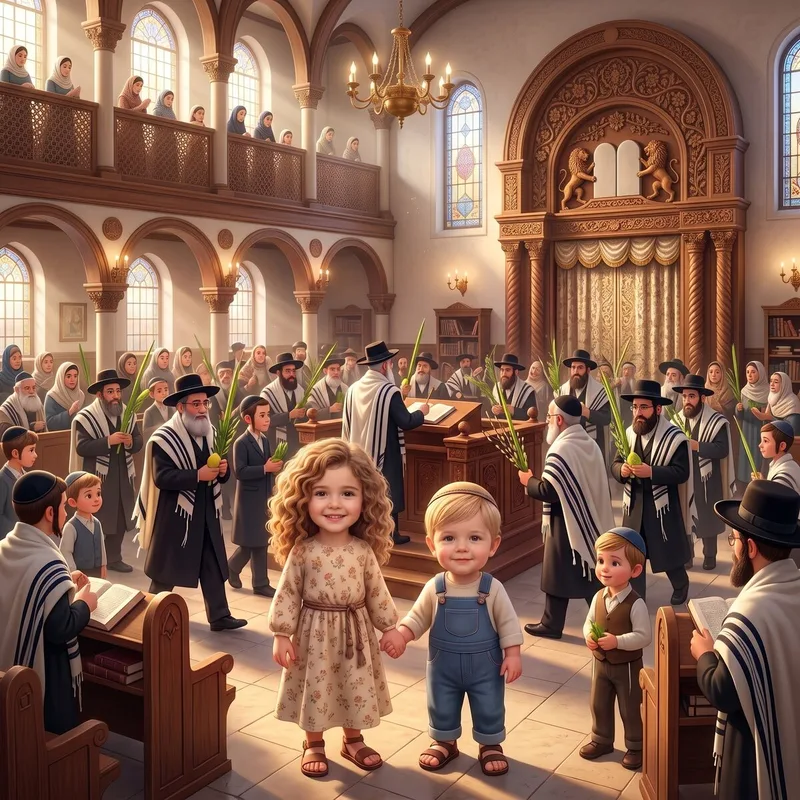
On the other days of Sukkos (apart from Shabbos), the Hoshanos are said with one circuit around the bimah. On Hoshana Rabbah we make seven hakafos, holding the lulav and esrog. In many shuls a Sefer Torah is held on the bimah while we walk.
At the end of the Hoshanos, the custom is to take a bundle of aravos and strike it on the ground. Then the aravos are put aside, and the day has a serious feeling together with its simcha.
Many people also have the minhag to stay up learning on the night of Hoshana Rabbah, often saying Tehillim and learning Sefer Devarim. Many families also eat kreplach at the Sukkah meal. These are customs, so families and communities differ, and a child should simply be told what your family does.
Where does Hoshana Rabbah come from?
The Mishnah in Maseches Sukkah (4:5) describes the Beis HaMikdash: each day of Sukkos the mizbeach was circled once, and on the seventh day it was circled seven times. The circuits are the root of our hakafos around the bimah.
The Mishnah in Rosh Hashanah (1:2) also teaches that on Sukkos the world is judged regarding water. That helps explain why the Hoshanos are so much about asking Hashem for salvation and for blessing in the coming year. Many sefarim, going back to the Zohar, also describe Hoshana Rabbah as a last day in the period of judgment that began on Rosh Hashanah. That is why the day carries real seriousness together with the joy of Sukkos.
What is the lesson for children?
The lesson is that we turn to Hashem with a full heart and ask Him to save us, and that we do it together. The Midrash (Vayikra Rabbah 30:12) compares the four minim to different kinds of Yidden. The aravah has neither taste nor smell, yet it is bound together with the other three. A child can hear from this that every Yid has a place in the bundle.
It also teaches a child that tefillah does not have to be complicated. Please, Hashem, save us is a sentence a three-year-old can say and mean. For a related middah, see davening to Hashem for kids.
How do I explain Hoshana Rabbah to a 3-year-old, a 6-year-old and a 10-year-old?
Around 3 to 4: Keep it concrete. Say: today is the last big day of Sukkos, we walk around the shul with our lulav and ask Hashem to please save us. Let your child hold the aravah and tap it gently on the floor with you. A child this age does not need more than that.
Around 6 to 7: Tell your child that on the other days we walk around once, and today we walk seven times, and that in the Beis HaMikdash the kohanim walked around the mizbeach just like this. Ask why they think the day gets seven walks. Then explain that Hoshana means please save.
Many children at this age love counting the hakafos. Let your child keep the count. It will keep them focused on the meaning too.
Around 9 to 12: Bring in the sources: the Mishnah in Sukkah about the seven circuits, the Mishnah in Rosh Hashanah about the judgment on water, and the idea in the sefarim of Hoshana Rabbah as the last day of the judgment period. Ask what the aravah, with no taste and no smell, can teach about our place among Yidden. Older children also respond to the minhag of the night learning as a chance to take part in something yearly.
What is the Torah Tale book of this story like?
The Hoshana Rabbah book is part of the Holidays collection, and your child is the hero. Their name and, from one uploaded photo, their likeness appear on every page, illustrated in 3D animated-film style. Every book is written with careful rabbinical guidance and strict tznius and is reviewed by our team before it goes to print.

Softcover 8″×8″

Hardcover 8″×8″

Board book 6″×6″

Coloring book 8.5″×11″
The book comes in three formats: a 6x6 board book with rounded safety corners (ages 0-4), an 8x8 softcover photo book (ages 4-8), and an 8x8 hardcover photo book (ages 5-18). Softcover and hardcover books open with a dedication page. Siblings can share a book, up to eight children aged 0 to 18. If you add parents and grandparents with their photos, they appear with the children on a closing family page in every format.
A book is something to read, so it fits well in the Sukkah on Chol HaMoed or at the meal on Shabbos Chol HaMoed. An optional matching coloring book is a weekday activity only. If you want it, plan it for the weekdays before Sukkos or a weekday of Chol HaMoed, never on Shabbos or Yom Tov.
What can we ask at the Sukkah table?
Every Torah Tale book ends with a discussion page of 10 questions, mixing comprehension with middos. It is what turns the book from something read to a child into something talked about at the table. If you would like to start now, here are a few of your own, all spoken and no writing:
- What do we hold when we walk around the bimah on Hoshana Rabbah?
- How many times do we walk around today, and how many on the other days?
- What does Hoshia na mean, and what do we ask Hashem for?
- The aravah has no taste and no smell. Why does it still belong in the bundle?
- Who can you help today so that everyone feels they belong?
If your child is very young, choose one question and let them answer in their own words. Your goal is a shared moment in the Sukkah, not a quiz.
When you are ready, create the book. It takes about five minutes: a free account and a few short questions, including each child's name, boy or girl, age and one photo, the story, your community, the language and the format. Other Yom Tov stories are in Shemini Atzeres for kids and Chol HaMoed for kids.
Frequently asked questions
What is Hoshana Rabbah in simple words for a child?
Hoshana Rabbah is the seventh day of Sukkos. In shul we walk around the bimah seven times holding our lulav and esrog and ask Hashem to please save us, because Hoshia na means please save. At the end we hold the aravos and tap them on the floor.
Why do we hit the aravos on Hoshana Rabbah?
Striking the aravah branches at the end of the Hoshanos is a long-standing minhag of Hoshana Rabbah, and it is connected to the day's tefillos for salvation. The Mishnah in Sukkah also describes aravah branches standing by the mizbeach in the Beis HaMikdash. For a child it is enough to say that this is how Yidden have marked the day, and that the aravah is one of the four minim we hold on Sukkos.
Is Hoshana Rabbah a Yom Tov?
Hoshana Rabbah is the last day of Chol HaMoed, not a Yom Tov with the full restrictions of melacha. It has its own special minhagim, such as seven hakafos and the beating of the aravos. Shemini Atzeres, which follows it, is a Yom Tov.
How do I explain Hoshana Rabbah to a 4-year-old?
Keep it to what a child can see and do: the lulav and esrog, walking in a circle in shul, and saying please, Hashem, save us. Let your child hold the aravah, which is the soft, thin-leaved branch, and say that this is the last day we walk around with our lulav in the Sukkos season. A child this age does not need the idea of judgment, only that we ask Hashem for good things and that He listens.
Is there a Torah Tale book about Hoshana Rabbah?
Yes, Hoshana Rabbah is a story in the Holidays collection. Your child appears by name and likeness on every page, illustrated in 3D animated-film style, and the book ends with a discussion page of 10 questions mixing comprehension with middos. You start at torahtale.com/create with a free account and a few short questions.