Davening to Hashem (תפילה) for Kids: Teaching Tefillah at Home
Davening is talking to Hashem. Here is how to explain tefillah to young children, what to ask at the Shabbos table, and how a personalized Torah Tale book can help.
Published by Torah Tale.
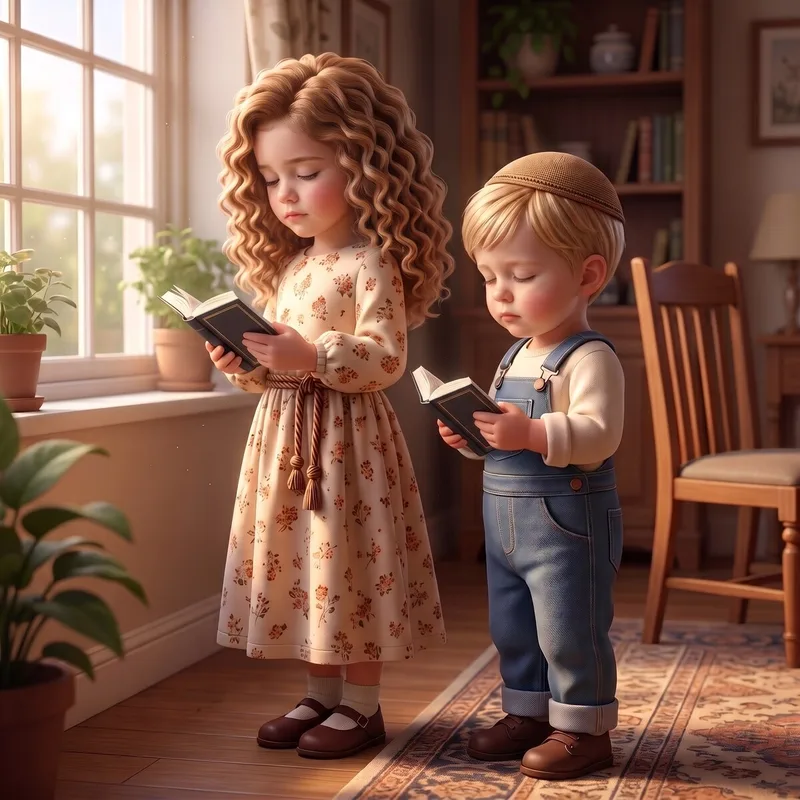
Create this book for your child
Davening is the mitzvah of speaking to Hashem: thanking Him, asking Him, and praising Him, in the words of the siddur and in our own words. Torah Tale's story on this theme, Davening to Hashem (תפילה), is set in everyday life today and is part of the Mitzvos collection. It works for children because they already know how to ask for things, and tefillah teaches them who to turn to and how to say thank you.
What is tefillah, in words a child understands?
Tefillah means talking to Hashem. We do not need a special place or a special voice to do it, and Hashem hears every Yid. In shul, in the kitchen or at a child's bedside, the same Hashem is listening.
There are two parts to explain. One is the fixed tefillos of the siddur, which Yidden say in the morning, afternoon and evening. The other is a child's own words, whenever they want to thank Hashem or ask for something.
Where does davening come from?
Chazal learn from the words 'ul'ovdo bechol levavchem' that there is an avodah that takes place in the heart, and that this avodah is tefillah (Taanis 2a). That is why davening is more than reading words off a page. The heart is meant to be part of it.
On the three daily tefillos, Maseches Brachos (26b) brings the view that the Avos established them: Avraham Shacharis, Yitzchak Mincha and Yaakov Maariv. Another view there connects them to the korbanos. You can tell a child that Yidden have davened at these times for a very long time.
What can children learn from Chana's tefillah?
Chana is a well-known example of a person davening from the heart. The pesukim tell us that she was in great distress and prayed to Hashem at Shiloh. She spoke in her heart, her lips moved, and her voice could not be heard (Shmuel I 1:13).
Eli saw her lips moving and thought she was drunk. She explained that she was pouring out her soul before Hashem. Eli then blessed her, and she went on her way. Chazal learn many halachos of tefillah from her. For the full story, read our article on the birth of Shmuel and Chana's tefillah.
For a child, the takeaway is simple. Davening does not have to be loud or polished. It can be quiet, and it is real when it comes from the heart.
How do I explain davening at different ages?
Ages 3 to 4: Keep it to one idea: we talk to Hashem. Say it with the child, one short phrase at a time. Modeh Ani in the morning is a good first tefillah, because it is a thank you.
Ages 6 to 7: Now you can explain that there are three tefillos a day and that the siddur gives us the words. Show your child where the tefillos are in the siddur and let them find the place themselves. Davening in shul, standing quietly with the others, is a good habit to build slowly.
Ages 9 to 12: Older children can be asked about kavanah, which means knowing what the words mean and who we are talking to. Choose one paragraph of the siddur to understand fully each week, and ask what it says. A child who understands one paragraph well davens it differently.
Does Hashem always say yes?
Children will ask this sooner or later, usually after something they davened for did not happen. A good answer is that Hashem always hears, and that, like a loving parent, He knows what is best for us. Sometimes the answer is yes, sometimes it is not yet, and sometimes it is different from what we hoped for.
It also helps to tell a child that davening is not only asking. Thanking Hashem is a big part of it, and a child who thanks Hashem for ordinary things sees how much there is to be thankful for.
What is the Torah Tale book about davening like?
Davening to Hashem (תפילה) is a personalized storybook from the Mitzvos collection, set in a child's everyday life today. Your child's name and, from one uploaded photo, their likeness appear on every page, illustrated in 3D animated-film style. Up to eight children can appear in the same book, so siblings can daven together in the same story.
The book is written with careful rabbinical guidance and strict tznius, and our team reviews it before it goes to print. Every book ends with a discussion page of 10 questions mixing comprehension with middos. These cover what happened in the story and what it asks of the child. If you add parents and grandparents when you create the book, they appear with the children on a closing family page in every format.

Softcover 8″×8″

Hardcover 8″×8″

Board book 6″×6″

Coloring book 8.5″×11″
For format, the 6x6 board book with rounded safety corners is for ages 0-4, the 8x8 softcover is for ages 4-8, and the 8x8 hardcover is for ages 5-18. Softcover and hardcover open with a dedication page. There is also an optional matching coloring book, and because coloring is melacha, it belongs on a weekday, such as an afternoon during the week or erev Shabbos. The storybook itself is a good choice for reading on Shabbos.
What can we ask at the Shabbos table?
Reading is entirely appropriate on Shabbos, and so are questions and conversation. These need no props, only talking:
- When do we daven during the day, and what is your favorite part?
- What is one thing you thanked Hashem for this week?
- Why do you think Chana davened quietly?
- What can we do to help ourselves pay attention when we daven?
- Is there something you would like to ask Hashem for, if you want to share it?
If the child does not answer right away, that is fine. Ask again a few weeks later. For another tefillah a child can learn, see teaching Krias Shema at home.
How do I order the book?
Creating a book takes about five minutes. You open a free account and answer a few short questions: each child's name, boy or girl, age and one photo, any siblings, the story, your family's community (asked once), the language and the printed format. Languages are English, Hebrew and Yiddish. Ready to start? Create the book and choose Davening to Hashem (תפילה) from the Mitzvos category in the story picker.
Frequently asked questions
How do I explain davening to a 4-year-old?
Tell your child that davening means talking to Hashem. We say thank you, we ask for what we need, and Hashem always listens. Start with one or two short things, such as Modeh Ani in the morning, and let your child add a few words of their own.
What is the lesson of davening to Hashem?
The lesson is that a child can turn to Hashem at any time, to thank and to ask, and that Hashem hears. Davening also teaches a child that the things they have come from Hashem, and that they are not alone when they are worried or hoping for something.
Why do we daven three times a day?
Maseches Brachos (26b) brings the view that the Avos established the tefillos: Avraham Shacharis, Yitzchak Mincha and Yaakov Maariv. Another view there connects the tefillos to the korbanos that were brought in the Beis HaMikdash. For a child, it is enough to say that Yidden speak to Hashem in the morning, the afternoon and the evening.
Can my child talk to Hashem in their own words?
Yes. A child can speak to Hashem in any language, at any time, in addition to the words of the siddur. Chana's tefillah, which she poured out silently, is a well-known example, and Chazal learn many halachos of tefillah from her. For where to add personal requests inside the formal tefillah, ask your rav or teacher.
What is the Torah Tale book about davening like?
Davening to Hashem (תפילה) is a story from the Mitzvos collection, set in everyday life today, with your child's name and likeness on every page in 3D animated-film style. It is written with careful rabbinical guidance and strict tznius, and it ends with a discussion page of 10 questions mixing comprehension with middos.