The Birth of Shmuel for Kids: Chana's Tefillah at Shiloh
Chana came up to the Mishkan in Shiloh and davened so quietly that only her lips moved. Hashem gave her a son, she named him Shmuel because she had asked for him from Hashem, and she brought him back to serve. Here is how to tell the story to children, what it teaches about tefillah, and what to ask at the Shabbos table.
Published by Torah Tale.
Create this book for your child
The birth of Shmuel is the story that opens Sefer Shmuel I, in Nevi'im. Chana, who had no children, came up with her family to the Mishkan in Shiloh and davened there so quietly that only her lips moved and no sound came out. Hashem heard her, she had a son, and she named him Shmuel because she had asked for him from Hashem. Children love this story because the hero of it does something they can do themselves: she talks to Hashem.
What happens in the story of Shmuel's birth?
Elkanah and his family went up every year to Shiloh, where the Mishkan stood and where Eli was the Kohen. Chana had no children, and year after year she was distressed by her rival in the house, until she would cry and not eat. Elkanah tried to comfort her and asked her why her heart was bad, and said that he was better to her than ten sons.
One year, after they ate and drank in Shiloh, Chana got up and went to daven. The pesukim say she was bitter of soul, she davened to Hashem and cried, and she made a vow: if Hashem would give her a son, she would give him to Hashem all the days of his life, and a razor would never come upon his head.
Eli was sitting by the doorpost of the Mishkan. He watched her mouth, and because he heard nothing he thought she had been drinking wine. Chana answered him that she was not drunk, that she was a woman of heavy spirit, and that she had poured out her soul before Hashem. Eli blessed her: go in peace, and may the G-d of Yisrael grant the request that you asked of Him. The pasuk says that she went on her way, she ate, and her face was no longer the same. Something had changed before anything had happened yet.
Hashem remembered Chana, and she gave birth to a son. She called his name Shmuel, ki me'Hashem she'iltiv, because she had asked for him from Hashem. Later, the pesukim tell us, Hashem gave her three more sons and two daughters.
What Chana's tefillah teaches us about davening
This is not only a beautiful story, it is a source of halacha. The Gemara in Berachos 31a learns a list of rules of Shemoneh Esrei from the way Chana davened. From "and Chana was speaking upon her heart" we learn that a person davening must direct his heart. From "only her lips moved" we learn that a person must form the words with his lips and not only think them. From "and her voice was not heard" we learn that one should not raise his voice while davening.
That is worth saying out loud to a child who is learning to daven. The way Shemoneh Esrei looks in shul, lips moving with almost no sound, comes from a woman standing in Shiloh who wanted something very badly and said it to Hashem.
It is also worth pointing out that Chana davened in her own words, about her own life. Children sometimes think tefillah is only the words in the siddur. Chana shows them it is also what you tell Hashem yourself.
Chana keeps her promise
The second half of the story is the part adults often find even harder than the first. Chana had asked for a child for years. When he was born, she did not go up to Shiloh with the family that year; she stayed home until the child was weaned. And then, while he was still very small, she brought him up to Shiloh with three bulls, flour and wine, and she said to Eli: I am the woman who stood here with you, davening to Hashem. For this boy I davened, and Hashem gave me what I asked. And now I am giving him over to Hashem all the days.
Chana asked, received and gave back. Then she sang the song that begins chapter 2, thanking Hashem. If you are looking for the middah of the story in one word, it is hakaras hatov that costs something: saying thank you not only with words but by keeping exactly what you promised.
How to explain this story to a 4-year-old and to an 8-year-old
For a four or five-year-old, keep it to three beats. Chana wanted a baby. She went to the Mishkan and talked to Hashem quietly, with her lips moving and no sound. Hashem heard her, and she had a baby boy, and she called him Shmuel because she had asked for him from Hashem. End there, with the point that Hashem hears even a whisper, even a thought.
For an eight to ten-year-old, you can give the whole arc, including Eli's mistake and Chana's respectful answer, and the promise she kept. This is the age to tell them that the Gemara learns the halachos of how we daven from these very pesukim, and to ask them to watch the adults in shul the next time Shemoneh Esrei starts. You can also tell them who this baby grew up to be: the navi Shmuel, who led Klal Yisrael and later anointed Shaul and then Dovid as king. Everything in Sefer Shmuel starts from a tefillah nobody else could hear.
If your children know the stories from Sefer Shoftim, this is the generation right after. A quick link backward helps: after the earlier judges, including Devorah and Gidon, comes Eli in Shiloh, and then Shmuel.
Questions for the Shabbos table
These need nothing but talking, so they fit Shabbos and a long Yom Tov afternoon.
- Why do you think Chana davened quietly instead of out loud?
- Eli thought something about Chana that was not true. What did Chana do about it, and how did she speak to him?
- The pasuk says that after Eli blessed her, Chana ate and her face changed, before anything had happened. Why?
- Chana waited years for Shmuel and then brought him to serve in Shiloh. Was that hard? What does it teach us about keeping a promise?
- What is one thing you would ask Hashem for in your own words this week?
Every Torah Tale book ends with a dedicated discussion page of ten questions about the story, mixing comprehension with middos, so this part of the table conversation is already written for you.
What a personalized Torah Tale book of the birth of Shmuel is like
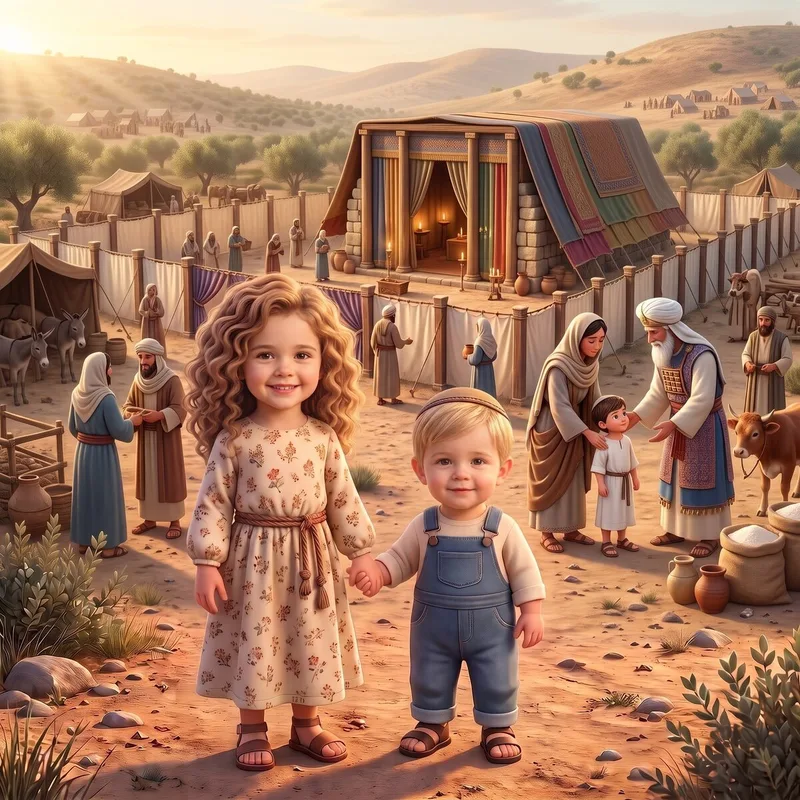
The birth of Shmuel is one of the stories in the Nevi'im collection, from Sefer Shmuel. In a Torah Tale book, your own child is the hero of the pages: their name and, from one uploaded photo, their likeness appear on every page, illustrated in high-resolution 3D animated-film style. They are there in Shiloh as the family comes up to the Mishkan, there as Chana stands and davens, there when the small boy is brought to Eli.

Up to eight siblings, ages 0 to 18, can star in the same book, and parents, grandparents and other relatives can be added with their photos to appear together with the children on a closing family page. Books come in English, Hebrew or Yiddish, and every book is written with careful rabbinical guidance and strict tznius and reviewed by our team before it goes to print.

Softcover 8″×8″

Hardcover 8″×8″

Board book 6″×6″

Coloring book 8.5″×11″
Three formats: a 6"x6" board book with rounded safety corners for ages 0-4, an 8"x8" softcover for ages 4-8, and an 8"x8" hardcover for ages 5-18. The softcover and hardcover open with a dedication page, and every format ends with the discussion page and the family page. There is also an optional matching coloring book, 8.5"x11" in black-and-white line art, which is a weekday activity, never for Shabbos or Yom Tov.
If your family is building a shelf of Nevi'im stories, you can order a single book or subscribe to the Nevi'im collection (four books a month in one delivery). Our step-by-step guide to creating a personalized Torah storybook walks through the whole flow.
When to give this book
Two moments fit it especially well. One is the season of Rosh Hashanah, when this chapter is the haftarah of the first day and the whole day leans on tefillah; see also our Rosh Hashanah story for kids. The other is the week a child starts davening Shemoneh Esrei on their own, or starts learning Sefer Shmuel in cheder or school. A story about a tefillah that was heard is a good thing to put into a child's hands exactly then.
Creating a book takes about five minutes. It needs a free account and a few short questions: each child's name, boy or girl, age and one photo, any siblings, the story, your family's community (asked once), the language and the printed format. You can create the book whenever you are ready.
Frequently asked questions
Where in Tanach is the story of Shmuel's birth?
It is the opening of Sefer Shmuel I, chapter 1, which is part of Nevi'im (not the Chumash). The chapter tells about Elkanah and his family going up to the Mishkan in Shiloh, Chana's tefillah there, the birth of Shmuel, and Chana bringing him to Eli the Kohen once he was weaned. Chana's song of thanks follows at the beginning of chapter 2.
How do I explain Chana's tefillah to a 5-year-old?
Say it in one sentence: Chana wanted a child very much, so she went to the Mishkan and talked to Hashem quietly from her heart, and Hashem heard her. Explain that nobody standing nearby could hear a sound, because tefillah does not need to be loud to be heard by Hashem. Then connect it to something the child does, like asking Hashem quietly for something in Shemoneh Esrei or before bed.
Why did Eli the Kohen think Chana was drunk?
The pesukim say that Chana was speaking in her heart, only her lips were moving, and her voice was not heard. Eli saw a woman standing and moving her lips with no sound and thought she had been drinking wine. Chana answered him that she had not, and that she had been pouring out her soul before Hashem, and Eli blessed her that Hashem should grant what she had asked.
What is the lesson of the birth of Shmuel?
The main lesson is that real tefillah comes from the heart, in a person's own words, and that Hashem hears it even when no one else can. A second lesson is keeping your word: Chana promised to give her son to Hashem's service, and when Shmuel was weaned she brought him up to Shiloh exactly as she had said. Both are ideas a young child can hold on to.
Why is the story of Chana read on Rosh Hashanah?
Shmuel I chapter 1 through the beginning of chapter 2 is the haftarah of the first day of Rosh Hashanah, read in both Ashkenazi and Sephardi shuls. The Gemara in Rosh Hashanah 11a teaches that Sarah, Rachel and Chana were remembered on Rosh Hashanah. It is also a fitting reading for a day built almost entirely around tefillah.
What did Shmuel become when he grew up?
Shmuel grew up serving in the Mishkan in Shiloh near Eli the Kohen, and he became one of the great nevi'im of Klal Yisrael. He led the Yidden, traveled to judge them, and later anointed Shaul and then Dovid as kings. All of that begins with one mother's quiet tefillah in chapter 1.