Gidon's Small Army for Kids: 300 Men, Shofros & Jugs of Light
Gidon had thirty-two thousand men ready to fight Midyan, and Hashem said it was too many. Here is the story of Gidon's small army, retold the way it is taught in a frum home, with age-by-age explanations and Shabbos table questions.
Published by Torah Tale.
Create this book for your child
Gidon's small army is the story in Sefer Shoftim, chapters 6 to 8, where Hashem tells Gidon that his army is too big. Thirty-two thousand men came out to fight Midyan, and Hashem sent all but three hundred of them home, so that nobody could ever say the Yidden won by their own strength. It lands with children because the arithmetic goes the wrong way: in every story a child knows, the hero gathers more help, not less.
What happens in the story of Gidon?
The Yidden had been under Midyan for seven years. Every year Midyan and Amalek and the bnei kedem came up with camels beyond counting, the pasuk compares them to locusts for their multitude, and they ruined the crops until nothing was left to eat. People hid in caves and in strongholds in the mountains.
The story opens with a very ordinary picture. Gidon is beating out wheat inside a winepress, in a sunken place meant for grapes, because he is trying to hide the little grain he has from Midyan. A malach comes and sits under the elah tree in Ofrah and says to him, "Hashem is with you, gibor hachayil."
Gidon does not feel like a gibor. He answers back with the question every oppressed generation asks: if Hashem is with us, why has all this happened to us, and where are all the wonders our fathers told us about? Then Hashem tells him, "Go with this strength of yours and save Yisrael from the hand of Midyan." Rashi explains that "this strength of yours" means the merit of the defense Gidon had just spoken on behalf of Klal Yisrael.
Gidon answers that his family is the poorest in Menashe and that he is the youngest in his father's house. He is sent anyway. He brings an offering, fire comes out of the rock and consumes it, and he builds a mizbeach and calls it "Hashem Shalom." That night, with ten of his servants, he breaks down the mizbeach of the Baal that stood in his father's house, because he was afraid to do it by day.
Why did Hashem send most of the army home?
A ruach from Hashem clothed Gidon, he blew the shofar, and men came from Menashe, Asher, Zevulun and Naftali. He asked for the sign of the fleece, dew on the wool alone with dry ground around it, and then the opposite, and Hashem did both.
Then came the part children remember. Thirty-two thousand men were camped and ready, and Hashem said: there are too many people with you. The pasuk gives the reason in Hashem's own words, lest Yisrael boast and say "yadi hoshia li," my own hand saved me.
So Gidon announced that whoever was afraid and trembling could turn back. Twenty-two thousand went home and ten thousand stayed. Hashem said it was still too many. He told Gidon to bring them down to the water, and there the men were sorted by how they drank: those who knelt down to drink on one side, and those who lapped the water with their hand to their mouth on the other. Three hundred men lapped. With those three hundred, Hashem said, I will save you.
That same night, before the battle, Gidon went down with Purah his na'ar to the edge of the enemy camp and overheard a man telling his friend a dream about a loaf of barley bread that rolled into the camp and knocked a tent flat. The friend answered that this is nothing other than the sword of Gidon ben Yoash. Gidon bowed down and went back up.
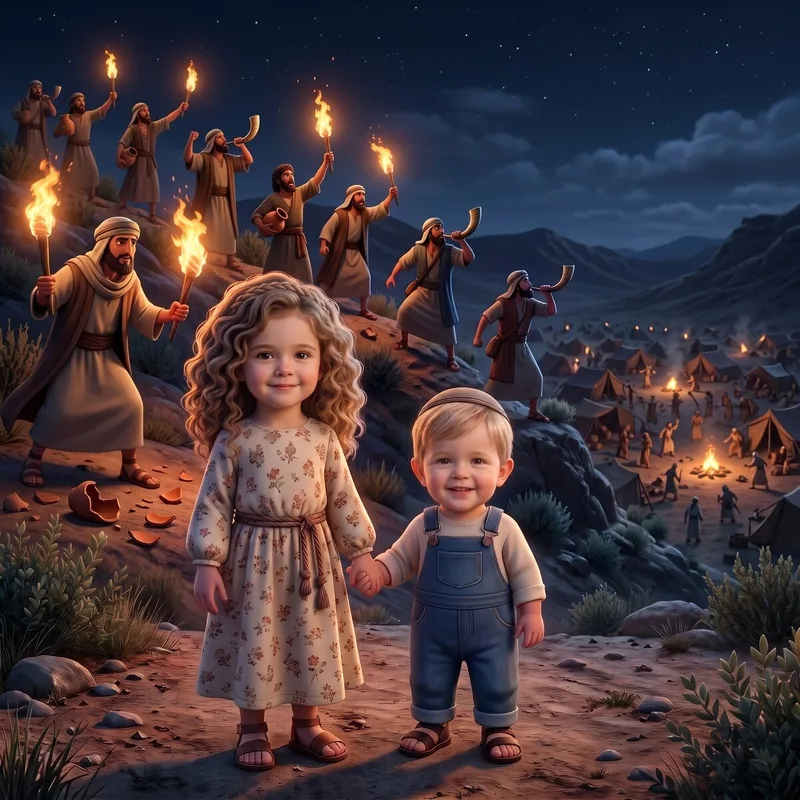
He split the three hundred into three groups of one hundred. Every man had a shofar in one hand and an empty jug with a torch burning inside it in the other. At the start of the middle watch they surrounded the camp, blew the shofros, smashed the jugs, held the torches high and called out, "Cherev laHashem ul'Gidon." Midyan ran. Hashem set each man's sword against his fellow, and the camp fled toward the Yarden, and Gidon called the men of Efrayim to seize the crossings ahead of them.
What is the lesson of Gidon's small army?
The whole story is built to remove any other explanation. Three hundred men with pottery and shofros did not out-fight a camp like locusts for multitude. The pesukim say plainly that the army was shrunk on purpose, so that the victory could only be read one way.
There is a second lesson underneath it, and it is the one that speaks to a child who feels small. Gidon's own first answer was that his family was the least and he was the youngest. He was not told that he was wrong about himself. He was told to go.
And there is a middah at the end that is easy to skip. When the men of Efrayim came to Gidon afterward with a sharp complaint about not being called earlier, he did not fight back. He answered them softly, gave them credit, and the pasuk says their spirit settled. Later, when the people wanted to make him their ruler, he refused: "I will not rule over you, and my son will not rule over you. Hashem will rule over you."
How to explain it to a 4-year-old and to an 8-year-old
For a four or five-year-old, keep it to one picture and one sentence. The picture: three hundred men standing in a circle in the dark, each one holding a shofar and a jug with a light hidden inside, and all at once the jugs break and the whole valley is full of light. The sentence: Hashem did not need a big army, because Hashem is the One who saves.
For a seven or eight-year-old, do the numbers out loud. Thirty-two thousand came. Twenty-two thousand went home when Gidon said that whoever was afraid could leave, which left ten thousand. From those ten thousand, three hundred stayed. Then ask why Hashem went to that much trouble to make the army small, and let them find the answer in Hashem's own words, so that Yisrael would not say "my own hand saved me."
For a ten or eleven-year-old, the interesting question is Gidon himself. He argues that he is the smallest and least important person for the job, and he is sent anyway. Ask what Hashem saw in him that he did not see in himself. Children this age are starting to decide what they are and are not good at, and this story pushes back on that gently.
Five questions for the Shabbos table
These are talking questions, meant for Friday night or a long Shabbos afternoon after the story has been read.
- Why did Hashem want the army to be small instead of big?
- Gidon said he was the youngest in his family and the least important. Was he right? Did it matter?
- What would you have thought if you were one of the twenty-two thousand men who went home?
- The men called out "Cherev laHashem ul'Gidon." Why did they say Hashem's name first?
- When the men of Efrayim complained, Gidon answered them softly. When is it hardest for you to answer softly?
If you want to extend it, Gidon sits naturally alongside two other stories from the same sefer. Devorah HaNevi'ah comes before him, and Shimshon HaGibor comes later. The same question runs through all three: where does strength actually come from. For a younger child, the walls of Yericho makes the same point with shofros and no battle at all.
A weekday activity that makes the three hundred real
Do this one on a weekday evening, not on Shabbos or Yom Tov. Turn off the lights in one room. Give each child a flashlight and a paper cup to put over it, and have them stand spread out around the walls. Count to three, lift the cups together, and let them see how much light three hidden lamps make when they all appear at once. Then ask them to imagine three hundred.
Counting is worth doing too. Put out three hundred dried beans or small blocks in groups of a hundred, then ask the child to picture the thirty-two thousand that started. Young children have no feel for those numbers until they see one of them on the table.
A matching coloring book, ordered as a one-time add-on alongside the storybook, is another good use of a weekday afternoon or erev Shabbos, when coloring is permitted.

Softcover 8″×8″

Hardcover 8″×8″

Board book 6″×6″

Coloring book 8.5″×11″
What a personalized Torah Tale book of this story is like
Gidon's Small Army is part of the Nevi'im collection, from Sefer Shoftim. In the Torah Tale version, your child's name and, from one uploaded photo, their likeness appear on every page, illustrated in high-resolution 3D animated-film style: down in the winepress with Gidon, at the water when the men are sorted, and standing in the dark circle with a shofar when the jugs break. Up to eight siblings, ages 0 to 18, can appear in the same book.
Every book is written with careful rabbinical guidance and strict tznius and reviewed by our team before it goes to print, and every book includes a discussion page with ten questions about the story, mixing comprehension with middos. That page is what turns the book from something you read to your child into something the family talks about at the table.
There are three formats. The 6x6 board book with rounded safety corners is for ages 0 to 4. The 8x8 softcover photo book is for ages 4 to 8. The 8x8 hardcover photo book is for ages 5 to 18. Softcover and hardcover books end with a page for the child to draw their own picture, and board books end with a family page. Books are available in English, Hebrew and Yiddish, and a book can be ordered in more than one language.
Reading it on Shabbos is exactly right. A story about shofros blowing in the dark holds a seven-year-old through a long Shabbos afternoon better than almost anything else in Nevi'im.
If your child has been feeling like the youngest, the smallest or the least likely one in the room, this is the story to put in their hands with their own face in it. You can create the book in about five minutes: a free account and a few short questions, each child's name, boy or girl, age and one photo, any siblings, the story, your community, the language and the format.
Frequently asked questions
What is the story of Gidon and the 300 men?
In Sefer Shoftim, Midyan was coming up every year and destroying the crops of Eretz Yisrael. Hashem sent Gidon to save the Yidden, but when 32,000 men gathered, Hashem said there were too many, and after two siftings only 300 remained. Those 300 surrounded the camp of Midyan at night with shofros and torches hidden in jugs, and Midyan fled in confusion.
Why did Hashem reduce Gidon's army to only 300 men?
The pasuk gives the reason directly: Hashem said the people with Gidon were too many, lest Yisrael boast and say 'yadi hoshia li', my own hand saved me. With a huge army the victory would have looked like a military achievement. With 300 men carrying jugs and shofros, nobody could mistake who won the battle.
How do I explain Gidon's small army to a 5-year-old?
Say it in one sentence: Gidon had a lot of soldiers, and Hashem said He only needed a few, because Hashem is the One who wins the war. Then tell the picture part, which young children love: three hundred men standing in the dark, each one with a shofar and a jug with a light inside, and when they broke the jugs the whole valley lit up at once.
Is Gidon in the Torah?
No. Gidon is in Nevi'im, in Sefer Shoftim, which comes after Sefer Yehoshua. The Torah means the Chumash, and Gidon lived in the period of the Shoftim, generations after Yehoshua brought the Yidden into Eretz Yisrael.
What middos does the Gidon story teach children?
Three stand out. Humility, because Gidon answered that his family was the smallest and he was the youngest, and Hashem sent him anyway. Bitachon, because the victory came from Hashem and not from numbers. And a soft answer, because when the men of Efrayim came to Gidon with a complaint afterward, he answered them calmly and their anger settled.
Can I get the Gidon story as a personalized book for my child?
Yes. Gidon's Small Army is part of Torah Tale's Nevi'im collection, from Sefer Shoftim, and the book is printed with your child's name and, from one uploaded photo, their likeness on every page in 3D animated-film style. Creating it takes about five minutes at torahtale.com/create with a free account and a few short questions: each child's name, boy or girl, age and one photo, any siblings, the story, your community, the language and the format.