Shimshon HaGibor for Kids: The Nazir, the Lion & Where Strength Comes From
Shimshon is the strongest man in Nevi'im, and his story is in Sefer Shoftim, perakim 13 to 16. Here is how to tell it to children, what his strength really was, and how to handle the hard ending at the Shabbos table.
Published by Torah Tale.
Create this book for your child
Shimshon is the strongest person in all of Nevi'im, and his story sits in Sefer Shoftim, perakim 13 to 16. Children are drawn in by the lion, the foxes and the city gates carried up a mountain. What makes the story worth telling at your table is what the pesukim keep repeating underneath all of it: Shimshon's strength was never his own. It was the spirit of Hashem resting on a boy who had been set aside as a nazir before he was born.
What happens in the story of Shimshon?
Sefer Shoftim opens this section by telling us that the Yidden did what was wrong in the eyes of Hashem, and they were given into the hands of the Pelishtim for forty years. That is the background to everything that follows.
A malach came to the wife of Manoach, from shevet Dan, and told her she would have a son. He would be a nazir to Hashem from birth: no razor was to touch his head. She herself was told not to drink wine and not to eat anything tamei. The malach said this child would begin to save the Yidden from the Pelishtim. Manoach davened that the malach come again, and he did, and when Manoach asked his name the malach answered that it is wondrous. Then he went up in the flame from the rock, and Manoach and his wife fell on their faces.
The boy was born and was called Shimshon. Hashem blessed him, and the spirit of Hashem began to stir in him in Machaneh Dan, between Tzorah and Eshtaol. From there the story moves quickly:
- On the way to Timnah a young lion came at him, and he tore it apart with nothing at all in his hand. Later he found a swarm of bees and honey inside the carcass.
- At the feast he gave the thirty Pelishti companions a riddle: from the eater came food, and from the strong came sweet. They pressured his wife until she told them the answer.
- He caught three hundred foxes, tied them tail to tail with torches between them, and sent them through the Pelishti grain fields.
- With the jawbone of a donkey he struck down a thousand Pelishtim at Lechi. Afterward he was desperately thirsty, he called out to Hashem, and Hashem split open a hollow place and water came out.
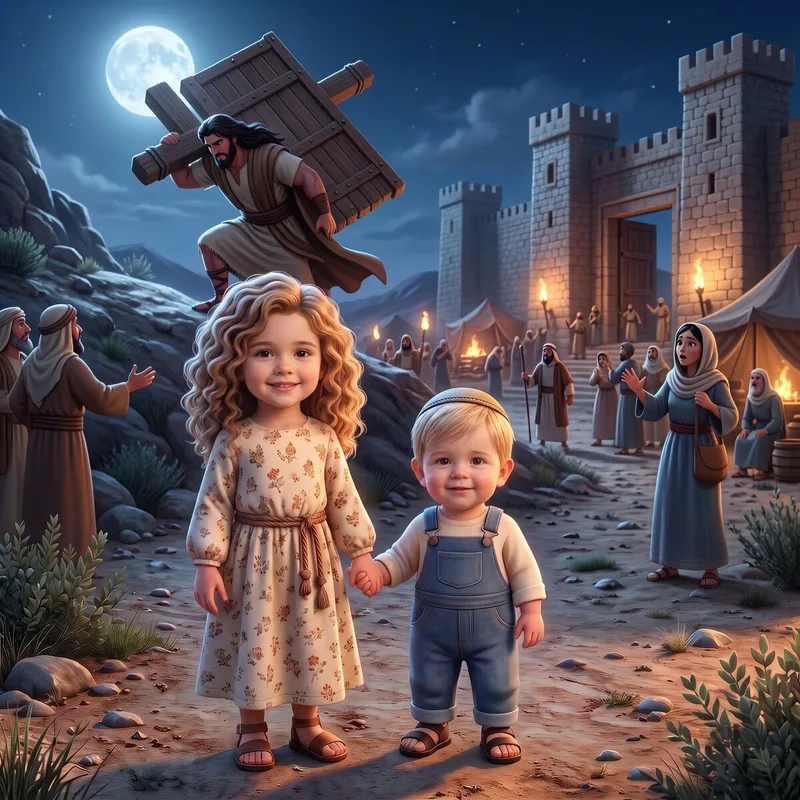
- In Azah the Pelishtim locked the city gate to trap him. He pulled up the doors, the two posts and the bar, and carried them to the top of the mountain facing Chevron.
One line in perek 14 is worth knowing as a parent: when his father and mother objected to the marriage in Timnah, the pasuk says they did not know that it was from Hashem, that He was seeking a cause against the Pelishtim. The pesukim themselves frame these episodes as the beginning of the rescue the malach had promised.
Where did Shimshon's strength actually come from?
This is the question every child asks, and the pesukim answer it clearly. Over and over the text says that the spirit of Hashem came upon him, and then he did what he did. His long hair was not a battery. It was the sign of his nezirus, the visible mark of a person who had been given to Hashem from before he was born.
So when the Pelishti leaders paid Delilah a great sum of silver to find out the secret, and she pressed him until he told her that no razor had ever touched his head because he was a nazir of Hashem from his mother's womb, the cutting of his hair was not a magic trick. The pasuk says it plainly: his strength left him, and Hashem had left him. The gift was tied to the guarding, and the guarding had been given away.
The Pelishtim captured him, took away his sight, bound him and put him to work grinding in the prison house. And then the pasuk slips in one quiet sentence: the hair of his head began to grow back.
The ending, and the one line children should remember
The Pelishtim gathered in the house of their avodah zarah to celebrate and to mock, and they brought Shimshon out to make sport of him. He asked the boy leading him to let him lean on the pillars that held up the building. Then he davened to Hashem to remember him and give him strength just this one time.
Hashem answered him. Shimshon pushed the two pillars, the building came down on the Pelishti rulers and the crowd, and the pasuk says that those who died with him were more than those he had struck in his lifetime. His brothers and his father's household brought him up and buried him between Tzorah and Eshtaol, in the grave of Manoach his father. He had judged the Yidden for twenty years.
That tefillah is the sentence to leave with a child. Shimshon's story does not end with muscles. It ends with a man who had lost everything calling out to Hashem, and Hashem listening.
How to explain Shimshon at different ages
Ages 3 to 5. "Hashem gave a boy named Shimshon the strongest kochos in the world so he could save the Yidden. There was one rule: his hair could never be cut. Shimshon fought off a lion with his bare hands and once carried the gates of a whole city up a mountain." Stop there, or add only that in the end he davened to Hashem and Hashem helped him one last time.
Ages 6 to 8. Add the nazir. Explain that a nazir does not drink wine and does not cut his hair, and that Shimshon was a nazir from before he was born because a malach said so. Then ask the question out loud: why did his strength go away when his hair was cut? Let them work it out. The answer is that the hair was the sign of what Hashem had given him.
Ages 9 to 12. Now you can talk about responsibility. Shimshon was trusted with something enormous, and the moment he handed over the secret he was supposed to guard, the strength went with it. Ask them what they are trusted with, and what it would mean to hand it away. End on the tefillah at the end, and on what it says about coming back.
What a personalized Torah Tale book of Shimshon looks like
Shimshon is one of the stories in Torah Tale's Nevi'im collection, from Sefer Shoftim, alongside stories like Devorah HaNevi'ah and, in Sefer Yehoshua, the walls of Yericho. Your child's name and likeness, built from one uploaded photo, appear on every page, illustrated in high-resolution 3D animated-film style. Up to eight siblings, ages 0 to 18, can appear together in the same book.
Every book includes a discussion page with ten questions about the story, mixing comprehension with middos. For a story like Shimshon that matters, because the questions are where "he was so strong" turns into "where did the strength come from, and what was he supposed to do with it." Softcover and hardcover books end with a page for your child to draw their own picture, and board books end with a family page.

Softcover 8″×8″

Hardcover 8″×8″

Board book 6″×6″

Coloring book 8.5″×11″
Formats are a 6x6 board book with rounded safety corners for ages 0-4, an 8x8 softcover for ages 4-8, and an 8x8 hardcover for ages 5-18. Books come in English, Hebrew or Yiddish, and a matching 8.5x11 black-and-white coloring book can be added as a one-time add-on to an order. Coloring is a weekday activity, so save it for a weekday afternoon or erev Shabbos, never for Shabbos or Yom Tov. The storybook itself is exactly right for the Shabbos table.
Shabbos table questions about Shimshon
These are for talking, not writing. Pick two or three.
- Shimshon's mother was told what to do before he was even born. Why would Hashem start with her?
- What did Shimshon have that nobody else had, and who gave it to him?
- If the strength came from Hashem, why did cutting his hair change anything?
- Shimshon told a secret he was supposed to keep. Has anyone ever asked you to guard something important?
- At the very end Shimshon davened. What does that teach us about a person who made a mistake?
- What is one kochos Hashem gave you, and what is one way you could use it for something good this week?
If you want a weekday follow-up, let an older child retell the story in order to a younger sibling on a weekday afternoon, using the five stages above as a checklist. Retelling is how a story becomes theirs.

Ordering a Shimshon book
You can order Shimshon as a single book or take the Nevi'im collection as a subscription, on the Monthly plan of four books a month in one delivery, or the Yearly plan where you pay once for the whole collection and get $30 off, still four books a month until the collection is done. US standard shipping is $4.99 per box of four books on subscriptions. On a one-time book order US standard shipping is $4.99 and is free over $60, arriving in 5-8 business days, and we ship worldwide with rates shown at checkout.
Creating the book takes about five minutes: a free account and a few short questions, including each child's name, boy or girl, age and one photo, any siblings, the story, your family's community (asked once), the language and the printed format. If your child has been asking about the strongest man in Nevi'im, create the book and let them be standing right there when Shimshon davens one last time. You can also browse other stories on the blog, including Yehoshua at Givon.
Frequently asked questions
Where is the story of Shimshon found?
Shimshon's story is in Nevi'im, in Sefer Shoftim, perakim 13 to 16. It is not in the Torah, which is the Chumash. Shimshon was one of the shoftim who led the Yidden in Eretz Yisrael before there was a king, and the pesukim say he judged the Yidden for twenty years.
Was Shimshon's strength really in his hair?
The hair was the sign, not the source. Shimshon was a nazir to Hashem from birth, and one of the things a nazir does not do is cut his hair, so his long hair was the mark of what he had been given. The pesukim describe his power as the spirit of Hashem coming upon him, and when the nezirus was broken the pasuk says plainly that Hashem had left him. Tell a child the strength was a present from Hashem that came with a condition attached.
How do I explain the ending of Shimshon to a young child?
Keep it short and non-graphic. Say that the Pelishtim captured Shimshon and took away his sight, and that he was put to work in prison, but his hair began to grow back. Then tell the part that matters most: Shimshon davened to Hashem to give him strength one more time, Hashem listened, and he brought down the building full of Pelishtim who were mocking Hashem. A four-year-old does not need more detail than that.
What is the lesson of Shimshon for kids?
Two things children can hold onto. First, every kochos a person has is a gift from Hashem, not something he made himself, so it has to be used for what Hashem wants. Second, a person who is given something special has to guard it, and when he slips, the way back is to turn to Hashem, exactly as Shimshon did at the end.
Is the Shimshon story too frightening for a five-year-old?
It does not have to be. Told the way it is told in cheder, the scary pieces stay general: Shimshon fought the Pelishtim who were oppressing the Yidden, he was captured, and he davened. The lion, the honey, the foxes and the city gates of Azah are the parts young children remember, and none of them need graphic description. Match the telling to the child, and leave the details for an older sibling's questions.
Can I get a personalized book about Shimshon for my child?
Yes. Shimshon is part of Torah Tale's Nevi'im collection, in Sefer Shoftim. You create a free account, answer a few short questions (each child's name, boy or girl, age, one photo, any siblings, the story, your community, the language and the format), and the book is written with careful rabbinical guidance and strict tznius and reviewed by our team before printing. It comes as a 6x6 board book with rounded safety corners for ages 0-4, an 8x8 softcover for ages 4-8, or an 8x8 hardcover for ages 5-18, in English, Hebrew or Yiddish.